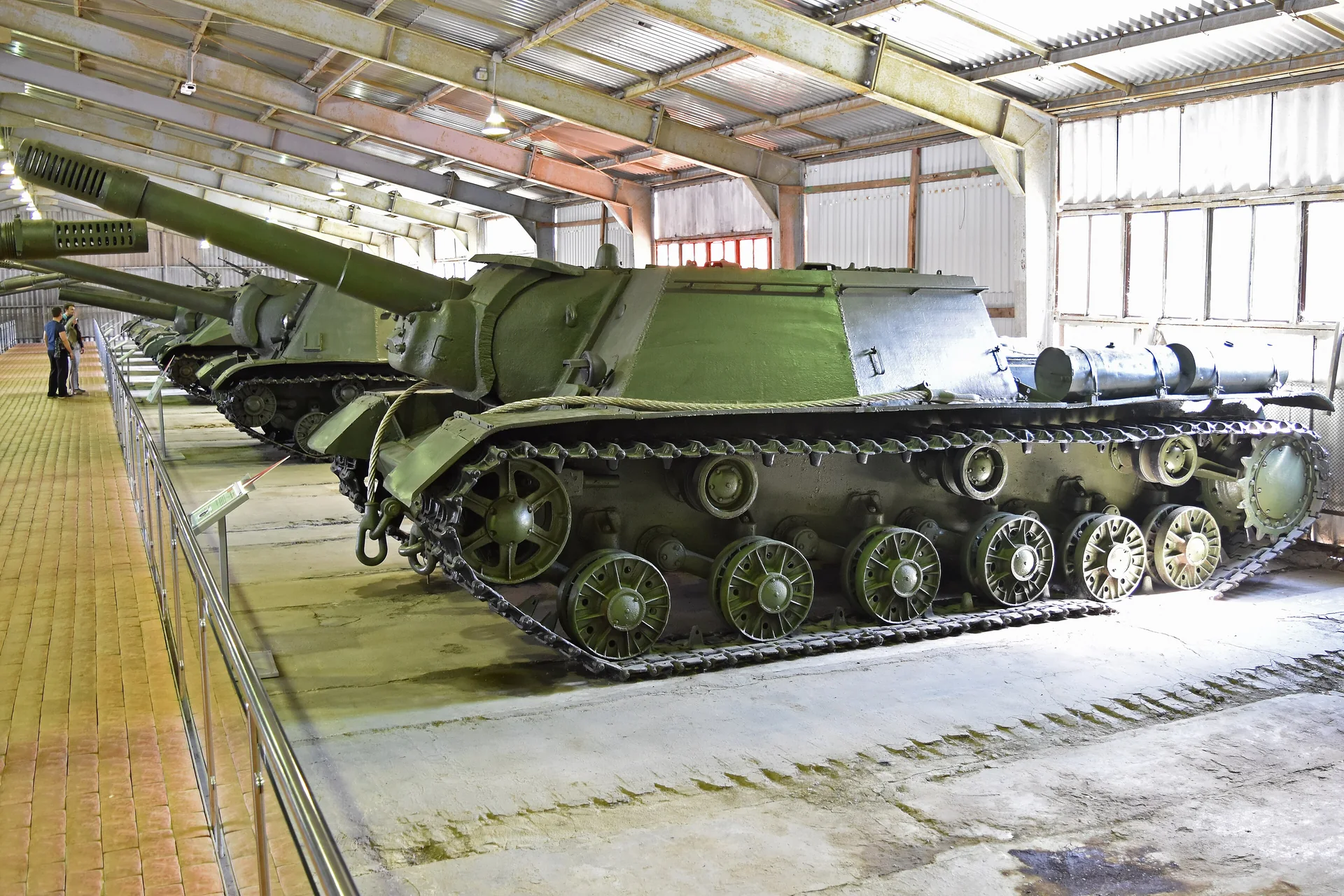
Requirement and development
Soviet heavy self-propelled-gun development was already moving quickly before the SU-152 received its service identity. The translated development account records a 4 January 1943 State Defense Committee order for a KV-1S-based vehicle with a 152 mm gun-howitzer, followed by prototype assembly on 23–24 January and trials soon afterward. That chronology places the vehicle in an accelerated assault-artillery program rather than in a design improvised solely as a reaction to German heavy tanks. 1
The KV-14 project combined the KV-1S automotive foundation with a 152 mm gun-howitzer. It provided a heavy direct-fire weapon without requiring a new rotating turret large enough to accommodate the gun and its ammunition. 1
The same account describes a compressed prototype test program in which the vehicle fired 234 rounds and recorded an average rate of about 2.8 rounds per minute during trials. That is a development-test figure, not a claim for a sustained battlefield rate of fire. It is useful because it shows that ammunition handling and firing-cycle performance were being measured before the type moved into production. 1
Patriot Park's SU-152 record describes the vehicle as a rapid wartime development on the KV-1S base, with work in January 1943 and official acceptance on 14 February 1943. The museum records 670 built. Those dates help distinguish design, acceptance, and production milestones that are sometimes compressed in later summaries. 4
Layout and engineering
The fixed fighting compartment accommodated a large gun installation on the KV-derived hull. The size of the weapon and its working clearances constrained the crew arrangement, while the existing heavy chassis supplied the automotive foundation. 1
The breech, recoil space and heavy ammunition occupied much of the enclosed compartment. Crew movement and access to the gun were therefore constrained even though the casemate appeared large from outside. The driver and gun crew depended on coordinated hull positioning when engaging targets outside the mounting’s traverse. 1, 2, 3
Armament and direct-fire role
The ML-20S was a gun-howitzer, not the same weapon as the KV-2’s earlier 152 mm howitzer merely because both shared a caliber. The SU-152 could deliver a heavy high-explosive effect and also engage armored targets. 1, 2
The gun’s heavy high-explosive ammunition suited attacks on field defenses and strongpoints. Antitank engagements added another demand, but the large projectile did not remove the limits imposed by loading time and restricted gun movement. 2
Protection and survivability
The armored casemate gave the gun crew an enclosed working space on a heavy-tank-derived foundation. That was a different proposition from an open light gun carrier, but the vehicle’s ability to survive still depended on the circumstances of an engagement. 1, 2
Track or running-gear damage could immobilize the vehicle without a penetration of its heaviest armor. Loss of mobility was especially serious for a fixed-gun vehicle because hull movement was also part of aiming outside the mounting’s limited arc. 1, 2, 3
Mobility, reliability, and logistics
Using the KV-1S foundation tied the SU-152 to an existing heavy-vehicle automotive system. The large forward gun installation nevertheless introduced its own balance and packaging problems; the development history records those concerns rather than presenting the conversion as mechanically effortless. 1
The heavy chassis required recovery equipment and a supply system able to move large ammunition. A gun that could support an assault from one firing position still had to be refueled, rearmed and brought forward for the next advance. 1, 2, 3
Variants, production, and naming
KV-14 was the development designation associated with the vehicle that became the SU-152. The later ISU-152 was a successor on the IS chassis, not simply a renamed SU-152. Their common gun family does not erase the change in vehicle foundation. 1, 3
Operational service
A Soviet combat report on the Bukrin bridgehead in October 1943 records a force that began with twelve SU-152s and one KV-1S. Batteries supported tank brigades and infantry against armored counterattacks and fortified positions. Its description of these assignments provides a dated example of assault guns supporting the wider formation. The translated report has conflicting regiment headings and uncertain German vehicle identifications; its claimed victories are not used here as independently confirmed losses. 2
Limitations and tradeoffs
The weight and dimensions of the gun shaped the entire vehicle. Ammunition handling, crew workspace, and restricted traverse imposed limits that a large projectile could not cancel. The SU-152’s effect on a target and the ease with which it could repeatedly engage targets were related but different questions. 1
Assault support and antitank work could overlap in the same operation. Batteries had to position the heavy gun where its fire could support the advance without leaving the fixed mounting and slow ammunition handling exposed to attacks from several directions. 1, 2, 3
Assessment and related development
SU-152 used the KV-1S automotive base to carry a heavy gun-howitzer in a fixed compartment. Its documented support tasks included both fortified positions and armored opposition. Combat reports can establish how batteries were assigned without proving every claimed target or result. The ISU family that followed retained the broad heavy-gun role on a different tank base. 1, 2, 3
Sources and further reading
References and further reading are listed below. Image identification, credit and reuse terms remain with each photograph.
- Tank Archives — SU-152: From Assault Gun to Tank Destroyer (secondary source; not primary certification)
- Soviet heavy self-propelled artillery combat report, October 1943, translated transcription
- Tank Archives — The Most Numerous Heavy SPG
- Patriot Park — SU-152 collection/history record
Visit an Armor Museum
Explore the worldwide museum directory to find armored vehicles, collections, and visitor-planning information.
Browse armor museums