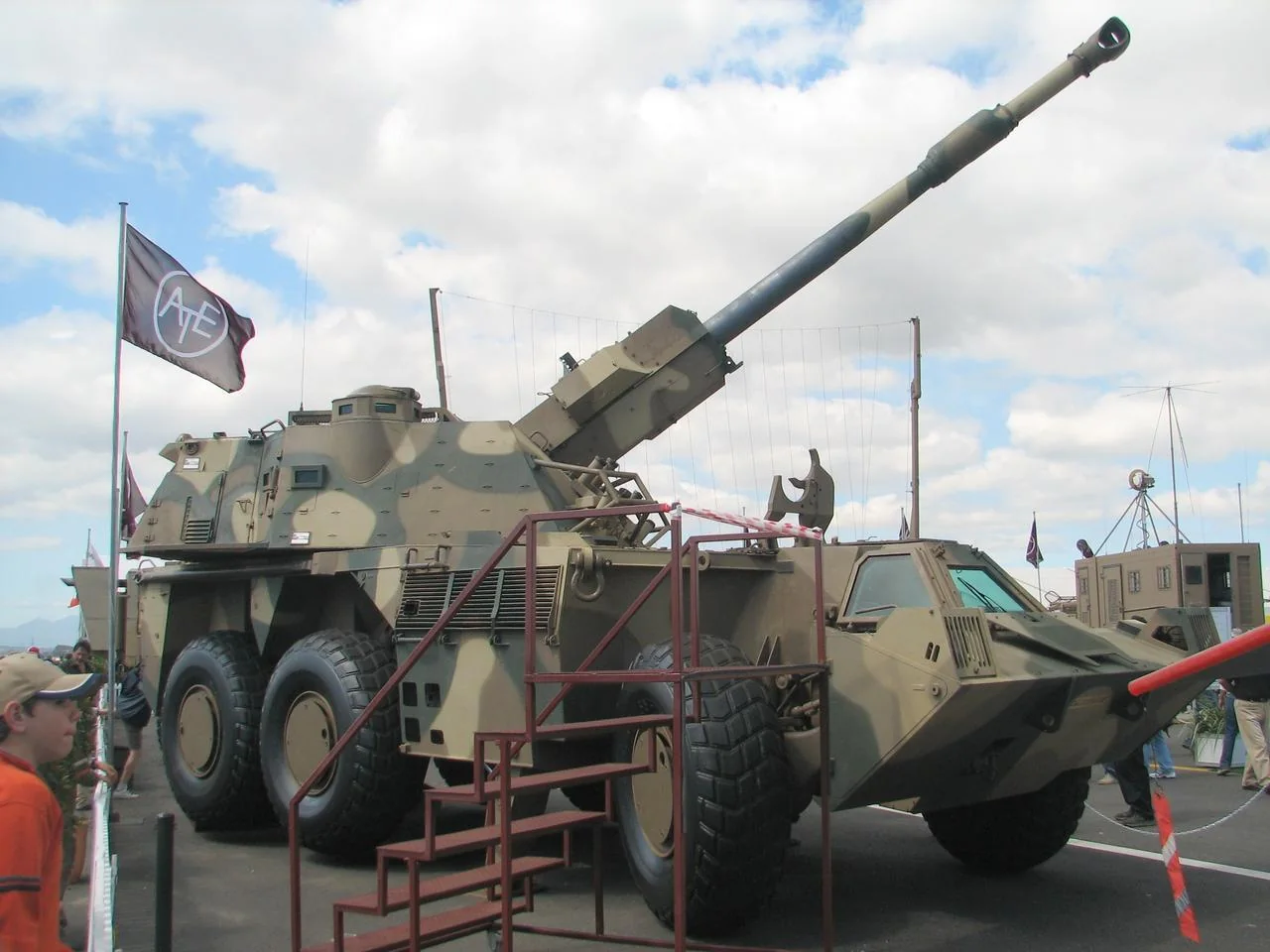
Development and design
The G6 emerged from a South African artillery modernization effort that sought more range, mobility, and survivability than older towed systems could provide. Denel’s historical account links the vehicle directly to the earlier G5 155 mm gun-howitzer program, while Weaponsystems.net describes the G6 as a purpose-built self-propelled platform rather than a simple field gun placed on an existing truck. That distinction mattered. South African forces operated across very large distances, often on road networks and open terrain where strategic mobility and the ability to relocate quickly were unusually important attributes for heavy artillery. 1, 2
Why a 6×6 chassis made sense
Most contemporary heavy self-propelled howitzers were tracked, but the G6 used a large 6×6 wheeled chassis. The choice reduced some of the maintenance and transport burdens associated with tracked vehicles and supported long road marches without requiring a transporter for every movement. Weaponsystems.net notes that the vehicle was designed for high road speed and long range while retaining cross-country capability. That balance fit southern African geography, where artillery might have to cover substantial distances between firing areas and support units spread across a broad operational frontage. 2
The 155 mm gun and the search for range
The original production G6 is generally associated with a 155 mm 45-caliber gun derived from the South African G5 artillery lineage. Both Denel and Weaponsystems.net emphasize the long-range character of the weapon. Exact figures depend heavily on projectile and propelling-charge combinations, and later ammunition developments extended the ranges publicized for the family. That dependence is important: artillery range is not a single immutable vehicle specification. It reflects the complete gun-and-ammunition system, and marketing literature often highlights the best performance achieved with specialized extended-range rounds. 1, 2
Service history
Denel's 2012 account places the original G6's launch in 1987 and lists South Africa, the United Arab Emirates and Oman as users at that time. That dated account is useful evidence of the design's established export career, not a current fleet census. It also identifies the later G6-52 as a separate development launched in 2003. Specifications advertised for that longer-barreled model should not be assigned to every original G6. 1
G6-52 and the evolution of the concept
The family did not remain frozen in its original Cold War configuration. Denel records the G6-52 as a later development and associates it with a 52-caliber gun, reflecting the broader international movement toward longer 155 mm barrels and improved ammunition. The designation is best understood as an evolutionary branch of the G6 concept rather than evidence that every production G6 was rebuilt to the same standard. Public descriptions of G6-52 prototypes and demonstrators also include updated ammunition handling and fire-control features that differed from early production vehicles. 1
Denel's retrospective says the G6-52 upgrade was first launched in 2003. That date belongs to the later 52-caliber development, not to the original G6 entering service. The distinction matters because brochure figures for very long range and high firing rates can reflect G6-52 and specialized ammunition rather than the baseline G6 configuration. 1
Operational mobility as part of the weapon system
The G6’s mobility is central to its identity because it was designed around movement before and after firing rather than simply around gun performance. A wheeled platform can exploit roads efficiently and can reduce the wear associated with long tracked marches. Weaponsystems.net describes a comparatively high road speed and substantial cruising range for a vehicle of its size. These characteristics do not make wheels universally superior, soft ground and severe obstacles still favor tracks in many circumstances, but they altered the logistical equation for artillery expected to operate across large distances. 2
A large vehicle built around crew endurance
The G6’s armored enclosure distinguished it from towed guns and more austere truck-mounted systems. The crew could remain within a protected vehicle while moving and while carrying out much of the firing process. The exact protection standard is not fully detailed in the open references used here, but both sources describe an armored design intended to protect against battlefield fragments and small-arms threats rather than to fight as a tank. Its size also provided space for ammunition stowage and a working environment suited to sustained artillery operations. 1, 2
A notable early example of modern wheeled heavy artillery
The G6 was not the first wheeled artillery vehicle, but it became one of the most visible demonstrations that a heavy 155 mm system could combine armor, a full turret, long road range, and substantial gun performance on wheels. Its export record gave the concept credibility outside South Africa. Later systems such as the French CAESAR followed a different and much lighter truck-mounted philosophy, while other designs retained armored cabins or turrets. The point is not that they directly copied the G6, but that the G6 broadened the accepted design space for self-propelled artillery. 1, 2
A system inseparable from South Africa’s defense-industrial history
The G6 cannot be understood only as a list of specifications. It was a product of a period in which South Africa’s defense industry expanded domestic development under sanctions and strategic isolation. That context encouraged unusual levels of national control over guns, ammunition, vehicles, and supporting technologies. The same environment produced both technical innovation and systems closely connected to the conflicts and policies of the apartheid-era state. A historical treatment therefore has to recognize the engineering achievement without stripping away the political setting in which it occurred. 1
Historical place
Denel's historical account describes the G6 as a South African 155 mm wheeled artillery design derived from the G5 gun program and attributes the original work to Lyttelton Engineering Works. The manufacturer also identifies South Africa, the United Arab Emirates and Oman as users in its 2012 retrospective. Those statements establish industrial lineage and export context, while performance claims in the same publication remain manufacturer claims tied to particular ammunition and later configurations. 1
Sources and further reading
References and further reading are listed below. Image identification, credit and reuse terms remain with each photograph.
- Denel Insights 2012, The G6: still outgunning the competition after 25 years
- Weaponsystems.net — G6 Rhino
Visit an Armor Museum
Explore the worldwide museum directory to find armored vehicles, collections, and visitor-planning information.
Browse armor museums