Development and design
The DANA was developed in Czechoslovakia during the 1970s and entered service in the early 1980s. Weaponsystems.net places development between 1972 and 1977 and describes the vehicle as a major break with the tracked self-propelled howitzers then common in Warsaw Pact armies. Instead of adopting a tracked chassis, the designers used an 8×8 Tatra automotive platform and installed the artillery system in a large central turret arrangement. The result was immediately recognizable and reflected Czechoslovakia’s strong heavy-truck industry as much as conventional artillery practice. 1
The characteristic Tatra-based layout
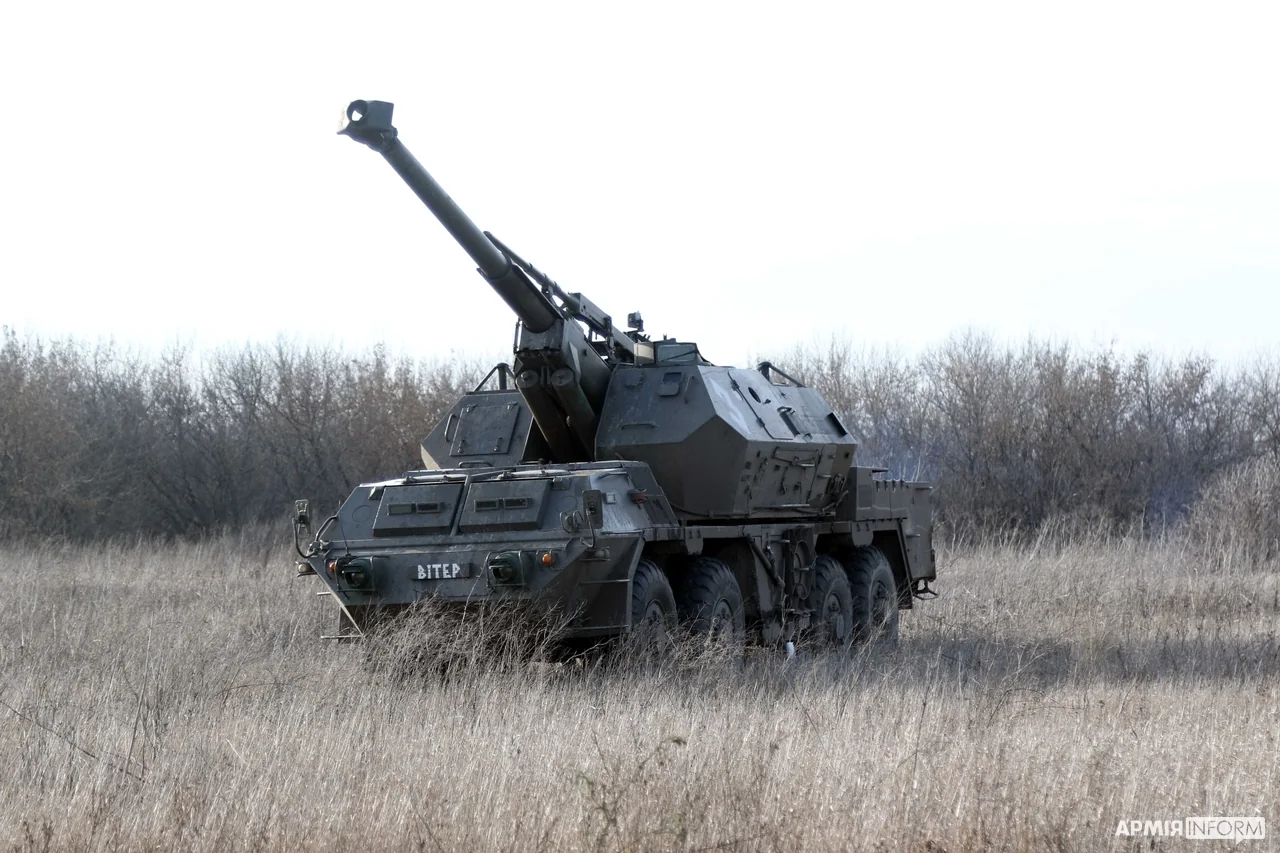
DANA’s layout placed the driver and commander in a forward armored cab, the artillery installation in the center, and the engine toward the rear. The Tatra 8×8 chassis gave the vehicle a long wheelbase and substantial road mobility while distributing the weight of the gun system across four axles. Weaponsystems.net describes the turret as divided around the gun, with crew positions and ammunition-handling equipment integrated into the structure. This gave DANA the enclosed working environment expected of a true self-propelled howitzer while retaining the logistical advantages of wheels. 1
From 152 mm Warsaw Pact ammunition to NATO-standard 155 mm
The original DANA used a 152 mm howitzer, matching the caliber environment of Czechoslovakia’s Warsaw Pact service. Weaponsystems.net describes a semi-automatic loading arrangement and an onboard ammunition supply intended to sustain artillery missions without exposing the crew to the same degree as a towed gun. The system’s firing characteristics were competitive for its period, but its larger historical importance was the successful marriage of a full-sized field-artillery weapon with a wheeled armored chassis. 1
Service history
DANA entered the artillery inventories of Czechoslovakia and foreign users, including Poland and the Soviet Union. That established a substantial service history for a wheeled heavy howitzer within forces otherwise strongly associated with tracked Soviet-pattern equipment. The history does not mean those armies abandoned tracked artillery. Nor should an aggregate family production estimate be used as a count of guns available to any one operator in a particular year. 1
Zuzana and the Slovak continuation
Zuzana carried the wheeled family into 155 mm artillery, with later Zuzana 2 adopting a 52-caliber gun. KONSTRUKTA describes the latter with a four-person crew, Tatra 8x8 chassis and automatic handling of projectiles and charges. Its specification also distinguishes turret rotation from the narrower permitted firing sector. These details belong to Zuzana 2; they are not specifications for the original 152 mm DANA or every earlier Zuzana. 3
The manufacturer lists a combat weight of about 33.8 tonnes and a road speed up to 90 km/h for Zuzana 2. Those figures are useful for the current manufacturer-described configuration, but they should not be copied backward onto early DANA vehicles. The family spans different calibers, automotive standards and electronics, so each specification needs a variant label. 3
The strategic advantages and limits of wheels
Wheels were one of DANA’s defining features. On roads, an 8×8 artillery vehicle can move quickly over long distances without the same track wear and transporter requirements associated with heavy tracked systems. Tatra’s chassis technology gave Czechoslovak designers a mature foundation for that approach. In Central Europe, where developed road networks coexist with off-road requirements, the design offered an attractive compromise between tactical cross-country ability and operational mobility. 1
From mechanical integration to digital artillery networks
The original DANA belonged to an era in which artillery fire direction and vehicle systems were far less digitized than they are today. Its automation was concentrated mainly in gun laying and ammunition handling rather than in the networked command architecture now expected of modern batteries. Over time, users added new navigation, communications, and fire-control equipment to keep older vehicles useful. This incremental modernization allowed the platform to remain relevant even as the surrounding artillery system changed dramatically. 1
A design sustained through political and industrial change
Few artillery families illustrate the consequences of political change as clearly as DANA and Zuzana. DANA was a Czechoslovak product built within the economic and military structures of the Warsaw Pact. Zuzana emerged from Slovak industry after the federation dissolved and after the strategic orientation of Central Europe had shifted toward NATO. The same broad engineering lineage therefore crossed a national breakup, a change in alliance structure, and a change in artillery caliber standard. 1, 2, 3
Influence beyond its own operators
DANA’s historical importance extends beyond the armies that bought it. It appeared well before the post-Cold War boom in wheeled 155 mm artillery and demonstrated that a heavily mechanized gun system did not require tracks. Later wheeled systems adopted many different layouts, some with turrets, others with exposed guns on trucks, but DANA had already established the feasibility of the broad concept in large-scale service. 1
Historical place
DANA and Zuzana form an industrial lineage, but their calibers, turrets and fire-control generations should not be treated as one unchanged vehicle. Konstrukta's current Zuzana 2 page describes a four-person crew distributed across the driver cab and separated turret cabins, with a 155 mm weapon on the modernized wheeled platform. That current configuration illustrates how far the family evolved from the original 152 mm DANA while retaining the basic wheeled-artillery concept. 3
Sources and further reading
References and further reading are listed below. Image identification, credit and reuse terms remain with each photograph.
- Weaponsystems.net — DANA
- Weaponsystems.net — Zuzana
- Konstrukta Defence, ZUZANA 2 (current manufacturer-described configuration)
See Armor in Person
This vehicle family is connected to 1 verified museum through 1 documented display record.