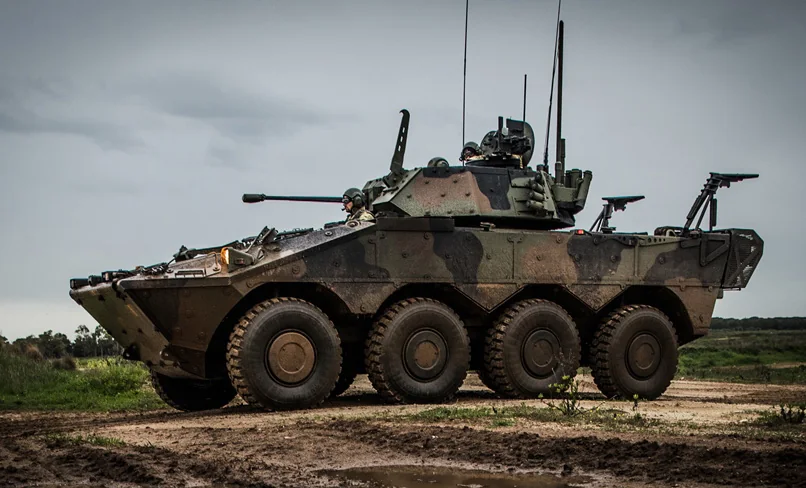
Development and requirement
Freccia emerged from Italy’s move toward medium forces able to deploy rapidly while retaining meaningful armor, firepower, and digital command-and-control capability. The Italian Army describes it as a Centauro-derived medium armored vehicle. 1
Freccia applies a turreted infantry-fighting role to an Italian eight-wheeled vehicle lineage associated with Centauro. That relationship does not make the troop-carrying Freccia a Centauro gun vehicle with unchanged internal accommodation. Space for infantry, a different combat installation and the equipment of a medium formation are central to its identity. It should also be kept distinct from tracked Dardo. The two can appear in the same national inventory while belonging to different vehicle programs and formation concepts. 1
Design, protection, and mobility
The 8x8 chassis trades some tracked cross-country performance for road speed, range, and deployability. Its turret and digital systems allow the vehicle to function as a fighting platform rather than merely a protected troop truck. 1
The wheeled character of the Freccia Infantry Fighting Vehicle is central to how it was intended to be used. Wheeled armored vehicles generally trade some soft-ground and obstacle performance for road speed, range, reduced automotive complexity, and easier long-distance movement without heavy transporters. That trade is especially valuable to reconnaissance, security, and rapidly moving infantry formations, where arriving first, screening a broad frontage, or shifting quickly between sectors can matter as much as maximum armor thickness. Tires, driveline arrangement, suspension travel, and vehicle weight therefore become tactical questions rather than engineering trivia: damage that slows the vehicle can also reduce the unit's ability to observe, disengage, reinforce, or deliver troops on time. 1
Protection and internal volume are especially difficult problems in an infantry fighting vehicle because the hull must serve both a vehicle crew and a dismounted fighting element. The troop compartment needs usable space, access routes, ammunition stowage, communications, and enough separation from fuel and mechanical systems to make the vehicle practical in repeated operations. The published configuration summarized here lists Carries a fully equipped infantry section. Adding armor improves resistance to fragments and direct fire, but it also increases weight and can reduce mobility, amphibious margin, payload, or growth capacity. As threats change, many IFV modernization programs therefore become exercises in managing accumulated weight and electrical demand as much as in fitting a new gun or sight. 1
Firepower and battlefield role
The infantry-fighting version of Freccia combines mounted support fire with the carriage of a dismounted infantry element. The vehicle’s gun system must therefore be described alongside its troop compartment, not as though it were simply a dedicated wheeled tank destroyer. Antitank, mortar and command configurations, where separately documented, require their own equipment descriptions. A family name or a shared manufacturer does not justify assigning every offered weapon to the basic infantry version. Exact turret and missile fits remain variant-level questions. 1
Service, variants, and modernization
Freccia has been used operationally, including in Afghanistan, and forms a central part of Italy’s medium-force concept. The broader family supports multiple mission variants built around a common wheeled platform. 1
Freccia family development and its operational employment are different timelines. A newly offered or ordered mission version is not proof of equipment already present in deployed units. The cited sources associate Freccia with Afghanistan but do not provide a readable unit account establishing the dates and configuration of that deployment. Until that record is available, the profile should not convert a broad mission association into specific combat claims or assume that later equipment was fitted to the earliest operational vehicles. 1
How the vehicle fits the formation
In combined-arms employment, the Freccia Infantry Fighting Vehicle is not an independent substitute for tanks, infantry, artillery, engineers, or air defense. Its purpose is to connect protected mobility with the infantry's ability to seize and hold ground. The mounted crew can observe and engage while the dismounted element deals with terrain and threats that cannot be solved from inside the hull. Effective use therefore depends on coordination: tanks provide heavier direct fire and protection, artillery and mortars suppress or isolate, engineers open routes, and the infantry fighting vehicle moves soldiers while contributing its own sensors and weapons. The platform is most effective when those capabilities overlap rather than when it is sent forward alone. 1
Strengths, limitations, and family boundaries
Freccia belongs in the IFV category because its baseline combat role combines troop carriage with integral cannon armament. Its shared ancestry with Centauro does not make it a tank destroyer or reconnaissance vehicle. 1
Freccia’s historical role lies in combining a wheeled medium-force chassis with infantry accommodation and a turreted fighting capability. Its Centauro ancestry explains part of the automotive development, while the troop-carrying mission explains why it needs a separate profile. Dardo is a useful national comparison, but the comparison must keep tracks, wheels, unit roles and equipment generations distinct. Neither common industrial origins nor the general label of IFV establishes identical deployment requirements or a shared modernization timetable. 1
IDV describes Freccia as an 8x8 armoured infantry fighting vehicle with a driver, two turret crew and up to eight dismounts, using a rear ramp and a two-man HITFIST turret or remote weapon station. That manufacturer record independently supports the vehicle's basic configuration alongside the Italian Army entry. 2
The same source identifies an integrated battle-management architecture and the H-drive automotive layout, helping distinguish Freccia's wheeled, networked design path from Italy's tracked Dardo even though both serve mechanized infantry roles. 2
Sources and further reading
References and further reading are listed below. Image identification, credit and reuse terms remain with each photograph.
Visit an Armor Museum
Explore the worldwide museum directory to find armored vehicles, collections, and visitor-planning information.
Browse armor museums