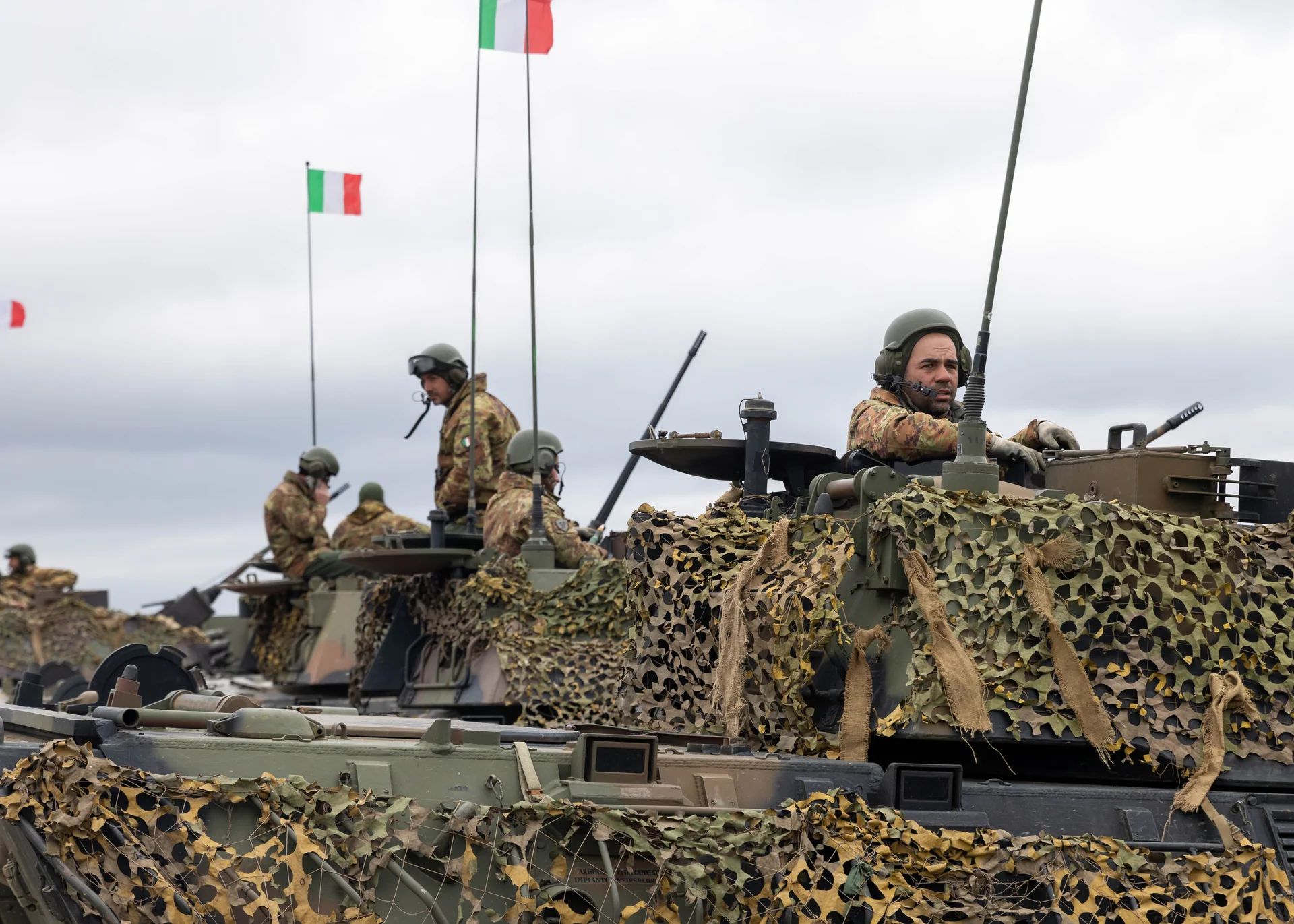
Development and requirement
Italy developed Dardo to move mechanized infantry beyond the limitations of older armored personnel carriers and to operate more naturally with tank units. The Italian Army identifies the vehicle as an Iveco–OTO Melara product for heavy infantry. 1
Dardo belongs to Italy’s tracked heavy-infantry force, not to the later wheeled medium-vehicle category represented by Freccia. Both vehicles can carry infantry and a turreted cannon, but they were not interchangeable answers to one automotive requirement. The Iveco and OTO Melara industrial relationship also does not make every component or mission package common to the two. Dardo’s history is best followed through the tracked vehicle’s own introduction, equipment and deployments before drawing comparisons with the separate wheeled program. 1
Design, protection, and mobility
Dardo uses a tracked hull, turreted autocannon, onboard sights, and armor intended to give the embarked squad a higher degree of battlefield survivability and fire support than a simple carrier. 1
The tracked layout of the Dardo Infantry Fighting Vehicle emphasizes cross-country mobility and the ability to remain with armored formations away from improved roads. Tracks spread vehicle weight over a larger contact area and help negotiate soft ground, broken surfaces, and obstacles, but they bring higher maintenance demand and more mechanical wear than an equivalent wheeled carrier. For crews and infantry, this means mobility is inseparable from sustainment: track condition, suspension components, fuel, recovery support, and route selection all affect whether the vehicle can deliver its combat function when required. The design is therefore a compromise between tactical mobility and the logistical cost of preserving that mobility over time. 1
Protection and internal volume are especially difficult problems in an infantry fighting vehicle because the hull must serve both a vehicle crew and a dismounted fighting element. The troop compartment needs usable space, access routes, ammunition stowage, communications, and enough separation from fuel and mechanical systems to make the vehicle practical in repeated operations. Adding armor improves resistance to fragments and direct fire, but it also increases weight and can reduce mobility, amphibious margin, payload, or growth capacity. As threats change, many IFV modernization programs therefore become exercises in managing accumulated weight and electrical demand as much as in fitting a new gun or sight. 1
Firepower and battlefield role
The vehicle’s principal armament, 25 mm autocannon; some configurations support antitank missiles, defines much of how the Dardo Infantry Fighting Vehicle can contribute after contact. Cannon and antitank weapons can allow an infantry or reconnaissance vehicle to suppress positions, engage light armor, and threaten heavier vehicles under favorable conditions without depending on a tank for every target. That firepower changes tactics because the carrier can support the infantry before and after dismount, cover movement, and respond quickly to targets that would otherwise require a separate support weapon. At the same time, mounted firepower does not erase the distinction between an IFV and a main battle tank: protection, ammunition, sensors, and survivability remain optimized around different missions. 1
Service, variants, and modernization
The Italian Army’s indexed Dardo equipment entry places its entry into service in 2002 and associates the vehicle with Ancient Babylon in Iraq, ISAF in Afghanistan and LEONTE in Lebanon. These are useful program and deployment markers, but they do not document the actions of every Dardo-equipped unit. The cited evidence is limited to the indexed Army equipment entry. Claims about particular engagements, vehicle losses, ammunition performance or subsequent fleet-wide upgrades therefore require additional records rather than inference from the list of mission names. 1
A tracked infantry vehicle’s continued use can involve maintenance and replacement of subsystems without creating a newly named vehicle generation. For Dardo, that history needs evidence identifying the work performed, the affected vehicles and the date. A common industrial supplier or a maintenance notice covering several Italian armored families is not proof that all received the same upgrade. The cited sources do not establish a complete Dardo modernization sequence, and current proposals should not be reported as changes already accepted across the fleet. 1
Dated manufacturer and Army records establish a clearer program chronology. The Iveco–Oto Melara Consortium records an Italian Army order for the first VCC-80 batch in October 1998, while the Army's current Dardo page places introduction from 2002. Those two dates describe different milestones—procurement and service introduction—and should not be collapsed into a single 'entry' date. 2, 3
The Italian Army also links Dardo service to Operation Ancient Babylon in Iraq, ISAF in Afghanistan, and LEONTE in Lebanon. Those official mission associations establish overseas use without, by themselves, proving a particular engagement, loss, ammunition effect, or fleet-wide modernization standard. 3
How the vehicle fits the formation
In combined-arms employment, the Dardo Infantry Fighting Vehicle is not an independent substitute for tanks, infantry, artillery, engineers, or air defense. Its purpose is to connect protected mobility with the infantry's ability to seize and hold ground. The mounted crew can observe and engage while the dismounted element deals with terrain and threats that cannot be solved from inside the hull. Effective use therefore depends on coordination: tanks provide heavier direct fire and protection, artillery and mortars suppress or isolate, engineers open routes, and the infantry fighting vehicle moves soldiers while contributing its own sensors and weapons. The platform is most effective when those capabilities overlap rather than when it is sent forward alone. 1
Strengths, limitations, and family boundaries
Dardo is classified as an IFV because its design centers on carrying an infantry squad while fighting with a turreted cannon. Italy’s wheeled Freccia is related by mission but belongs to a separate vehicle family. 1
The Dardo Infantry Fighting Vehicle's strengths come from how well its mobility, protection, firepower, and capacity fit the mission for which it was designed. The corresponding limitations are usually the reverse side of those same choices: more firepower consumes volume and weight, more protection strains mobility, amphibious or airborne requirements limit armor, and larger troop compartments compete with ammunition and machinery. No armored vehicle escapes these exchanges. A useful historical assessment therefore asks whether the design gave its formation the capability it needed at acceptable cost and complexity, and how successfully later upgrades preserved that balance as the threat and doctrine changed. 1
Family names can also obscure important differences. A common hull or manufacturer does not mean every derivative belongs in the same operational category. Command posts, mortar carriers, antitank vehicles, recovery vehicles, reconnaissance versions, air-defense systems, and direct-fire variants may share engines and running gear while performing fundamentally different tasks. For that reason the Armor Archive keeps the Dardo Infantry Fighting Vehicle tied to its lineage but classifies individual branches by what they actually do on the battlefield. That approach preserves engineering relationships without turning one successful chassis into an all-purpose label that hides the history of the specialized vehicles built from it. 1
Sources and further reading
References and further reading are listed below. Image identification, credit and reuse terms remain with each photograph.
- Italian Army: Dardo ACV equipment entry (indexed excerpt) (indexed excerpt)
- Iveco–Oto Melara Consortium — history of the Italian armored-vehicle programs
- Italian Army — VCC Dardo
Visit an Armor Museum
Explore the worldwide museum directory to find armored vehicles, collections, and visitor-planning information.
Browse armor museums