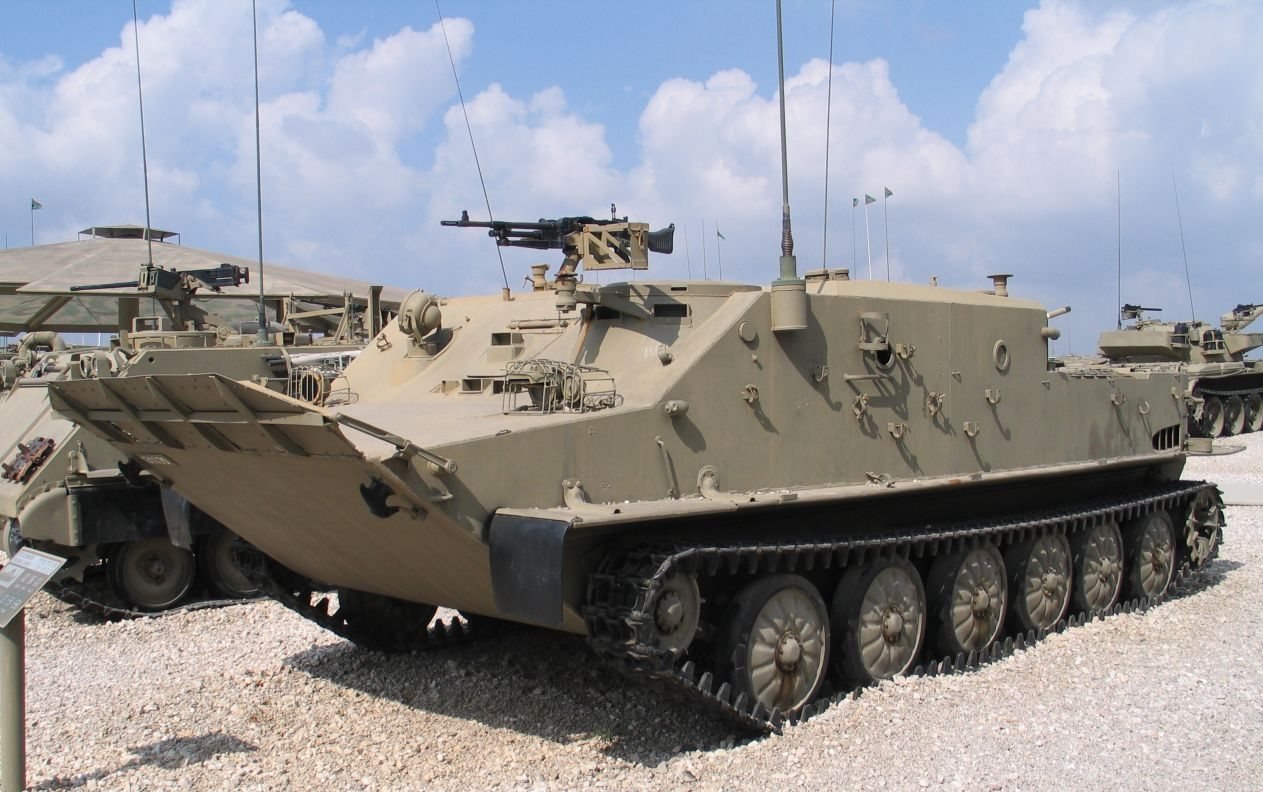

Development and requirement
The BTR-50 emerged during the early Cold War as the Soviet Army sought amphibious tracked transport for infantry and equipment. Its chassis lineage was closely associated with the PT-76 amphibious light tank, giving the carrier useful cross-country performance and substantial water mobility at a time when river crossing was a major Warsaw Pact operational requirement. 1, 2
Design and fighting role
Early BTR-50P vehicles had an open troop compartment, while later BTR-50PK variants added overhead armor and collective protection. The vehicle could carry a large infantry element or cargo and used waterjet propulsion for amphibious movement. Armament was relatively light because its principal mission remained transport rather than fighting from the vehicle. 1, 2
Service and evolution
BTR-50s were widely exported and produced in related forms outside the Soviet Union. Their spacious hulls also supported command and specialist versions. The type gradually gave way in Soviet frontline infantry units to BMP infantry fighting vehicles and wheeled BTR carriers, but remained useful in secondary, support, and amphibious roles. 1, 2
Archive boundaries
BTR-50 is an APC despite sharing mobility concepts with the PT-76 and later being adapted for command and support tasks. The archive separates its troop-carrier family from the more heavily armed BMP IFV line. 1
Sources and further reading
Representative source set used for this profile. Primary image source and reuse terms are listed with the image.
- U.S. Army TRADOC ODIN Worldwide Equipment Guide — BTR-50 search
- U.S. Army TRADOC ODIN Worldwide Equipment Guide — BMP-1