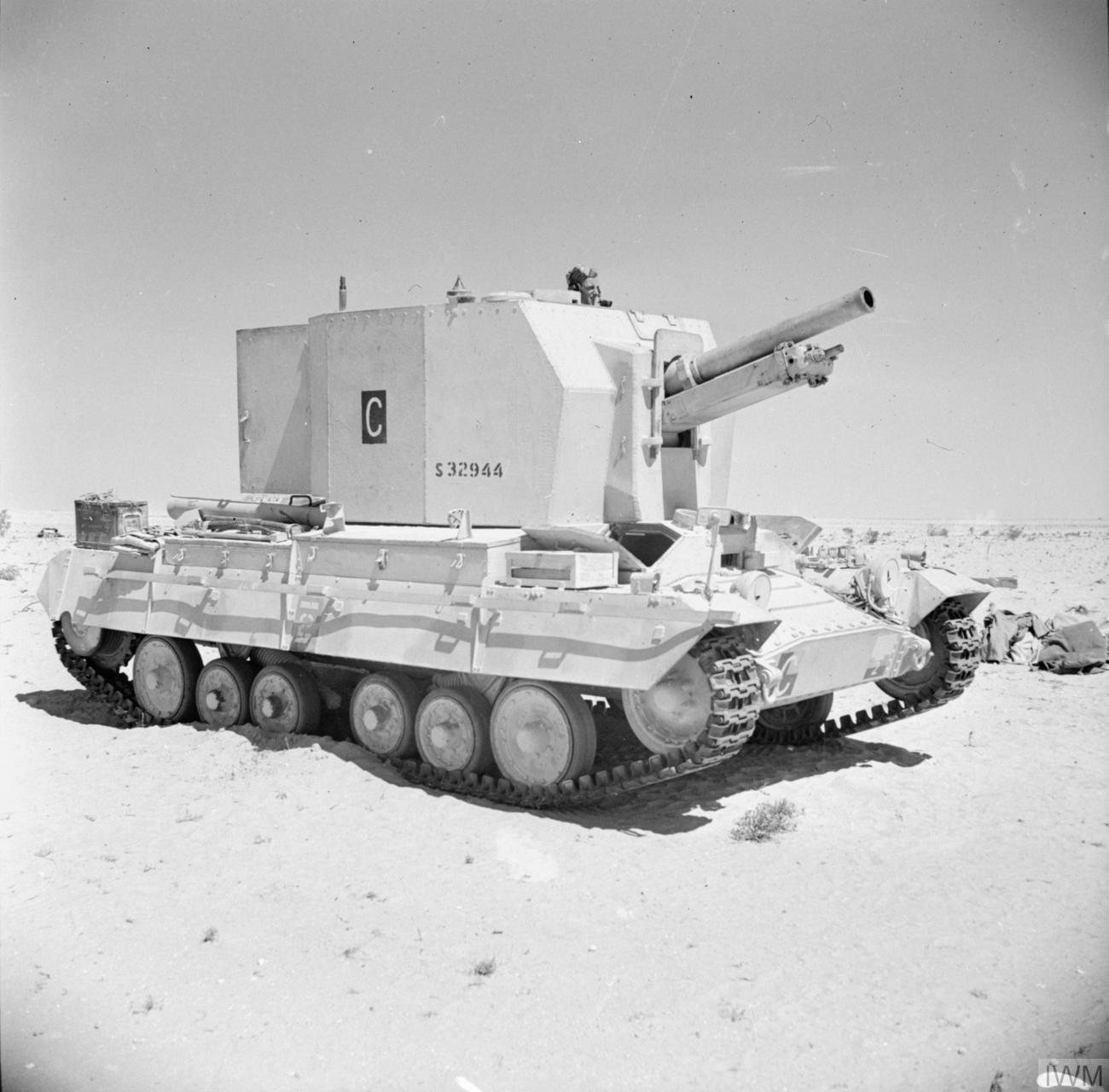
The Bishop was Britain’s first wartime attempt to put the standard 25-pounder field gun on a tracked armored chassis so artillery could keep pace with mobile formations in North Africa.
Bishop. Primary reference image for this archive profile. Source date: Taken on 25 September 1942.No 1 Army Film & Photographic Unit : James (Sgt); Public domainImage source
Rolearmored field artillery support
Main weapon / systemQF 25-pounder gun-howitzer
Platform / layoutValentine tank chassis with fixed armored superstructure
MediaPrimary image integrated
Development and design
Developed quickly on the Valentine tank chassis, the Bishop placed the 25-pounder in a tall fixed armored superstructure. The improvised arrangement provided mobility and protection but restricted gun elevation and therefore reduced the weapon’s normal range. 1, 2
Operational use
Bishops served in North Africa and the early Italian campaign. Crews sometimes drove onto prepared ramps to gain elevation, a practical workaround that also highlighted the limitations of the design. 1, 2
Role and significance
The Bishop matters less as a refined design than as a bridge from towed artillery to purpose-built self-propelled guns. Its shortcomings accelerated British interest in the M7 Priest and then the Canadian Sexton. 1, 2
Sources and further reading
Representative source set used for this profile. Primary image source and reuse terms are listed with the image.