Development and design
Soviet planners retained an interest in very heavy mortars after the Second World War because steep-trajectory weapons could attack fortifications, urban positions, and reverse slopes in ways conventional guns did not always match. The towed 240 mm M-240 delivered exceptional projectile weight but was cumbersome to move. The 2S4 program mechanized that capability by combining a revised 240 mm mortar with a tracked chassis, allowing the system to travel with fewer of the movement penalties associated with towing such a massive weapon. 1, 2
The same source dates development to 1966-1971, with state trials and service introduction around 1972. Those milestones are useful because public histories sometimes compress prototype, trials and fielding into one year. Here they remain separate, and the dates are treated as secondary-source chronology rather than a substitute for Soviet acceptance records. 1
Patriot Park's current 2S4 record attributes the self-propelled system to Uraltransmash with the mortar developed at the Perm machine-building plant, and states that the 2S4 was accepted in 1971 to replace the towed M-240 in high-power artillery. That institutional chronology is a stronger anchor for the transition from towed to self-propelled 240 mm mortar capability than an undated summary alone. 3
A mortar carried externally at the rear
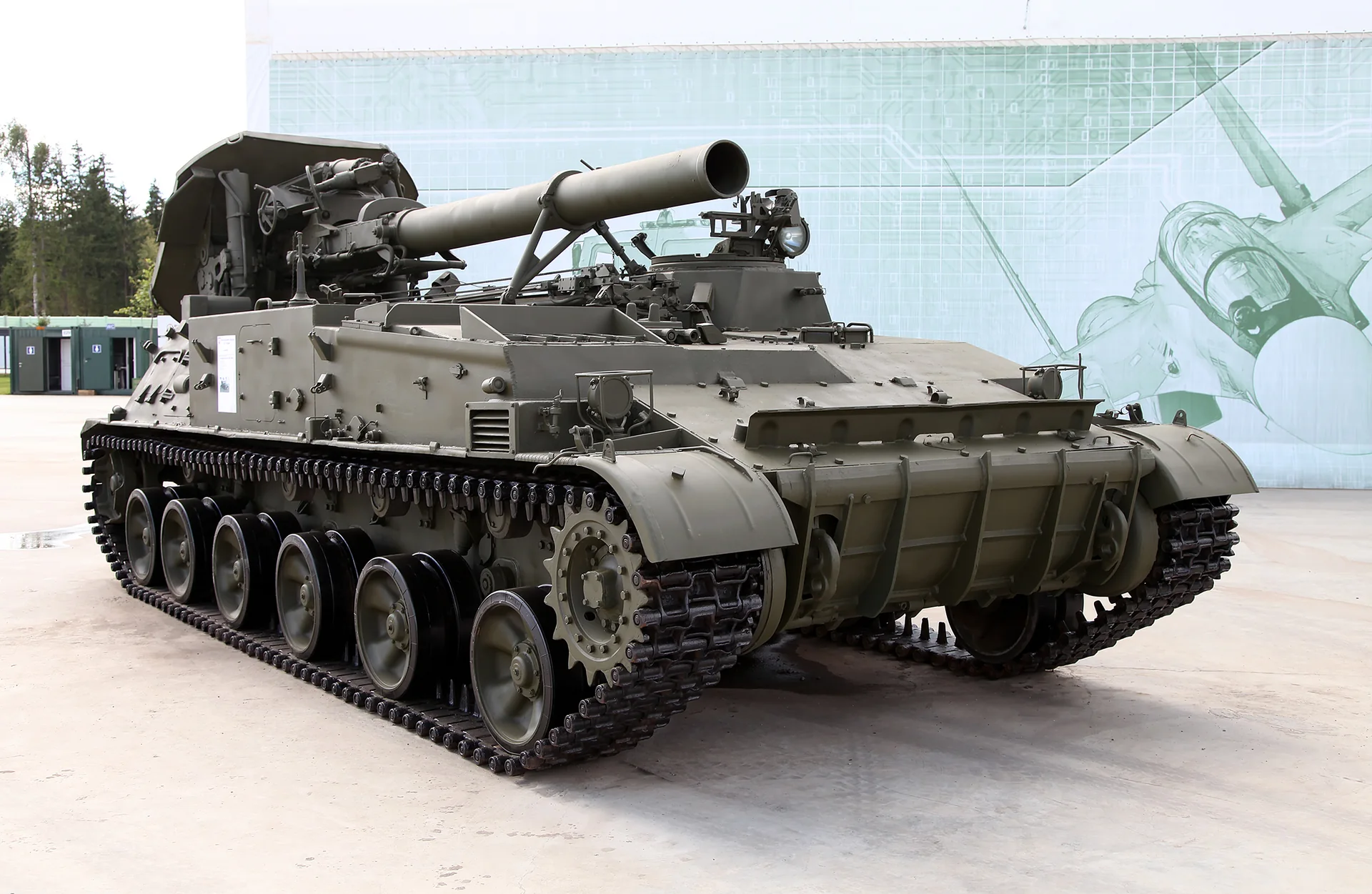
The Tyulpan does not use a conventional gun turret. During movement the 240 mm mortar rests along the rear of the chassis, leaving the crew and automotive components inside the armored hull. For firing, the weapon is brought to the rear and supported against the ground, allowing the earth to absorb forces that would be difficult for a light turret structure to manage. This architecture makes the vehicle immediately recognizable and explains why crewmen are much more exposed during firing than when traveling under armor. 1
A 240 mm weapon built for exceptional effects
The 2B8 mortar fires 240 mm ammunition, placing it in a different category from ordinary divisional howitzers. Large individual rounds, a slow firing cycle and mechanical handling dominate the design. Conventional and assisted projectiles do not share one range, and their size affects how many can be carried. The Tyulpan was built around the effect of a heavy mortar bomb rather than the continuous volume expected from batteries of medium-caliber guns. 1
Tracked movement for a weapon too heavy to be nimble
For its size, the Tyulpan has respectable road mobility. Published specifications give a road speed around sixty kilometers per hour and range around 500 kilometers, using a diesel powerpack related to other Soviet artillery carriers. The important improvement over the towed M-240 was not raw speed but the ability to transport the weapon, crew, and immediate equipment as one tracked vehicle. That reduced dependence on a separate prime mover and made displacement more practical after a mission. 1
A high-level specialist, not a divisional standard
The 2S4's scale and ammunition burden kept it out of the mass divisional-artillery role occupied by 2S1 and 2S3. It belonged to specialized heavy artillery formations controlled at higher levels, where commanders could allocate a small number of mortars to targets that justified their logistical cost. This organizational position is essential to understanding the system: its low production and unusual caliber were features of a narrow mission rather than signs that it was expected to become the Soviet Army's universal howitzer. 1, 2
Service history
The Tyulpan saw combat in Afghanistan and later in the Chechen wars, where heavy high-angle fire was employed against difficult terrain and fortified or urban positions. Published operational histories also record appearances in later conflicts involving post-Soviet forces. These uses fit the original logic of the system: a large mortar becomes relevant when commanders face targets that are difficult to affect with ordinary field artillery and are willing to accept a slower, more cumbersome weapon. 2
Keeping a specialized Cold War weapon usable
Later refurbishment and communications upgrades did not turn the Tyulpan into a different type of artillery. The externally mounted 240 mm mortar, heavy ammunition and exposed work around the weapon remained central features. A modernized radio or position-finding system can change how a unit receives and processes information without removing those mechanical constraints. Published accounts should therefore identify the particular upgrade rather than assume a uniform standard across surviving vehicles. 2
Short range, low rate of fire, and exposed operation
The 2S4's limitations follow directly from its purpose. The giant mortar delivers exceptional projectile weight but at a low rate of fire. Standard ammunition range is shorter than modern 152 or 155 mm systems, which places the weapon closer to enemy reconnaissance and counterbattery threats. The vehicle also carries relatively few rounds and requires substantial resupply. These characteristics make it poorly suited to routine high-volume artillery missions. 1
Operating a very heavy mortar as a team
The Tyulpan's five-man vehicle crew cannot by itself erase the handling problem created by 240 mm ammunition. The bombs are so large that mechanical handling equipment and additional support personnel are central to practical operations. Every round delivered to the mortar has to be transported, protected, and moved into position before it can contribute to a mission. This makes the battery's ammunition vehicles almost as important as the firing carrier itself and sharply limits how much fire can be sustained without a well-organized supply route. 1
Historical place
Tyulpan is best understood as a specialized heavy mortar carrier rather than a large conventional turreted howitzer. Weaponsystems.net describes the 240 mm 2B8 mortar as mounted externally and brought into firing position at the rear, with a five-person crew and limited onboard ammunition. That arrangement explains both the weapon's unusual destructive effect and the exposed, labor-intensive firing cycle that separates it from Akatsiya or Msta-S. 1
Sources and further reading
References and further reading are listed below. Image identification, credit and reuse terms remain with each photograph.
- Weaponsystems.net, 2S4 Tyulpan (secondary source; not primary certification)
- 2S4 Tyulpan — operational history overview
- Patriot Park — 240 mm self-propelled mortar 2S4 Tyulpan
Visit an Armor Museum
Explore the worldwide museum directory to find armored vehicles, collections, and visitor-planning information.
Browse armor museums