Development and requirement
Wirbelwind appeared in 1944 as an answer to Möbelwagen’s slow transition from protected travel to unrestricted firing. Instead of folding walls, it used a permanently traversable armored turret carrying an established Flakvierling mount. The design retained the mature Panzer IV chassis so Germany could improve tactical readiness without introducing a new automotive family during an increasingly desperate production environment. 1, 2
Conversion and layout
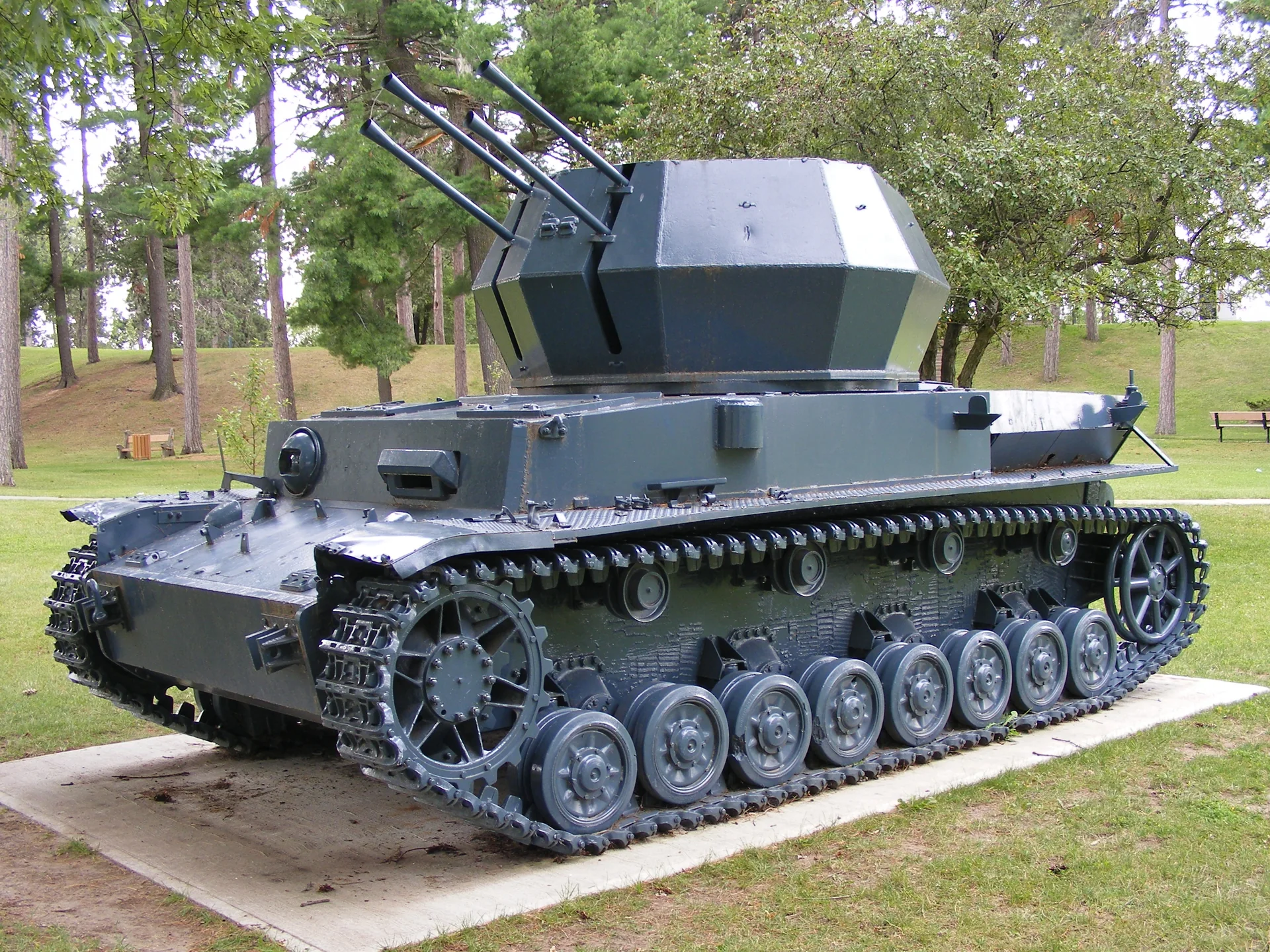
Its distinctive multi-sided open turret rotated with the weapon, keeping side armor around the crew while preserving high elevation and wide observation. The top remained open because the four-gun mount, loaders, and high-angle movement required space and ventilation. The turret was cramped but operationally cleaner than a folding gun platform and could be kept ready while the vehicle moved. 1, 2
Armament and engagement role
The Flakvierling 38 combined four 20 mm cannon and produced a dense close-range volume of fire. That increased the chance of hits during the brief time a low-flying aircraft crossed the engagement zone. The trade was limited projectile power and reach compared with a 37 mm gun, a weakness that helped motivate the related Ostwind concept even while Wirbelwind remained valuable at short range. 1, 2
Crew protection
The turret gave much better lateral protection than an entirely open mount and allowed the crew to remain behind armor while traversing. The open roof still left them vulnerable to overhead fragments, strafing, grenades, and weather. Wirbelwind therefore improved survivability without solving it completely, illustrating the difficulty of combining high-elevation gun movement with a fully protected turret on the existing Panzer IV ring. 1, 2
Mobility and automotive commonality
Panzer IV automotive commonality let Wirbelwind follow mechanized formations and use repair infrastructure already familiar to German armored units. Tracks gave better movement over broken ground than many truck-mounted light flak systems. The late-war penalty was fuel and maintenance demand in an army already short of both, but a completely new chassis would have imposed an even greater logistical burden. 1, 2
Production and conversion scale
Modern accounts generally cluster around roughly one hundred Wirbelwinds built from mid-1944 into early 1945, though exact totals differ. That was too few to provide comprehensive coverage across the army. Production also competed with many other Panzer IV-based demands, and bombing, transport disruption, and shortages constrained the number of specialized Flakpanzers that could reach units before the war ended. 1, 2
Operational service
Wirbelwind served on both Western and Eastern fronts during the final phase of the war. Its four 20 mm guns were dangerous to low-flying aircraft and could also be used against exposed ground targets, though that use risked a scarce air-defense vehicle. Operationally it provided a mobile local shield rather than strategic air defense and could not compensate for Germany’s overall loss of control of the skies. 1, 2
Limitations
The design solved reaction time better than Möbelwagen but sacrificed the greater reach and effect of a 37 mm projectile. Four rapid-firing cannon also consumed ammunition quickly, while the Panzer IV turret ring limited crew and storage space. The open top remained a vulnerability. These compromises made Wirbelwind an effective short-range answer without making it the final form of armored gun air defense. 1, 2
Evolution of the Flakpanzer concept
Ostwind represented the next major attempt to combine the ready turreted arrangement with a larger 3.7 cm weapon. Other late-war projects explored twin guns and more enclosed designs, but few reached meaningful production. Seen together, the Panzer IV Flakpanzers show rapid wartime learning: Germany moved from folding armor to traversing turrets and from choosing between fire density and caliber toward designs that tried to improve both. 1, 2
Wider air-defense context
Wirbelwind operated within a layered German air-defense structure that included fighters, heavy flak, towed light guns, half-tracks, radar-supported fixed defenses, and many improvised mounts. Its distinctive value was mobility with armored formations. It brought short-range fire to the same roads and field routes as tanks, but early warning and coordination still came from the broader unit and air-defense system. 1, 2
The March 1945 U.S. handbook recognizes a four-gun 20 mm Flakvierling on the Panzer IV. Its shield description is wartime intelligence, not a definitive turret drawing. The reproduced text also lacks the original illustrations, limiting what can be checked from this copy. 3
Historical place
Wirbelwind combined a rotating open turret and four 20 mm cannon on the Panzer IV chassis. It replaced Möbelwagen's folding-wall arrangement with armor that moved with the guns, but retained an exposed roof and optical engagement. Its distinction from Ostwind lies in the gun installation as well as the turret shape, not merely the number of visible barrels. 1, 2
The four-gun mounting and armored turret are the vehicle's best-known features, but neither establishes a measured probability of defeating an aircraft. Observation, warning, ammunition supply and crew operation remained separate constraints. Wirbelwind should be compared with the other Panzer IV Flakpanzers through those design differences rather than treated as a complete solution to the air-defense problem. 1, 2
Sources and further reading
- Tank Encyclopedia — Flakpanzer IV Wirbelwind
- The Tank Museum Shop — Panzer Tracts No. 12-1 Flakpanzer IV description
- U.S. War Department: TM-E 30-451, March 1945, VII/V/5, transcribed text
Visit an Armor Museum
Explore the worldwide museum directory to find armored vehicles, collections, and visitor-planning information.
Browse armor museums