Development and requirement
By 1943 German armored units faced growing Allied air attack and needed a Flakpanzer with more payload than earlier light conversions. The Panzer IV was a logical carrier because its running gear was already in mass service. Möbelwagen emerged as an interim solution while turreted Flakpanzers were still being developed, prioritizing rapid availability over an ideal fighting compartment. 1, 2, 3
Conversion and layout
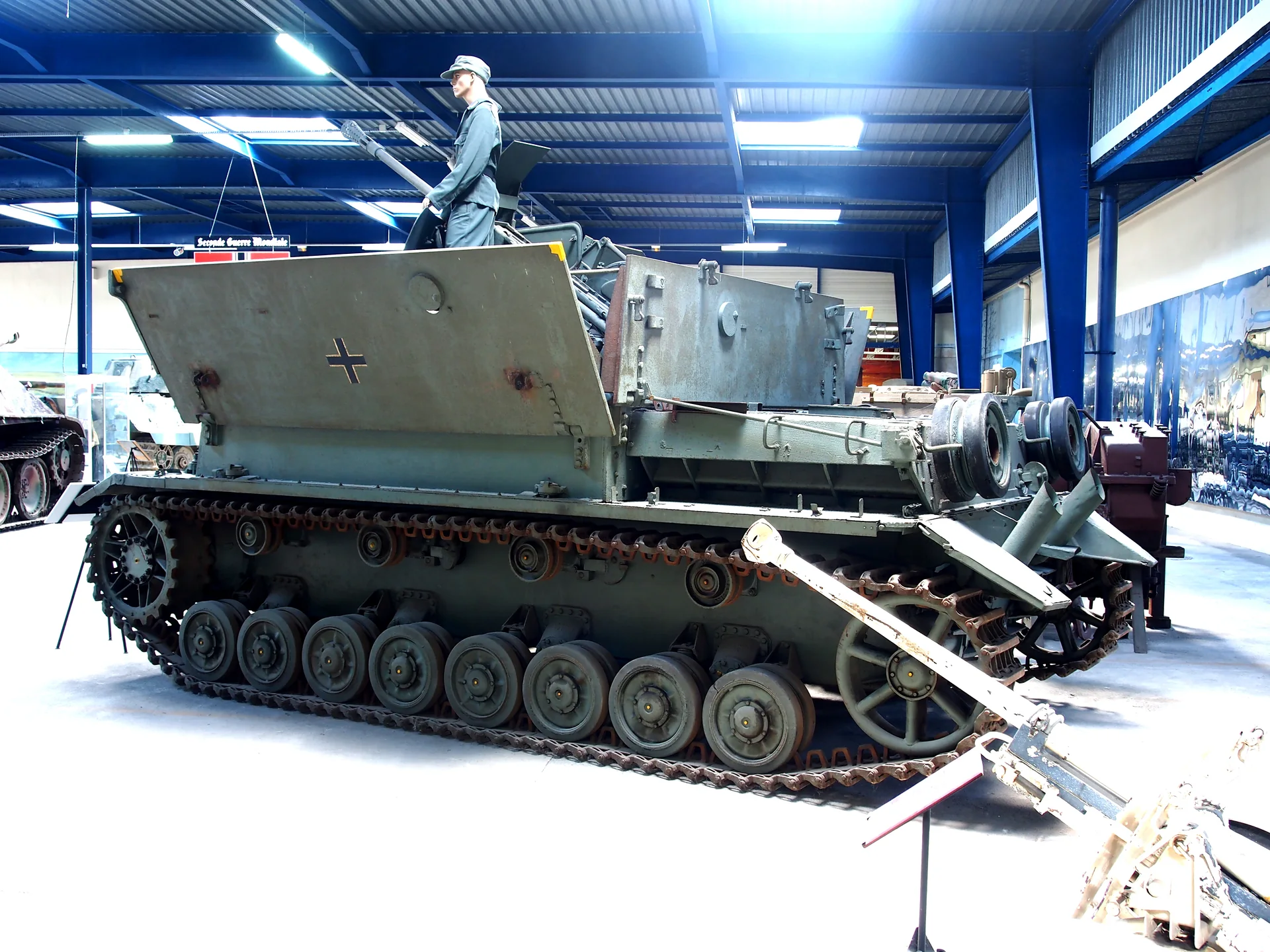
The normal Panzer IV turret was removed and replaced by a flat gun platform surrounded by four large folding armored panels. Raised panels created the vehicle’s boxlike “furniture van” appearance and gave some protection in travel; lowered panels opened the firing arcs. This arrangement was simple and producible but forced crews to trade protection against immediate freedom to engage. 1, 2, 3
Armament and engagement role
The production vehicle used the 3.7 cm Flak 43, providing greater projectile effect and useful reach compared with 20 mm light flak. The larger gun was attractive against increasingly robust Allied aircraft. It could also threaten lightly armored ground targets, but using an open anti-aircraft platform for direct ground combat exposed scarce crew and equipment to return fire. 1, 2, 3
Crew protection
The Panzer IV hull protected the driver and major automotive components, while the folding side walls offered the gun crew some shielding when raised. In action the roof remained open and the panels often had to be lowered, leaving personnel vulnerable to fragments and strafing. The vehicle therefore improved protection over truck-mounted flak without solving the basic open-fighting-compartment problem. 1, 2, 3
Mobility and automotive commonality
Panzer IV running gear allowed Möbelwagen to move with armored formations across terrain that could delay trucks or towed guns. The weapon was always on its carrier and needed no separate tractor. Commonality also mattered to repair units already familiar with Panzer IV components, although by 1944 fuel, tracks, transmissions, and spare parts were under severe pressure across the German army. 1, 2, 3
Production and conversion scale
Tank Encyclopedia gives a commonly cited total around 240 vehicles produced from 1944 into 1945, with exact figures varying by account. That was enough for Möbelwagen to appear in multiple formations, unlike the tiny Flakpanzer I program. Its interim status remained clear, however: Germany continued producing it while simultaneously pursuing more responsive turreted Panzer IV air-defense designs. 1, 2, 3
Operational service
Bundesarchiv imagery documents a Panzer IV-based 3.7 cm flak vehicle in northern France in June 1944, and modern histories describe broader employment during the late-war defense of panzer formations. Möbelwagen could make low-level attack more dangerous and stay near moving columns, but no local Flakpanzer could reverse the overwhelming strategic Allied air superiority of 1944-45. 1, 2, 3
Limitations
The folding-panel fighting compartment was the central weakness. A sudden air attack rewarded a weapon that was ready to traverse immediately, yet raised armor could restrict employment and lowering the panels took time. With them lowered the crew was exposed. This awkward trade directly encouraged the turreted Wirbelwind and Ostwind approach, where side armor rotated with the weapon instead of having to be transformed before action. 1, 2, 3
Evolution of the Flakpanzer concept
Möbelwagen was followed by two better-known Panzer IV Flakpanzer concepts. Wirbelwind used an open armored turret with four 20 mm cannon for immediate close-range reaction, while Ostwind combined a turreted arrangement with a 37 mm gun. The sequence shows German designers experimenting with the balance between projectile power, fire density, crew protection, and production simplicity under intense wartime pressure. 1, 2, 3
Wider air-defense context
The vehicle entered service when Germany’s air-defense problem had become enormous. Fighters, heavy flak, light guns, rail and road defenses, and mobile weapons all competed for ammunition and production. Möbelwagen’s contribution was specifically to the moving armored formation, where a gun on tracks could remain close to tanks and support vehicles. It was one tactical layer in a much larger and increasingly overmatched system. 1, 2, 3
The March 1945 U.S. handbook lists a 37 mm Flak 43 on a Panzer IV chassis. It does not name Möbelwagen or Ostwind in that entry, so the description cannot by itself distinguish the two vehicles or supply a production total. 4
Historical place
Möbelwagen paired a Panzer IV carrier and 37 mm gun with folding protective panels rather than a conventional rotating turret. Its production and service overlapped the development of Wirbelwind and Ostwind. That overlap is important: the later turreted vehicles were alternatives within the mobile-flak effort, not evidence that every Möbelwagen was immediately replaced or converted. 1, 2, 3
Möbelwagen also shows why wartime procurement often accepts overlapping solutions. Germany continued using the folding-sided vehicle even as turreted successors appeared because production, training, and operational demand did not pause while engineers refined the next design. Units needed mobile flak immediately. The resulting mixture increased logistical complexity, but it also prevented the pursuit of a better future vehicle from leaving a complete capability gap in the present. That tension between interim availability and ideal design is central to the vehicle’s history. 1, 3
Sources and further reading
- Tank Encyclopedia — Flakpanzer IV Möbelwagen
- Bundesarchiv photograph — 3.7 cm Flak on Panzer IV chassis in northern France, 21 June 1944
- The Tank Museum Shop — Panzer Tracts No. 12-1 Flakpanzer IV description
- U.S. War Department: TM-E 30-451, March 1945, VII/V/5, transcribed text
Visit an Armor Museum
Explore the worldwide museum directory to find armored vehicles, collections, and visitor-planning information.
Browse armor museums