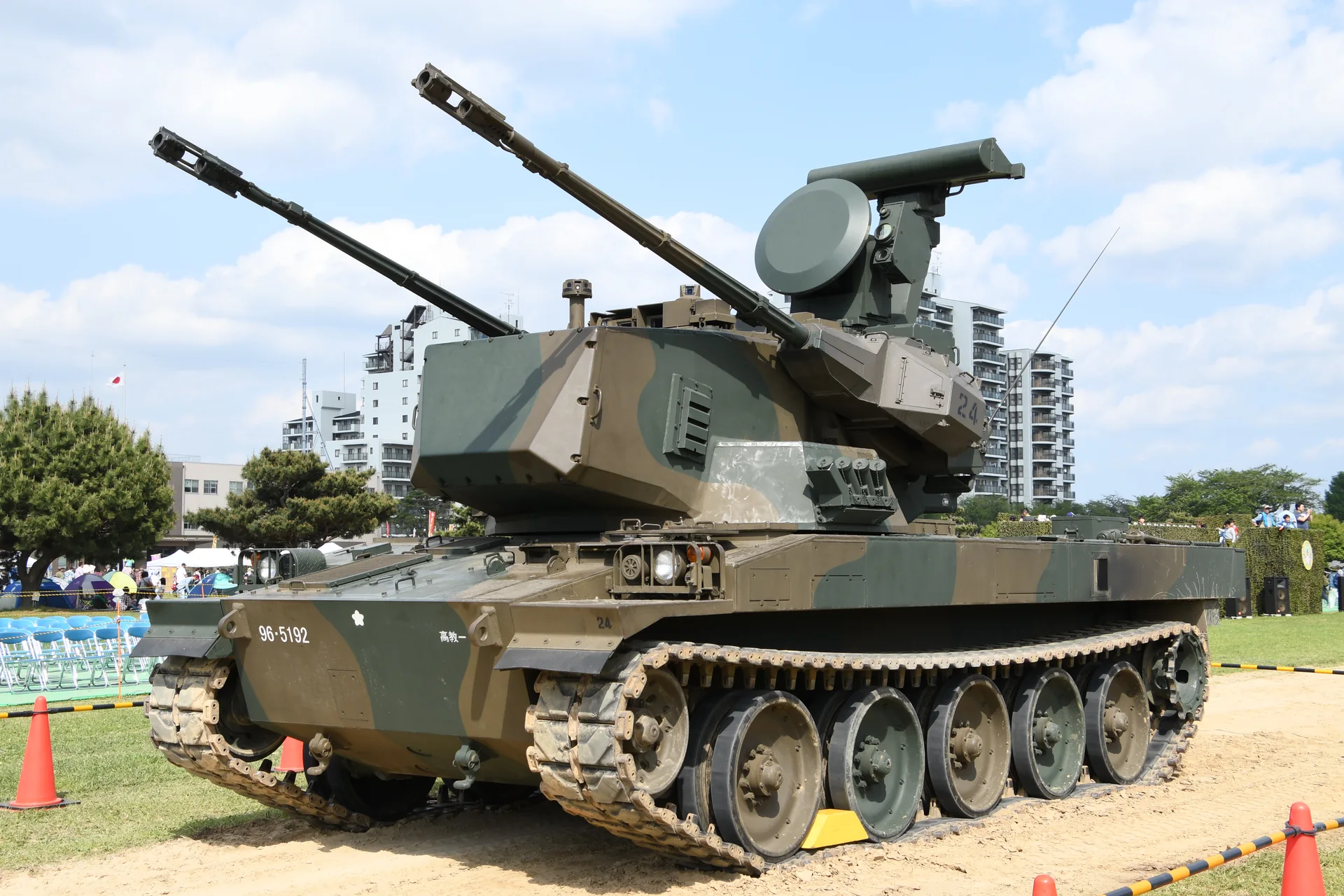
Requirement and development
Japan developed Type 87 to replace the aging American M42 Duster while preserving a gun-based close-defense capability for armored units. The program combined a domestically adapted tank-family chassis with licensed 35 mm gun technology and Japanese radar and electronics. Entry into service in 1987 placed it among the last major Cold War generation of dedicated tracked radar SPAAGs. 1, 2, 3, 4
The 2nd Division's equipment account supplies a more precise sequence than the designation alone. Development began in fiscal 1982 as a replacement for M15 and M42 self-propelled anti-aircraft weapons. An initial Type 61 chassis approach gave way to the Type 74 base. The account explicitly mentions the difficulty of combining the Japan Steel Works turret and imported reference Oerlikon KDA cannon with Mitsubishi Electric fire-control equipment. Development ended in fiscal 1986, followed by an initial procurement of four vehicles in fiscal 1987. The Type 87 thus resulted from an integration program, not simply the installation of foreign guns on an available tank. 5
Vehicle architecture and crew arrangement
The vehicle uses a modified Type 74-family hull with a two-person powered turret for commander and gunner, while the driver sits in the hull. Twin 35 mm cannon flank the turret and radar equipment is mounted at the rear. The engine remains in the rear of the chassis, producing a conventional tank-like automotive arrangement beneath a highly specialized air-defense turret. 1, 2, 3, 4
The same record identifies a three-person crew, Mitsubishi Heavy Industries responsibility for the hull, and Japan Steel Works responsibility for the turret. It gives the vehicle a separate search radar, tracking radar and digital fire-control arrangement, including automatic correction for movement. Those responsibilities and subsystems explain why the finished anti-aircraft vehicle cannot be understood through Type 74 tank specifications alone. 5
Weapons and engagement concept
The Japanese Ministry of Defense’s short equipment guide identifies Type 87 as a tracked armored close-air-defense vehicle with twin 35 mm guns. That official description establishes the basic weapon category and carrier role. It is not a detailed firing manual, and it does not by itself establish exact burst settings, radar performance or the ammunition carried by each service configuration. The gun system belongs to the close-defense layer rather than replacing missiles with greater reach. 3
Sensors, fire control, and target information
Type 87 carries surveillance and tracking equipment together with optical sights. Finding a possible target is not the same task as maintaining the precision needed for gun laying. External warning complements the local view, especially where terrain masks a low-flying aircraft. The published regimental organization includes separate radar and information functions, but that does not establish every detail of the electronic interfaces or the precise sequence followed by an individual vehicle crew. 1, 2, 3, 4
Mobility, protection, and sustainment
The Ministry of Defense equipment guide describes Type 87 as a tracked armored vehicle for close air defense. That establishes the broad carrier category and mission, not a comparative mobility trial. The Type 74-family relationship and detailed automotive arrangement remain dependent on the retained technical references. The short guide does not measure performance against a truck-mounted system or identify the carrying margin of a particular production configuration. 3
Place in the air-defense system
The 7th Anti-Aircraft Artillery Regiment’s published outline lists Type 87 gun vehicles in companies 1–4 and Type 81 missile equipment in companies 5–6. It also identifies radar and information-processing functions in the headquarters management company. That is useful evidence of gun, missile and supporting sensor elements within one organization. The undated outline is not a September 2026 order of battle, and it does not establish the number of serviceable vehicles in any company. 2
The regiment's published outline distinguishes Type 87-equipped companies from companies assigned Type 81 missiles. It also identifies different garrison locations for elements of the regiment. The organizational point is that gun and missile equipment coexisted within the same regimental framework rather than representing competing names for one vehicle. Because the page is undated, its listed companies are retained as an institutional description, not used to calculate an October 2026 inventory or to assert that every Japanese air-defense regiment had the same composition. 2
Variants and modernization
Type 87 remained a Japanese tracked-gun program rather than a broad export family. The shorthand 87AW appears in descriptions, but a different abbreviation does not establish a separate production variant. The retained references do not provide a sufficiently complete change record to divide the fleet into named electronic blocks. Support and component replacement may occur without creating a new vehicle designation; precise modernization claims require a dated configuration record rather than inference from photographs or procurement search results. 1, 2, 3, 4
Service history and operators
Type 87 entered Japanese service in the late 1980s and became associated with the Ground Self-Defense Force’s armored air-defense units. The published regiment outline and MOD equipment guide document that role, while the vehicle’s continued appearance in such material shows its place in the institutional history. These descriptions are not dated fleet censuses. They should not be used to assign current vehicle numbers, serviceability rates or a completed procurement program to particular companies. 1, 2, 3, 4
An official report of training held from 25 February to 4 March 2022 records the 7th Anti-Aircraft Artillery Regiment working in a winter exercise environment. Its captions place Type 87 vehicles among the unit's movements and field preparations, alongside camouflage, communications and casualty-care activity. This is a documented example of the system as part of a functioning regiment rather than a vehicle photographed alone on a display ground. It supports a dated training history in Hokkaido, not a claim of combat experience, a national readiness percentage or an unchanged establishment after 2022. 6
Constraints and changing threat environment
Type 87’s guns, sensors and carrier have to be considered together. Radar line of sight and the distance at which a particular round can be employed are different constraints, and both depend on conditions. The inspected official descriptions do not provide target-specific firing tables, turret maintenance costs or a comparison with every modern short-range missile. They therefore support the vehicle’s close-defense role without quantifying those wider performance or economic claims. 2, 3
Historical place
Type 87 placed a twin 35 mm gun installation, radar and a tracked tank-derived automotive base in one Japanese air-defense vehicle. It addressed the same mobility problem as other Cold War radar gun systems: close-defense equipment had to accompany armored formations rather than remain at fixed sites. The published combination of gun and missile units also shows why the vehicle is better understood as one part of a layered organization. Its history is not a claim that a single gun system could provide every category of air defense. 1, 2, 3, 4
Sources and further reading
- U.S. Army ODIN , Type 87 Japanese SPAAG
- JGSDF 7th Division, 7th Anti-Aircraft Artillery Regiment outline
- Japan Ministry of Defense, Type 87 equipment video guide description
- Japan Ground Self-Defense Force recruiting material , air-defense equipment
- Japan Ground Self-Defense Force, 2nd Division Type 87 equipment record
- JGSDF 7th Division, February–March 2022 air-defense training report
Visit an Armor Museum
Explore the worldwide museum directory to find armored vehicles, collections, and visitor-planning information.
Browse armor museums