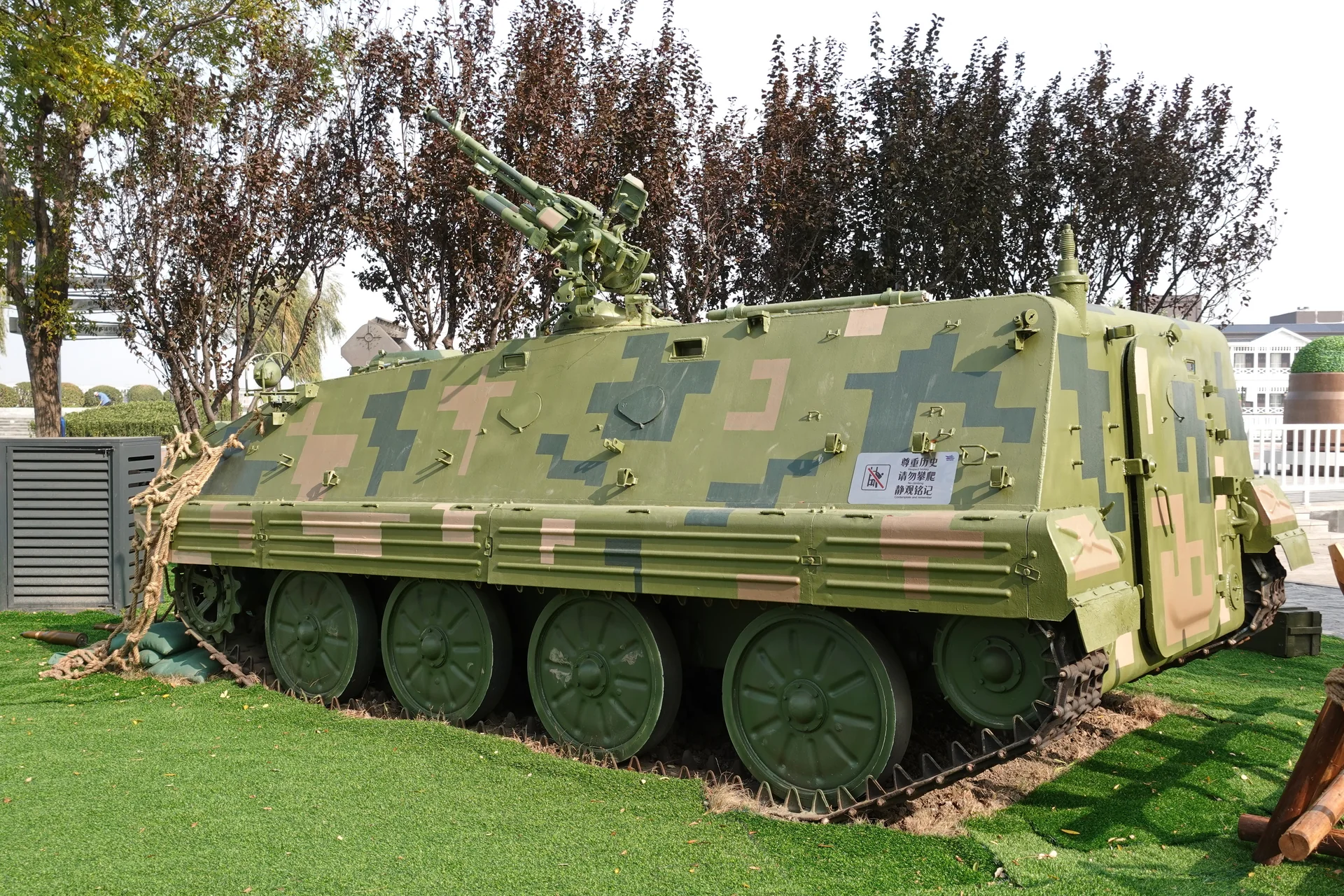
Development and requirement
China developed the Type 63/YW531 as a domestically designed tracked troop carrier during the 1960s, reducing dependence on Soviet vehicle designs. 1
The Australian War Memorial identifies the Type 63, also known by the industrial designation YW531, as a tracked Chinese armored personnel carrier that entered service in the late 1960s. Its collection record describes it as the first armored vehicle designed in China without Soviet assistance. That makes the Type 63 significant not merely as another Cold War APC but as an early marker of an independent Chinese armored-vehicle design capability. 1
A 1990 U.S. Army Research, Development & Acquisition Bulletin describes the YW531 chassis—also identified there as Type 63/K-63—as introduced in the late 1960s and significant in Chinese service. The same period source emphasizes the chassis family's many carrier, artillery, mortar, command, ambulance, and other derivatives, which is why this profile does not assign one internal layout to every Type 63-related vehicle. 2
Design, protection, and mobility
The vehicle used a straightforward welded hull, front drive arrangement, rear troop compartment, and roof-mounted heavy machine gun. Simplicity supported large-scale production and export. 1
The War Memorial's vehicle record places the driver forward with the engine immediately to the driver's right rear. Drive is taken to a front sprocket, and the track runs over four rubber-tired road wheels without return rollers. Those details replace the generic tracked-mobility paragraph with an identifiable Type 63 layout while leaving export-engine differences tied to the source rather than treated as one universal specification. 1
The Type 63's troop-carrying mission depended on a simple enclosed tracked hull rather than tank-level protection or firepower. Its large production family included many variants, so passenger arrangements and equipment can differ by model. This profile keeps the baseline carrier separate from later specialist or export configurations unless a source ties a feature to the YW531/Type 63 version being discussed. 1
The Australian War Memorial's carrier record places the engine behind and to the right of the driver, with intake and exhaust arrangements on that side of the hull. It also describes the four-road-wheel running gear and front drive. These details are attached to an identified Type 63-family object rather than borrowed from a generic Soviet personnel carrier. The record distinguishes baseline and export engine descriptions, so an export power figure should not automatically be assigned to the preserved vehicle or to every early production example. 1
Firepower and battlefield role
The baseline carrier used a roof-mounted machine-gun installation rather than a tank turret. That weapon supported the vehicle's transport mission, but the archive does not infer stabilization, sighting or ammunition features that are not established in the cited record. Later weapons carriers and other derivatives remain separate configuration questions. 1
Service, variants, and modernization
Type 63 variants appeared in many countries and conflicts, and the chassis served as a foundation for numerous specialized vehicles. 1
The War Memorial reports that roughly 8,000 vehicles of all types and variants were produced and that the family equipped numerous armies. Because that number covers multiple versions, it should not be read as the production total for one exact Type 63 configuration. The same record notes combat use in the Vietnam War, providing a documented conflict association without requiring a generic modernization narrative. 1
The museum's acquisition history follows a specific vehicle from South Vietnam to Australia. Major Jim Ellis obtained it in Military Region 1 in August 1972; it was handed over at Da Nang on 1 September and shipped aboard John Monash alongside a Type 59 tank. This documented chain is more informative than an unsupported list of every possible operator. It establishes how this object reached the Australian collection while leaving its earlier individual combat history unresolved. 1
How the vehicle fits the formation
The museum vehicle adds a concrete service-provenance example. An Australian Technical Intelligence Officer obtained the APC in South Vietnam in August 1972, and it was formally presented to Australia at Da Nang on 1 September before shipment home. That history establishes the presence of this captured Type 63 in the Vietnam theater while remaining specific to the preserved vehicle. 1
Strengths, limitations, and family boundaries
The later Type 85/89 family evolved from the Type 63 concept but is separated as a new generation because of the expanded chassis and significant automotive changes. 1
Type 63 combined a relatively simple tracked carrier layout with amphibious and cross-country mobility suitable for a mass-produced troop vehicle. Its significance is also industrial: the War Memorial identifies it as a Chinese design developed without Soviet assistance. Those points are more specific than treating it as a generic low-cost APC whose strengths can be inferred from category alone. 1
The Type 63/YW531 family generated numerous variants, but shared ancestry does not make their engines, weapons, passenger arrangements or mission equipment interchangeable. The later Type 85/89 family remains a separate evolutionary subject in this archive. Where the museum record describes export engines or total all-variant production, the wording is kept at that broader family level. 1
Sources and further reading
- Australian War Memorial, Chinese Type 63 armored personnel carrier, REL10942
- U.S. Army Research, Development & Acquisition Bulletin, July–August 1990 — Chinese Armored Families
Visit an Armor Museum
Explore the worldwide museum directory to find armored vehicles, collections, and visitor-planning information.
Browse armor museums