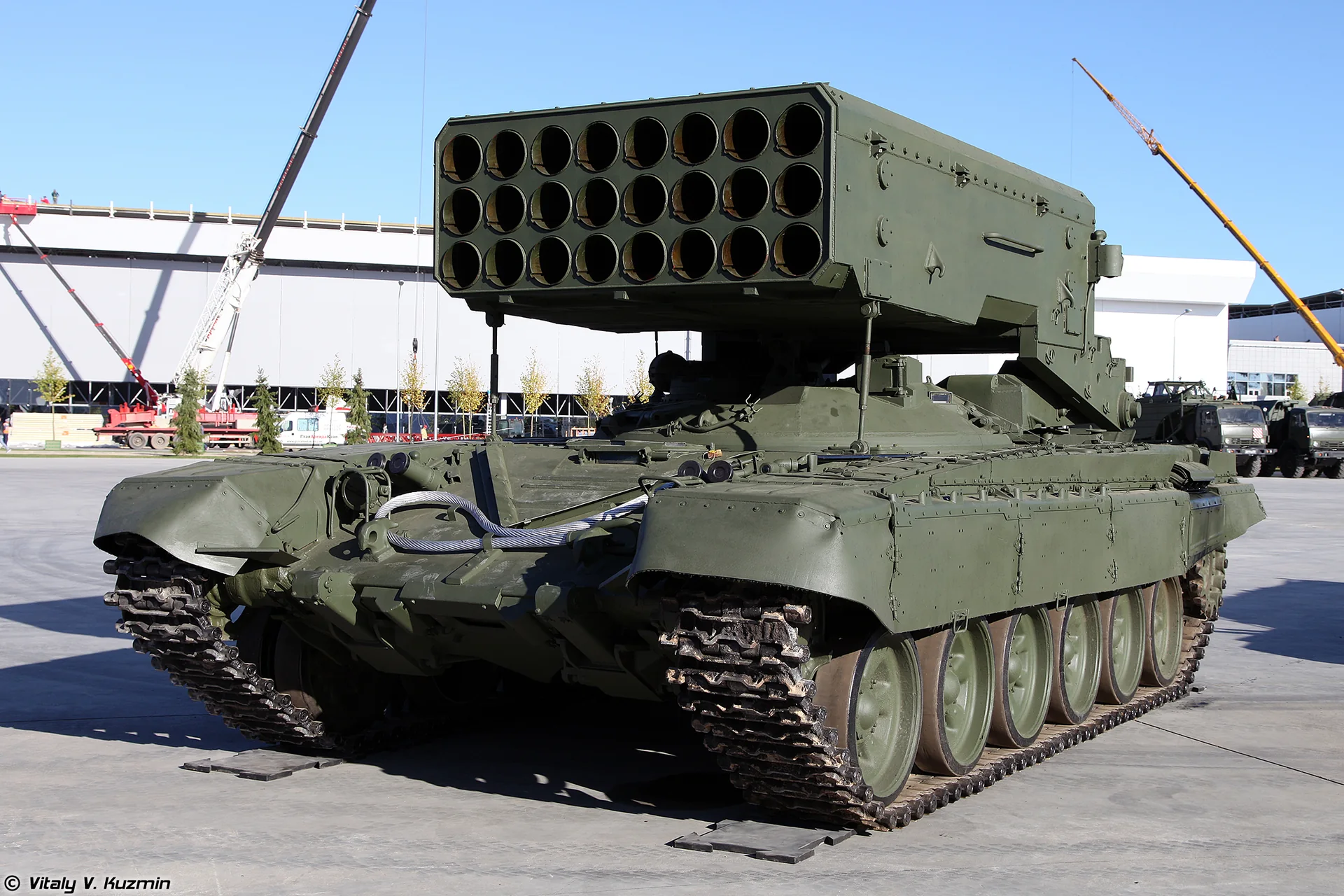
A specialized Soviet assault-support system
TOS-1 grew from a Soviet requirement for a protected launcher able to deliver concentrated incendiary and thermobaric rocket fire at relatively short range. The original system combined a T-72-derived tracked chassis with a large rectangular 220 mm launcher containing thirty tubes. U.S. Army reference material classifies it as a heavy flamethrower system rather than conventional field artillery, reflecting Russian organizational terminology and the specialized munitions it was designed to employ. Its armored chassis was a response to the need to work much closer to the forward area than long-range rocket artillery. 1, 5
The unusual combination of tank-derived mobility and a multiple rocket launcher gave TOS-1 a different operational character from systems such as BM-21. It sacrificed long standoff range for protection, a compact armored vehicle and a very large volume of fire against fortified or area targets. That tradeoff explains both its distinctive appearance and its limitations. The vehicle could accompany armored forces over difficult terrain, but short firing ranges placed the launcher and its support vehicles in an environment where enemy artillery, antitank weapons and later unmanned systems could threaten them. 1, 3, 5
Launcher, chassis and supporting vehicles
The launcher vehicle is only one element of the TOS complex. Rosoboronexport describes the TOS-1A system as a BM-1 combat vehicle together with dedicated transporter-loaders, while Army ODIN identifies the TZM-T as the associated reloading vehicle. The BM-1 uses a tank chassis and carries the fire-control equipment needed to lay the launcher. The transporter-loader carries additional rockets and the handling equipment needed to replenish the launcher. This pairing is essential to understanding the vehicle: its full combat function depends on a small system of armored or protected support vehicles rather than the launcher alone. 2, 4
The original TOS-1 carried thirty launch tubes. The improved TOS-1A reduced the launcher to twenty-four longer tubes so it could use rockets with greater range. ODIN records the TOS-1A BM-1 as an improved version of the original system, while the Rosoboronexport brochure similarly identifies a twenty-four-tube launcher on a T-72A-based chassis. The change is a reminder that tube count is not a simple measure of capability; the newer vehicle accepted fewer rockets in exchange for a redesigned launcher, ammunition and fire-control system. 1, 2, 4
Thermobaric and incendiary effects
The TOS family is associated with incendiary and thermobaric rockets rather than a tank gun or a liquid-flame projector. Published Army and manufacturer descriptions place it in a specialized short-range support role. The rocket type and launcher generation are important distinctions: the original thirty-tube TOS-1 and the twenty-four-tube TOS-1A should not be assigned a single timeless ammunition capacity or range. 3, 4
The specialized warhead also explains the Russian “heavy flamethrower” terminology. The system does not project a continuous stream of burning liquid like a Second World War flamethrower tank. Instead, it launches rockets carrying incendiary or thermobaric payloads. In organizational and historical terms, the name links TOS to Russia’s radiation, chemical and biological defense troops and their flamethrower tradition. In mechanical terms, however, the vehicle is a rocket-launching armored system, which is why it sits at an unusual boundary between artillery technology and specialized assault-support weapons. 1, 3, 4
A short-range rocket system with onboard fire control
The TOS-1A BM-1 incorporates a dedicated fire-control system rather than functioning as a simple rack of rockets. Rosoboronexport lists a laser rangefinder sight, digital computer, sensor package, powered launcher drives and firing equipment. Those components help the crew determine the launcher’s orientation and ballistic solution without turning the vehicle into a precision-guided system. The rockets remain unguided; the fire-control equipment improves the placement of a salvo by accurately orienting the launcher and applying the relevant firing data. 4
Because the system works at comparatively short range, the time spent exposed during movement, preparation and resupply has important tactical consequences. U.S. Army doctrine places TOS batteries in direct support of maneuver formations and describes their integration with reconnaissance and command networks. That doctrinal context is more informative than quoting a single maximum range without date or munition. The original TOS-1, TOS-1A and later rockets differ, and newer ammunition can extend performance beyond the figures associated with the first system. 1, 2, 3, 5
From late Soviet development to Russian and export service
The TOS family originated in the late Soviet period and remained comparatively obscure for years. U.S. Army equipment guides place the original system in service by the early 1990s, while later references describe the improved TOS-1A as entering Russian service in the early 2000s. The family subsequently appeared with Russian and export operators. Because public sources mix original TOS-1 launchers, TOS-1A vehicles, newer ammunition and the later wheeled TOS-2, this profile keeps the TOS-1/TOS-1A lineage separate from later systems rather than merging every Russian thermobaric launcher into one specification. 1, 2, 5
Descriptions of Russian and export service often use TOS as a family label. That can conceal differences between the original launcher, TOS-1A, later ammunition and the wheeled TOS-2. Individual photographs or reported engagements require identification at that level before they can establish a specific model's service history. This account does not attempt an inventory or tally of combat engagements. 1, 2, 3
Why a tank chassis mattered
The T-72-derived chassis gave the original TOS vehicles protected mobility comparable to the armored formations they were intended to support. The heavy launcher and short engagement distances made a truck chassis less attractive for the first generation, while the existing tank automotive family provided a proven engine, tracks and running gear. The chassis should not be interpreted as evidence that the launcher possessed the same protection layout as a T-72 tank: the turret was removed and replaced by a large rocket pack, producing very different vulnerable areas and internal arrangements. 1, 4, 5
The large external rocket pack has a different protection arrangement from the tank turret it replaces. Tank-derived armor around the hull does not enclose every rocket tube, sight or launcher drive to the same standard. Nor does shared T-72 ancestry establish the survivability of the ammunition installation. The launcher, its crew compartment and its supporting replenishment vehicles must be considered separately. 1, 2, 4
TOS-1, TOS-1A and the family boundary
The original TOS-1, commonly called Buratino, is characterized by the thirty-tube launcher. TOS-1A Solntsepek uses the twenty-four-tube BM-1 launch vehicle and dedicated TZM-T resupply vehicles. ODIN identifies longer rockets and greater range among the changes. Later ammunition developments mean that a range figure must be tied to a particular rocket and configuration rather than assigned permanently to every TOS-1A. 1, 2, 4
The wheeled TOS-2 is a separate vehicle branch rather than another T-72-based launcher. U.S. Army material describes it as a newer heavy flamethrower system with greater automation. It carries the same broad mission into a different automotive arrangement, with different mobility, protection and support characteristics. Its appearance does not establish that every tracked TOS-1A was replaced or modified to the same standard. 1, 3
A weapon of assault support rather than long-range field artillery
Russian doctrine described by the U.S. Army places thermobaric fires in support of maneuver forces and treats the TOS complex differently from ordinary long-range rocket artillery. Its value is concentrated effect against area targets and fortifications within a relatively close fight. That helps explain the heavy chassis and the emphasis on protection. A conventional multiple-launch rocket system can remain farther behind the forward line; TOS historically had to operate nearer the action to place its rockets on target. 3, 5
The U.S. Army’s indexed description places TOS-1A in Russian nuclear, biological and chemical protection troops. That organizational terminology explains the heavy-flamethrower designation without making the vehicle a conventional field-artillery launcher. The affiliation is not proof that every deployment used the same command arrangement, and it does not establish current inventories or the equipment of the separate wheeled TOS-2 branch. 6
Historical place
TOS-1 uses a tank-derived chassis but is not a tank. It launches rockets, while the Russian heavy-flamethrower designation reflects its ammunition and organizational history rather than a nozzle projecting burning liquid. Those distinctions explain why the family sits outside a simple sequence of conventional tank guns and long-range rocket artillery. 1, 3, 4
The T-72 automotive lineage supported both the rocket launcher and its associated replenishment concept, yet shared running gear did not give these vehicles the tank's original fighting role. The TOS-1A development retained that tracked approach while changing the launcher and ammunition arrangement. TOS-2 belongs to a different, wheeled branch and should not be folded into the same chassis description. 1, 2, 4
Sources and further reading
- U.S. Army ODIN — TOS-1 Buratino Russian 220mm Heavy Flamethrower System
- U.S. Army ODIN — TOS-1A Solntsepek Russian 220mm Heavy Flamethrower System
- U.S. Army — ATP 7-100.1 Russian Tactics, February 2024
- Rosoboronexport — TOS-1A heavy flamethrower system product brochure
- U.S. Army TRADOC — Worldwide Equipment Guide 2011, Ground Systems
- U.S. Army OE: Russia’s thermobaric weapons employment, indexed description (indexed asset-page evidence only)
Visit an Armor Museum
Explore the worldwide museum directory to find armored vehicles, collections, and visitor-planning information.
Browse armor museums