Requirement and development
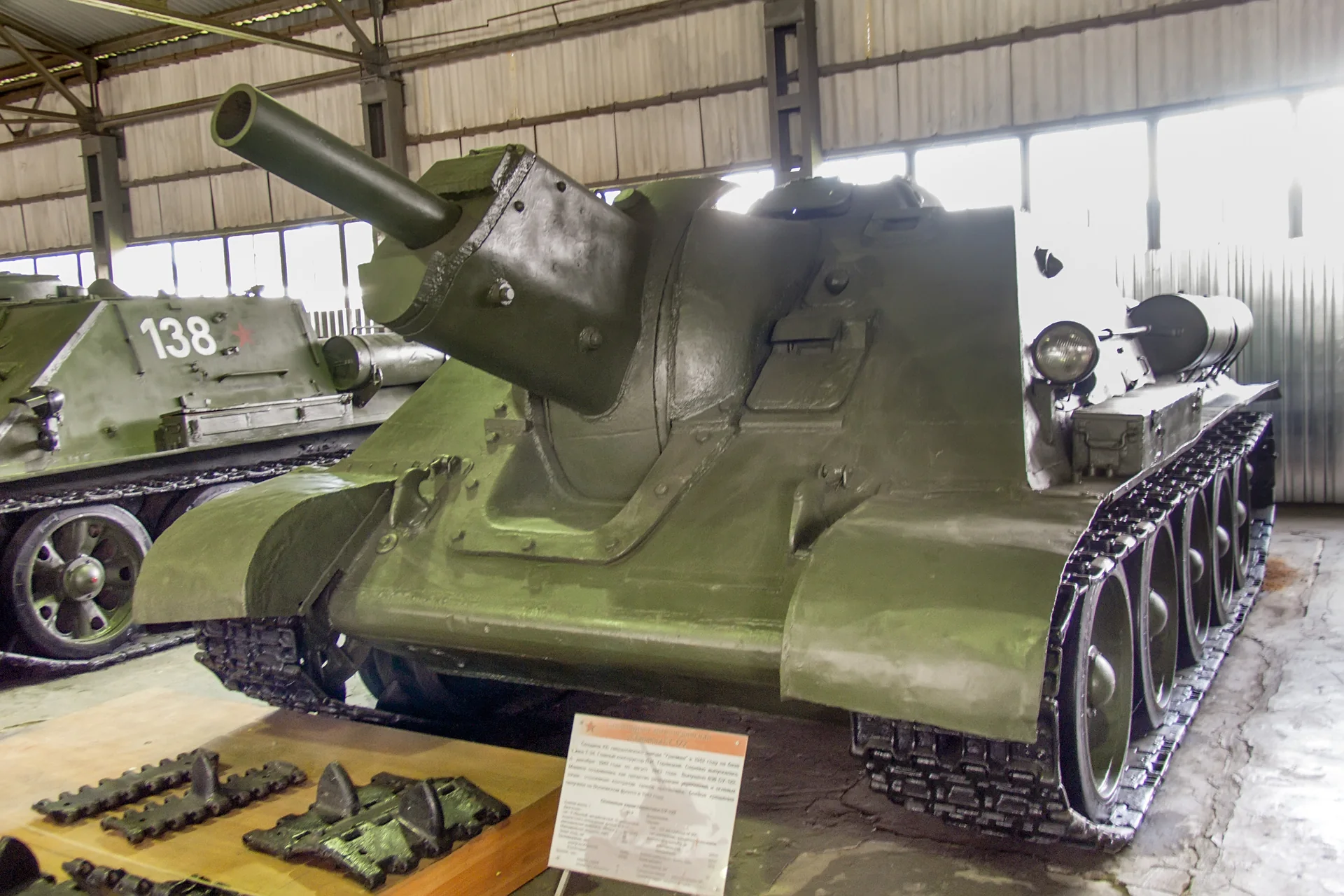
The October 1942 requirement for a 122 mm self-propelled howitzer called for a T-34 chassis and the artillery component of the M-30 howitzer. Its stated purpose was to accompany infantry and tanks and engage fortified positions using either direct or indirect fire. That requirement establishes the intended assault-support mission. Its requested firing rate, armor and mobility figures are design targets, however, and must not be copied as the measured performance of the subsequent production SU-122. 2
Patriot Park's SU-122 history places production from December 1942 through August 1943 and gives a total of 638 vehicles. The same institutional record connects the type's first combat trials with the Volkhov Front in February 1943. These dated milestones provide a useful cross-check on the secondary reconstruction while remaining separate from individual unit war diaries. 5
Layout and engineering
The fixed superstructure accommodated the howitzer installation and a five-man crew. The inherited field-gun layout helped make the weapon available, but fitting its working arrangements into a tank-derived hull created ergonomic difficulties. 1
The October 1942 SU-122 requirements show that crew arrangements were part of the design problem from the start. The translated archival material called for at least 40 rounds, a 9-R radio, TPU-3 intercom equipment, adjustable observation ports, and firing ports for PPSh submachine guns. Those were requested features, not proof that every production vehicle met every value exactly. They do, however, show that communications, ammunition stowage, observation, and local defense were explicit requirements alongside mounting the 122 mm howitzer. 2
The requirement’s call for at least 40 rounds is especially useful as a design target rather than a production specification. Together with communications and observation requirements, it shows how much volume had to be allocated beyond the gun itself. The crew needed room for ammunition, radios, intercom equipment, vision devices, and personal weapons inside the armored compartment, which helps explain why later trial criticism focused so strongly on working space. 2
Armament and direct-fire role
The short 122 mm howitzer was intended to deliver high-explosive support. The requirement allowed both direct and indirect fire, but the presence of those possibilities should not be treated as proof that every unit used them in the same proportions. 2
The SU-122 and ISU-122 shared a nominal caliber but not the same gun. A short howitzer installation and a long gun have different ballistic and handling characteristics. Grouping them together solely under “122 mm” erases the distinction that explains their separate development and roles. 1, 4
Protection and survivability
The enclosed T-34-derived superstructure protected the crew while placing observation, access, and the howitzer installation within a limited volume. Trial criticism included cramped working conditions, making clear that enclosure was an engineering compromise rather than an unqualified benefit. 1
The armored enclosure gave the crew greater protection than an exposed field howitzer, but restricted observation and working space. Infantry support and careful positioning remained necessary when approaching defended buildings or antitank weapons. 1, 2, 3, 4
Mobility, reliability, and logistics
The requirements sought to preserve the T-34 engine, transmission, and running gear. This connected the new assault gun to an existing automotive production and maintenance foundation, even while the armored superstructure and weapon installation required separate work. 2
Reusing the chassis reduced the number of unfamiliar systems introduced together. It did not eliminate manufacturing bottlenecks or guarantee that an already crowded factory could add another vehicle without difficulty. The production history needs to be read alongside the engineering description rather than as a simple consequence of using familiar parts. 1
Variants, production, and naming
U-35 identifies the development vehicle behind the SU-122, while subsequent improvement proposals should not be merged into one universal production standard. The development literature records an evolving effort to improve the installation and crew arrangement. 1, 3
The SU-122’s M-30-based short howitzer separated it from the later ISU-122, which carried a long 122 mm gun on an IS-derived chassis. They shared a caliber and support tasks, not an interchangeable gun installation. 1, 2, 3, 4
Operational service
The SU-122 entered production in late 1942 and established the medium assault-gun configuration from which the SU-85 program developed. The shift to SU-85 production in 1943 marked a change in manufacturing priorities toward a stronger antitank weapon. 1, 3
Limitations and tradeoffs
The large field-howitzer-derived installation, cramped crew arrangement, and restricted gun arc complicated the SU-122’s work. Its short weapon also gave it a different antitank proposition from the later dedicated medium tank destroyers. Those were connected consequences of bringing an existing howitzer and chassis together quickly. 1, 3
The October 1942 requirements called for a vehicle that could accompany tanks and infantry, engage fortifications and fire both directly and from covered positions. Fitting the howitzer and its ammunition into the T-34-based compartment required compromises in crew access, loading and weapon movement. The requested performance was a development target, not an achieved production specification. 2
Assessment and related development
SU-122 was conceived as mobile howitzer support on a T-34-derived base. Its October 1942 requirement is especially useful because it states the intended purpose before production experience intervened. Requested performance and achieved performance must remain distinct. The later SU-85 changed the weapon and emphasis rather than simply continuing the same howitzer installation. 1, 2, 3, 4
Sources and further reading
References and further reading are listed below. Image identification, credit and reuse terms remain with each photograph.
- Tank Archives — Assault Gun from the Urals
- Tank Archives — SU-122 Requirements (secondary source; not primary certification)
- Tank Archives — From Medium Assault Gun to Medium Tank Destroyer
- Tank Archives — Heavy Tank Destroyer
- Patriot Park — SU-122 collection/history record
Visit an Armor Museum
Explore the worldwide museum directory to find armored vehicles, collections, and visitor-planning information.
Browse armor museums