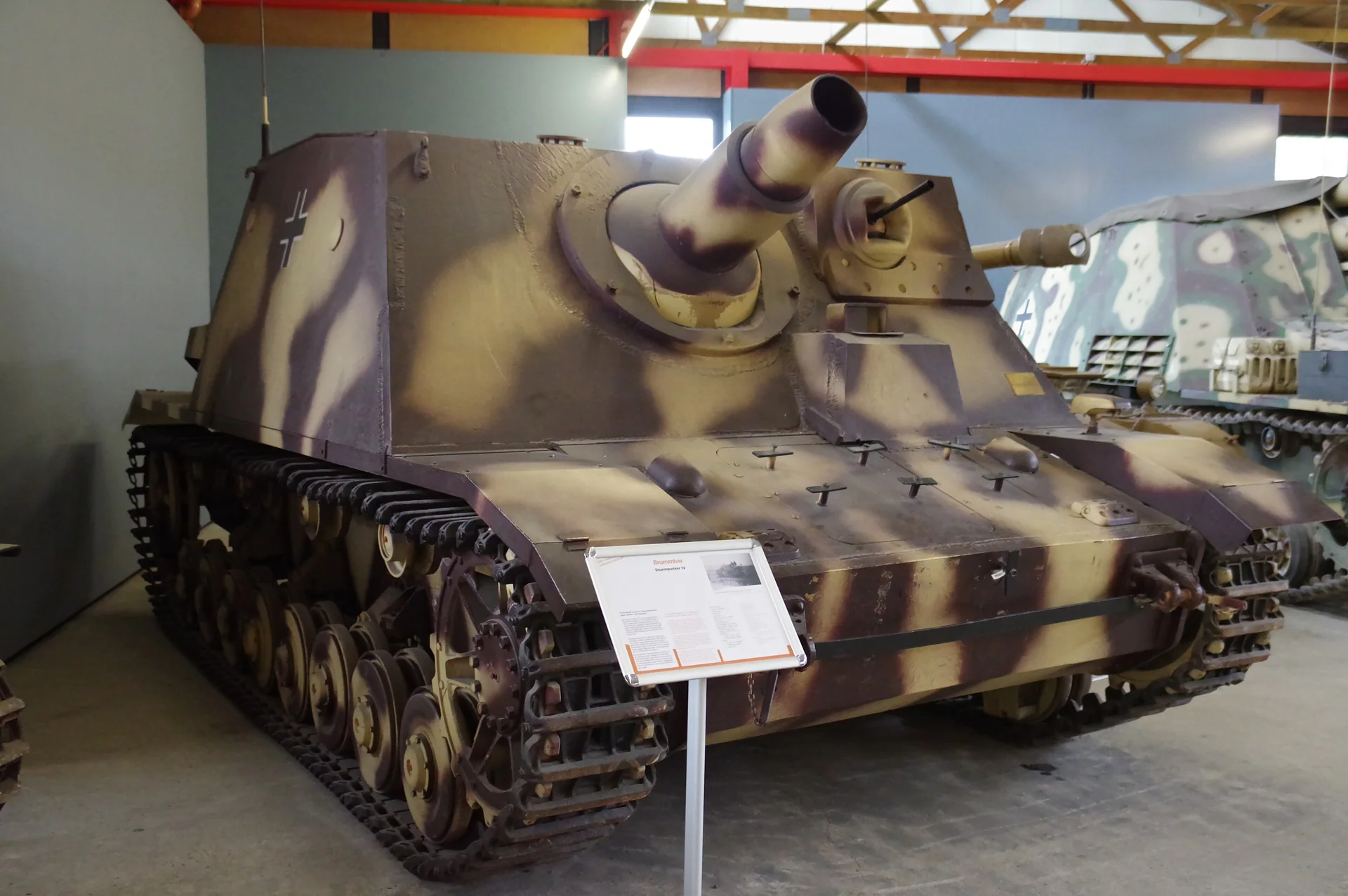
Requirement and development
German production records show Sturmpanzer deliveries beginning in 1943 and continuing into 1945. The design used the Panzer IV automotive foundation for a different job: carrying a large howitzer inside an armored superstructure. 1
This was a change in emphasis rather than simply a larger replacement for the tank’s gun. A weapon intended to attack structures and field positions imposes different priorities from one selected mainly for armor penetration. Judging the resulting vehicle only by its performance against tanks misses the requirement that shaped it. 1, 2
Layout and engineering
A fixed, enclosed fighting compartment replaced the revolving tank turret. The cited German technical record lists a commander, gunner, driver, and two loaders. That crew distribution reflects the work of serving a heavy weapon in a constrained hull. 1
Panzerworld’s document-based technical table gives the Sturmpanzer a five-man crew: commander, gunner, two loaders, and driver. It lists 15 rounds for the 15 cm StuH 43, with 20 degrees of traverse to either side and elevation from -8 to +30 degrees. Those figures show why two loaders mattered. The vehicle carried a large separate-loading weapon in a confined armored superstructure, so ammunition handling was a central crew task rather than an incidental detail. 1
Panzerworld’s production table also separates planned vehicles, accepted vehicles, new manufacture, repairs, shipments, and inventory. Those categories should not be summed indiscriminately. They show that a monthly ‘production’ story can include newly accepted vehicles and repaired vehicles moving through the system at the same time, which is why this profile avoids converting one table column into a universal production total without qualification. 1
Armament and direct-fire role
The main weapon was the short 15 cm Stu H 43 howitzer. Its characteristics identify the Sturmpanzer as an assault-support vehicle, not a PaK-armed tank destroyer. The gun had a limited horizontal arc within the casemate. 1
Large-caliber high-explosive effect and antitank performance are different measures. The former emphasizes the consequences of a burst against a position; the latter also depends heavily on ammunition and impact conditions. A claim that one vehicle has “more firepower” is incomplete until the target and task are specified. 1, 2
Protection and survivability
The German technical sheet records a 100 mm superstructure front, with thinner sides, rear, and roof. An enclosed compartment gave the crew overhead protection absent from open gun carriers, but the vehicle’s armor was not uniform in all directions. 1
A single frontal number can therefore distort the entire design. The useful comparison is not simply thick versus thin armor, but the protected volume, the direction of protection, and the burden of carrying it. Those considerations distinguish this approach from the much lighter shield around a Marder’s crew. 1, 2
Mobility, reliability, and logistics
The recorded automotive installation retained a Maybach gasoline engine and Panzer IV-related transmission components. Sharing this foundation connected the Sturmpanzer to an established vehicle-support system, but did not make its load or operating demands identical to those of a turreted Panzer IV. 1
Common components can ease parts supply without guaranteeing identical reliability. A vehicle’s mass distribution, armor, and gun installation change what those components must carry. A careful comparison separates that engineering observation from unsupported claims that every machine was either mechanically disastrous or consistently dependable. 1, 2
Variants, production, and naming
The name Brummbär is familiar in modern accounts, while Sturmpanzer is the useful starting point for the German records cited here. Configuration-specific technical data should remain attached to the vehicle or document concerned rather than being combined into an imaginary universal model. 1
The production table separately records planned manufacture, acceptance, new vehicles, repairs, and deliveries. Adding repaired vehicles to newly produced vehicles would inflate construction totals. Likewise, a monthly factory delivery says nothing by itself about how many vehicles were fit for action in a particular unit that day. 1
Operational service
The German Army's authorized Sturmpanzer company organization of 1 November 1943 provides a concrete picture of how these guns were supported. It allotted two vehicles to headquarters and four to each of three platoons, for fourteen in the company. It also included maintenance personnel, ammunition transport and supply elements. An establishment table describes authorized organization, not how many running vehicles any company had on a particular battlefield. The supporting vehicles were part of the unit's ability to keep its heavy howitzers operating. 2
Limitations and tradeoffs
The Sturmpanzer’s tradeoff was concentration. A large shell and substantial frontal protection were placed on an existing medium-tank foundation, while turret flexibility was surrendered. That makes it a specialized answer to a defined support problem. It should not be rated as though the army had purchased a general-purpose tank and somehow forgotten to give it a turret. 1
Its enclosed layout also shows why protection is not free space. Armor and the gun installation compete with people and ammunition for the same volume. The design’s strengths and constraints are connected, so a fair assessment has to retain both rather than select only the most impressive specification. 1, 2
Assessment and related development
Sturmpanzer IV carried a heavy howitzer for close support rather than a high-velocity antitank gun. The dated company establishment also shows that its guns depended on maintenance and ammunition vehicles. It belongs beside the other Panzer IV-derived vehicles as a different use of the chassis, not as an alternative name for StuG IV or Jagdpanzer IV. 1, 2, 3
Sources and further reading
References and further reading are listed below. Image identification, credit and reuse terms remain with each photograph.
- Panzerworld — Sturmpanzer (secondary source; not primary certification)
- German Army K.St.N. 1160 — Sturmpanzer company, 1 November 1943
- U.S. War Department, TM-E 30-451 VII.V.6: self-propelled artillery list (March 1945), transcription
Visit an Armor Museum
Explore the worldwide museum directory to find armored vehicles, collections, and visitor-planning information.
Browse armor museums