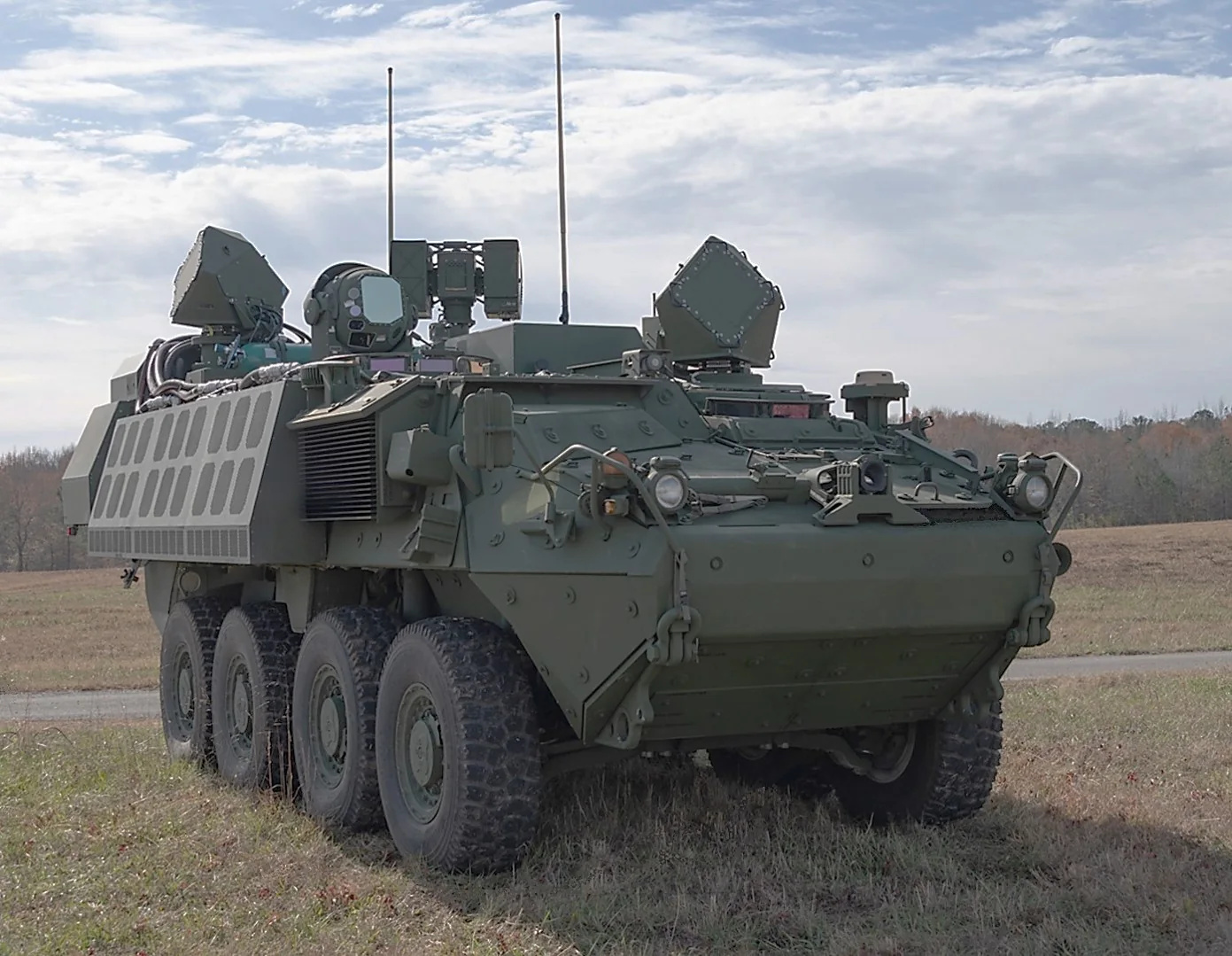
Rapid response to a maneuver air-defense gap
The Army identified a serious short-range air-defense gap as peer threats, unmanned aircraft, helicopters, and cruise-missile concerns returned to maneuver warfare. Rather than wait for a long clean-sheet program, it used rapid prototyping to integrate available weapons and sensors on the Stryker A1. 1, 2, 3, 4, 5
The Army's June 2024 naming account dates the requirement to 2018 and describes early battalion fielding in Germany and at Fort Sill, followed by another battalion in February 2024. It is a dated account of an expanding program, not a September 2026 inventory or confirmation that later procurement decisions had been completed. 2
Stryker A1 air-defense platform
SGT STOUT is built on the eight-wheeled Stryker A1 family, giving it protected crew space, digital architecture, and the mobility of formations already operating Strykers. The air-defense mission equipment is concentrated in an integrated turret and sensor arrangement rather than a dismounted weapon team. 1, 2, 3, 4, 5
The wheeled chassis offers road speed, strategic deployability, and electrical/space margins useful for sensors and weapons. It does not duplicate the cross-country behavior of a tracked Bradley, so the platform reflects a trade between tactical mobility, available vehicle capacity, fielding speed, and supportability. 1, 2, 3, 4, 5
A mixed set of effectors
The fielded configuration combines Stinger missiles with a 30 mm cannon and a 7.62 mm coaxial machine gun; early Army descriptions also identified additional missile effectors in the integrated weapon station. The mixed armament is intended to give crews more than one way to respond to different classes of aerial threat. 1, 2, 3, 4, 5
Leonardo DRS identifies the Increment 1 mission package as including the XM914 30 mm cannon and M240 7.62 mm machine gun, alongside missile effectors. Its product page describes local sensors and interoperability with Sentinel and Army networks. These are manufacturer descriptions of integration, not independently measured performance against every class of target. 6
Onboard radar and networked cueing
The Increment 1 manufacturer description lists onboard sensors for all-round aerial surveillance and integration with existing Army networks. It also identifies interoperability with the separate Sentinel radar. This distinguishes local vehicle sensing from an externally supplied air picture; it does not mean that Sentinel is physically carried on the Stryker. 6
The combination of organic sensors and networked warning addresses a limitation shared by many earlier armored air-defense guns. A weapon can be powerful but still ineffective if the crew sees the threat too late; modern SHORAD increasingly treats detection, identification, command links, and the effector as one system. 1, 2, 3, 4, 5
Protection for a maneuvering air-defense crew
The Stryker hull gives the air-defense detachment armor and protected mobility while keeping the crew mounted with the formation. That is a direct response to the vulnerability of dismounted teams and lightly protected carriers that may need to operate near maneuver forces. 1, 2, 3, 4, 5
Protection remains relative. A Stryker is not a main battle tank, and modern unmanned systems can threaten armored vehicles from multiple directions. Survivability therefore depends on mobility, signature management, combined-arms support, and the larger air-defense network in addition to the vehicle’s armor. 1, 2, 3, 4, 5
Mobility and operational deployment
The eight-wheel platform can move rapidly on roads and sustain long operational movement without the track wear associated with heavy tracked vehicles. This supports theater movement and allows air-defense units to reposition frequently as protected formations change routes and assembly areas. 1, 2, 3, 4, 5
The wheeled automotive arrangement belongs to the Stryker A1 platform chosen for Increment 1. It should not be treated as a tracked Bradley with different wheels, or as the only possible carrier for every later maneuver-air-defense program. Changes to the mission package and changes to the chassis are separate parts of the development history. 1, 2, 3, 4, 5
Fielding from Europe to additional formations
The first operational battalion, 5th Battalion, 4th Air Defense Artillery Regiment in Europe, began receiving the system in 2021. Additional units followed as the Army rebuilt divisional short-range air defense and incorporated the vehicle into large-scale training and evaluation. 1, 2, 3, 4, 5
The cited ATEC account describes testing and a production decision scheduled for fiscal year 2026. These are different milestones from receipt by a unit. A planned decision date does not establish its outcome, while an exercise appearance documents only the participating configuration. Fielding, evaluation and procurement decisions therefore belong to separate parts of the chronology. 3, 4
From M-SHORAD to SGT STOUT
On 15 June 2024 the Army announced the SGT STOUT name in honor of Sgt. Mitchell W. Stout. The announcement referred to the fielded maneuver-air-defense system. Older publications retain the M-SHORAD program name, which remains useful when following its development chronology. 2
The named conventional Increment 1 system should be distinguished from directed-energy development and other follow-on efforts. The common M-SHORAD label describes a broader program context, not proof that a laser demonstrator and a gun-and-missile Stryker carry the same equipment or have the same acceptance history. 1, 2, 3, 4, 5
Modernization and evidence boundaries
Follow-on work concerns weapons, sensors, software and support as well as the vehicle. A budget request records proposed funding and planned activity; it does not, by itself, establish completed installation, procurement or fielding. This profile therefore does not convert the retained fiscal-year material into a claim that every listed improvement was operational in 2026. 1, 2, 3, 4, 5
Leonardo DRS describes directed-energy weapons as a growth provision for the mission-equipment architecture, to be considered when available. That statement is not a specification for a fielded Increment 1 laser. The company’s listed Increment 1 weapons and sensors, directed-energy development, and later approved modifications must therefore remain distinct configuration histories. 6
Historical place
SGT STOUT restores a capability that largely disappeared when M6 Linebackers were converted back to ordinary Bradleys. Once again, dedicated air-defense crews can move under armor with maneuver forces while carrying organic weapons and sensors specifically intended for low-altitude threats. 1, 2, 3, 4, 5
Its significance also lies in integration. Earlier vehicles were often a gun on a mobile chassis; SGT STOUT is a sensor, network, software, missile, cannon, and vehicle system. That architecture reflects the modern reality that defeating drones, helicopters, and other low-altitude threats is as much an information problem as a gunnery problem. 1, 2, 3, 4, 5
Sources and further reading
- U.S. Army — M-SHORAD system bolsters Army’s air defense capabilities
- U.S. Army — Army names the M-SHORAD after Vietnam War Medal of Honor recipient
- U.S. Army — First NATO live fire with SGT STOUT in Norway
- U.S. Army Acquisition Support Center, 28 May 2026 — ATEC Continuous Evaluation Campaign: Purpose-Driven Learning
- Department of the Army — FY2027 M-SHORAD procurement justification
- Leonardo DRS: SGT STOUT M-SHORAD Increment 1 (current manufacturer-described configuration)
Visit an Armor Museum
Explore the worldwide museum directory to find armored vehicles, collections, and visitor-planning information.
Browse armor museums