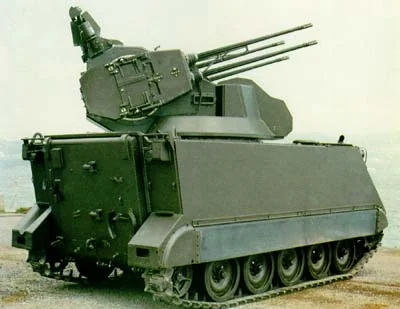
Requirement and development
Italy developed SIDAM 25 to provide a mobile short-range air-defense layer for army formations that could keep pace with tracked mechanized units. Work began as the Italian Army considered how to replace or supplement older anti-aircraft weapons whose manual aiming and limited sensor integration were increasingly inadequate against fast jets and attack helicopters. Forecast International records formal development activity during the first half of the 1980s, with testing from the mid-1980s and a production order in 1987. The decision to use the established M113 family reduced vehicle-development risk and allowed the program to concentrate on the turret, weapons, sights, ammunition arrangement, and integration. 1, 2
The system entered production during the closing years of the Cold War, when NATO armies expected armored formations to operate under a persistent low-altitude air threat. Italy selected four 25 mm cannon rather than a smaller number of larger guns, creating a dense burst of projectiles during the short time a target might be visible. SIDAM did not attempt to reproduce the fully autonomous radar search-and-track architecture of systems such as Shilka. Instead it accepted greater reliance on optical acquisition and external warning, a design choice that simplified the individual vehicle but transferred part of the detection burden to the wider air-defense network. 1, 2
M113-based vehicle architecture
SIDAM uses an M113-derived hull as the mobility base, with a large powered turret carrying the four cannon and the associated sighting equipment. The carrier choice offered a mature drivetrain, common running gear, and logistical familiarity within an army that already operated M113-family vehicles. The trade-off was payload and protection. A turret with four automatic cannon, ammunition, optical equipment, crew stations, and power demands consumed much of the available capacity and increased vehicle weight well above that of a basic personnel carrier. 1
A crew of three operates the vehicle. Their work is concentrated on driving, commanding, acquiring, tracking, and firing rather than carrying dismounts. The turret architecture places two cannon on each side, leaving the central area for sights and crew functions. WeaponSystems lists a combat weight of roughly 15 tonnes, showing how the air-defense conversion remained relatively light compared with later armored systems. That kept the vehicle mobile and easier to support, but it also meant protection remained in the M113 class rather than approaching the armor of contemporary main battle tanks or heavy infantry fighting vehicles. 1
Four-gun armament and ammunition
The Italian Army’s indexed SIDAM description identifies four 25 mm cannon. It describes defense of mechanized or armored units within a 2 km radius and separately lists a maximum firing distance of 2,500 m. These are not interchangeable measures and should not be collapsed into a single guaranteed engagement range. The four-gun installation supplies a high volume of short-range fire, but ammunition type, tracking quality and target conditions still govern an engagement. 3
Rate of fire should not be confused with unlimited sustained fire. A close-range air-defense vehicle carries finite ready ammunition, and the four-gun arrangement can consume it rapidly if crews fire long bursts. The system is therefore designed around short controlled engagements cued by target tracking rather than continuous barrage fire. In historical context, this made sense against aircraft and helicopters expected to expose themselves briefly during attack runs. It also explains why ammunition resupply and battery-level coordination are central parts of the vehicle’s real combat endurance even though they receive less attention than the visually impressive four-cannon turret. 1
Electro-optical fire control and warning
The indexed Italian Army equipment description specifies optical acquisition, laser ranging and automatic or manual television tracking. These are local fire-control functions, not an integral rotating surveillance radar. Timely warning from observers or other sensors is therefore a separate part of the air-defense arrangement. The available indexed description does not establish modern all-weather thermal tracking or a complete counter-drone upgrade. 3
A separate Italian Army entry concerns anti-laser binoculars and infrared viewers used for safety around SIDAM’s laser rangefinder. The equipment is described for the laser-safety officer during firing exercises. An infrared safety viewer should not be mistaken for a thermal target-tracking sight installed in the turret. This distinction prevents support equipment from becoming an invented vehicle modernization in the specification. 4
The Army also identifies protective eyewear for personnel working with SIDAM and the GTL-85 during training activities. This belongs to the human and range-safety side of operating laser-equipped weapons. It should not be read as evidence of a different thermal sight, an additional target sensor or improved radar performance. The presence of eye-protection equipment documents a support requirement around the existing system, not a new SIDAM weapon configuration. 6
Mobility, protection, and logistics
The M113-derived chassis gave SIDAM a mobility base well understood by the Italian Army. Tracked running gear let it accompany mechanized columns across terrain that could impede wheeled support vehicles, while established maintenance practices eased training and spare-parts support. Because the air-defense turret added considerable weight and shifted the vehicle’s center of gravity, the conversion was not identical in handling to a personnel-carrier M113, but it still benefited from the large family’s logistical infrastructure. 1, 2
Protection remained modest. The vehicle was expected to operate near maneuver forces but not to exchange direct fire with tanks, and the need to carry ammunition and turret equipment limited how much armor could be added. Survivability therefore depended heavily on position selection, movement, camouflage, and the ability to displace. The same is true of sustainment: four automatic cannon and a sophisticated turret require maintenance, while ready ammunition can be expended quickly. A SIDAM battery was consequently a system of vehicles, crews, resupply, warning, and command rather than a collection of independent gun tanks. 1
Italian Army service
Italy ordered SIDAM during 1987, and first deliveries followed near the end of the decade. WeaponSystems places production through the early 1990s and gives an overall fleet of about 275 vehicles. That number was large enough to make SIDAM a significant Italian Army short-range air-defense asset rather than an experimental curiosity. Its service coincided with a major strategic transition: it had been conceived for a dense Cold War European battlefield, but much of its operational life unfolded after the Warsaw Pact disappeared and Western armies reduced heavy ground-based air-defense forces. 1, 2
SIDAM’s operational history begins with the Italian fleet fielded at the end of the Cold War. Later discussions of reuse against unmanned aircraft raise a different question from its original mission against aircraft and helicopters. Reuse would depend on the actual sensors, warning arrangements, ammunition and support available, not simply on the presence of four automatic cannon. A possible new role should not be confused with a documented transfer, completed deployment or tested engagement capability. 1, 2
The 121st Ravenna Regiment's official history supplies a unit-level milestone: it received Stinger in 1988 and adopted the 25 mm SIDAM system in 1991 after conducting experimentation. That wording distinguishes trials from the regiment's subsequent adoption. It is a stronger service reference than a general production estimate, but it remains the history of a named unit. It does not establish that all Italian batteries received SIDAM during 1991, that the entire procurement was completed then, or that the gun and missile systems were interchangeable. 5
Configuration and related concepts
SIDAM 25 did not generate the broad family of major production variants seen in some longer-lived armored platforms. Its identity remained tied to the M113-derived carrier, four KBA cannon, and electro-optical fire-control concept. Incremental equipment changes could occur over a service life, but the core configuration stayed recognizable. This relative stability is itself informative: the vehicle was optimized for a specific short-range gun mission and lacked the large growth margin that would have made major radar or missile additions straightforward. 1
Italian industry also pursued OTOMATIC, a much heavier radar-directed 76 mm prototype. The comparison separates two approaches: a light common carrier with four small cannon and a tank-class carrier supporting a larger automatic gun and radar suite. SIDAM reached Army service; OTOMATIC did not become a production fleet. Those outcomes do not, by themselves, prove that the programs were equivalent candidates in one final competition or that one specific factor alone decided procurement. 2
Operational boundaries
SIDAM’s effective engagement envelope is short, so success depends on detecting a threat early enough to point the turret and establish a track. Fast aircraft can cross a two-kilometre zone quickly, and terrain or weather can delay visual acquisition. Without an integral search radar, the vehicle is especially dependent on external surveillance for timely cueing. Four cannon also impose a high ammunition demand. A burst that appears brief to the observer can consume a meaningful share of the ready load, forcing commanders to control fire and plan resupply. 1
The original SIDAM concept addressed low-altitude aircraft and helicopters with a short-range gun installation. Applying it to small unmanned aircraft would require assessment of detection, identification, tracking and ammunition, not merely a comparison of gun caliber. External cueing and any later fire-control work would be central to such a role. The presence of rapid-fire cannon alone does not establish a complete counter-drone system or demonstrate successful engagements against a particular target. 1
Historical place
SIDAM 25 captures a particular late-Cold War solution to the close air-defense problem: combine a widely supported tracked carrier with a purpose-built turret carrying several fast-firing cannon, then rely on electro-optical fire control and a wider warning network instead of putting a complete surveillance radar on every vehicle. It was less technically extravagant than some contemporary systems, but that simplicity helped make it affordable enough for a fleet of several hundred vehicles. 1, 2
The contrast with OTOMATIC helps explain the range of Italian air-defense design work without reducing procurement to a contest between gun calibers. A service fleet requires crews, ammunition, spare parts and compatible organizations as well as a functioning turret. SIDAM’s established carrier and gun installation became an operational system. The larger prototype explored another approach, but its technical ambition should not be used to invent a direct operational comparison that never occurred. 1, 2
Sources and further reading
- WeaponSystems.net , SIDAM 25
- Forecast International , SIDAM 25 program history
- Italian Army, SIDAM equipment description, indexed official excerpt (indexed excerpt)
- Italian Army, anti-laser binoculars and IR viewers for SIDAM 25, indexed official excerpt (indexed excerpt)
- Italian Army, history of the 121st Ravenna Anti-Aircraft Artillery Regiment (indexed evidence only)
- Italian Army, anti-laser protective eyewear (indexed evidence only)
Visit an Armor Museum
Explore the worldwide museum directory to find armored vehicles, collections, and visitor-planning information.
Browse armor museums