Requirement and development
Roland grew from a Franco-German requirement for a mobile short-range missile system able to protect field formations against low-altitude aircraft. Germany wanted an all-weather version and selected the Marder family as the tracked carrier for Army units. Pre-series work in the 1970s led to procurement in the early 1980s, when the system joined Gepard in the Bundeswehr air-defense structure. 1, 2, 3, 4
Vehicle architecture and crew arrangement
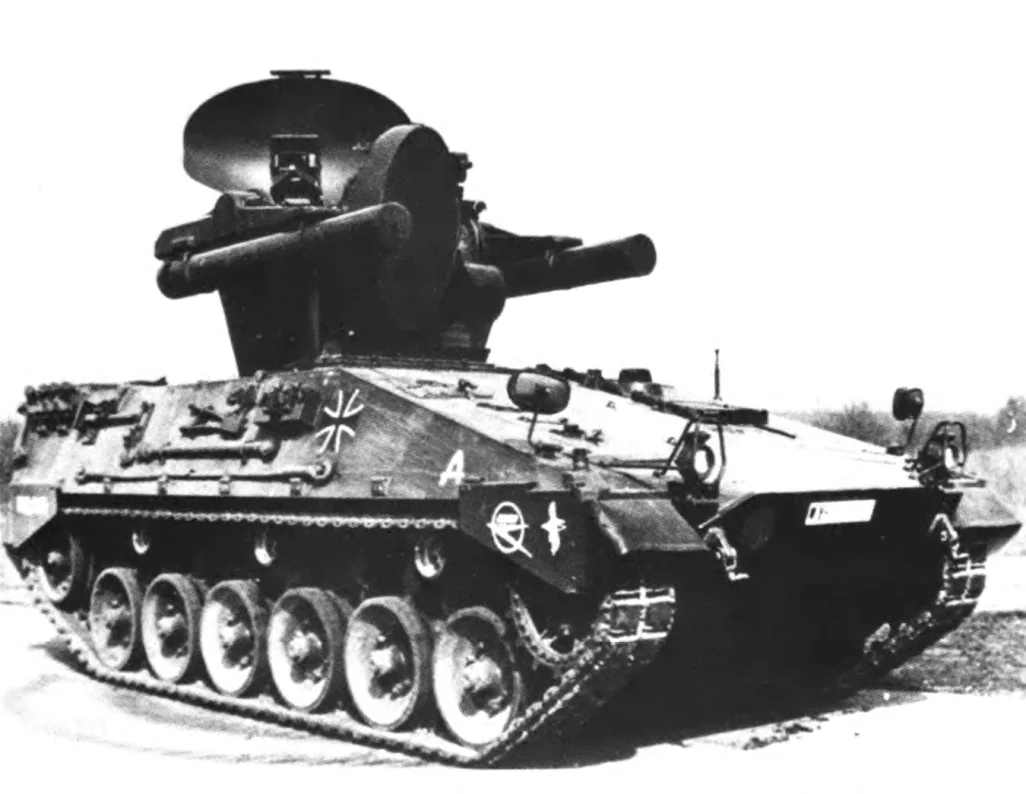
The German firing vehicle used a Marder-derived tracked carrier arranged around the Roland mission equipment. Two ready missile rails flanked the sensor installation, while magazines and electronics occupied much of the protected hull. This should be described as a specialized carrier, not as evidence that every production vehicle was converted by removing an infantry turret and troop seats from an issued Marder. The automotive relationship gave the program an established tracked base, but the internal functions were those of an air-defense vehicle: missile handling, radar operation, tracking and guidance. 1, 2, 3, 4
Weapons and engagement concept
Retained U.S. Army course material describes two missiles ready on the rails and eight more in automatic magazines, for a total of ten. The German all-weather Roland system used command-guided missiles, with missile and electronics changes during its life. Automatic reloading reduced the handling needed between engagements, but a ten-missile load was still finite. The quoted load should not be transferred automatically to every wheeled or export Roland installation, and a later missile capability does not prove that every early vehicle received the same upgrade. 1, 2, 3, 4
Sensors, fire control, and target information
The retained description of the German all-weather configuration combines search radar, tracking radar, optical tracking and missile command-guidance equipment. The later NDV work proposed digital electronics and links to the Army air-defense command network. These features belong to the modernization and trial configuration described in the dated account. They should not be read as evidence that all operational tracked Roland vehicles received a completed digital upgrade. 1, 2, 3, 4
Mobility, protection, and sustainment
Using the Marder chassis let Roland move with German mechanized formations and draw on an existing support base. The tracked vehicle was heavier and more expensive than a truck-mounted launcher, but it offered cross-country mobility and armor appropriate to the forward area. The choice illustrates the Bundeswehr assumption that a portion of its low-altitude air defense had to remain close to armored brigades rather than operate only from roads or fixed sites. 1, 2, 3, 4
Place in the air-defense system
Roland was intended to complement Gepard rather than replace it. Gepard provided radar-directed cannon fire in the close zone, while Roland missiles extended the short-range defense and could engage targets before they entered gun range. German command systems later sought to link Roland, Gepard, and other air-defense elements so target information and engagement responsibility could be coordinated across the formation instead of managed by isolated vehicle crews. 1, 2, 3, 4
Variants and modernization
The tracked fleet is usually associated with Roland 2 and later missile and electronics improvements. Germany tested an extended-service-life NDV configuration designated FRP 1A2, with new digital computers, built-in test equipment, improved missile control, and network connections. The 2003 EADS account expected modernization to extend service, though Germany ultimately retired the system rather than keeping the full tracked fleet through the originally discussed horizon. 1, 2, 3, 4
A later Ministry of Defence information response describes disposal, transfers and demilitarized equipment used to represent an air-defense threat in training. A retained training object was therefore not necessarily a serviceable Roland firing system. That distinction also applies to museum and exercise photographs taken after retirement: survival of a chassis or recognizable launcher equipment is not proof of an operational air-defense battery. The response concerns the subsequent disposition of equipment, not a new German reactivation or procurement program. 6
Service history and operators
Retained accounts give roughly 143 or 144 German Army tracked Roland systems, with deliveries in the early 1980s. Those totals are not reconciled here into an exact accepted-vehicle count. The tracked vehicles belonged to the Army’s mobile air-defense force; the Luftwaffe’s wheeled installations were a separate branch. The dated 2003 modernization account describes intended service extension and troop trials, not proof that the entire proposed NDV fleet was completed. Procurement, trials and later retirement must be kept as separate stages of the history. 1, 2, 3, 4
The Bundeswehr's retrospective on mobile army air defense places Roland's retirement in 2005, separately from Gepard's later withdrawal. This supplies a firm institutional endpoint for German Roland service without treating the two systems as one program. It also places a boundary around the earlier modernization story. Announcing a new equipment standard or demonstrating a trial vehicle did not guarantee that the serving fleet would be converted and retained. Roland's final years must therefore be described through the documented trials and the documented retirement, rather than an assumed completed upgrade between them. 5
Constraints and changing threat environment
Roland’s sensors and automatic magazines occupied a large specialized vehicle, and continued operation depended on both automotive support and support for the missile and electronic equipment. Like other line-of-sight short-range systems, it had a limited local engagement zone and could lose sight of low-flying targets behind terrain. External warning and coordination with gun vehicles therefore remained useful. These engineering and organizational demands should not be turned into a single asserted explanation for retirement without a procurement or disposal record establishing the decision. 1, 2, 3, 4
Historical place
The tracked Roland and Gepard occupied different weapon roles within mobile air defense. Their coexistence does not make either a universal substitute for the other. The NDV account documents an attempt to extend Roland’s usefulness through electronics and integration work, but it does not establish that electronics were the sole cause of retirement or that the entire fleet remained mechanically suitable for an extended service life. 1, 2, 3, 4
Sources and further reading
- GlobalSecurity / U.S. Army course , Marder Roland system description
- EADS release archived by GlobalSecurity , Roland NDV troop trials and German procurement history
- Bundeswehr , Marder chassis background
- GlobalSecurity , Roland specifications
- Bundeswehr, historical account of Gepard and the retirement of Roland
- German Ministry of Defence, April 2024 information response on former Roland equipment (indexed evidence only)
Visit an Armor Museum
Explore the worldwide museum directory to find armored vehicles, collections, and visitor-planning information.
Browse armor museums