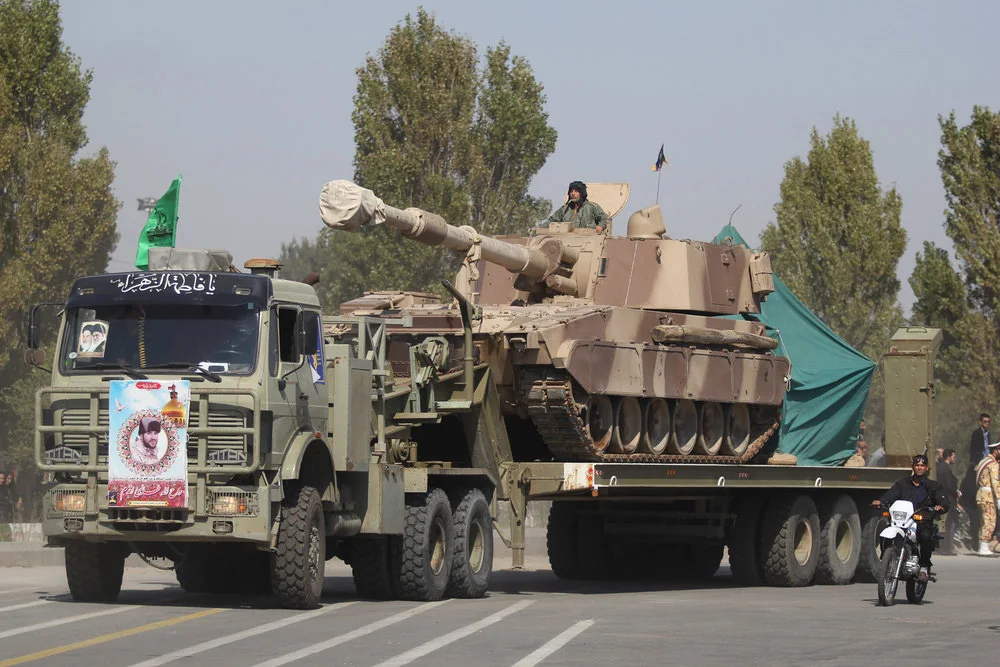
Development and design
Raad-2 appeared publicly in the late 1990s as an Iranian 155 mm tracked-howitzer program. Published reference accounts connect it with the Boragh tracked-vehicle family and describe a turret arrangement influenced by the M109. Those relationships identify design precedents, but do not demonstrate that a complete M109 turret or automotive system was copied unchanged. 1, 2, 3
Current U.S. Army ODIN material identifies Raad-2 as an Iranian 155 mm self-propelled howitzer and records public testing reporting from September 1997. ODIN also distinguishes the Raad-2M powerplant variant rather than treating its engine as universal across the family. 1
Vehicle configuration
The vehicle uses a conventional front-engine tracked hull with a large rear turret. ODIN associates the chassis with the Boragh APC family, while the turret arrangement strongly resembles the M109 concept that Iran had operated for decades. Visual similarity should not be confused with interchangeability: Raad-2 integrates Iranian structures, gun components, and automotive elements into its own production system. 1, 2, 3
ODIN's Boragh-family entry describes Raad-2 as a related conversion and notes the M109A1-like turret arrangement with Iran's HM44 155 mm weapon. That supports a relationship in layout and lineage, not a claim that Raad-2 is mechanically identical to an M109 or that every Boragh-family component is shared. 4
Gun and ballistic performance
Published equipment references identify an HM44-family 155 mm howitzer. Its installation distinguishes Raad-2 from the smaller-caliber Raad-1, despite the similar names. Public range figures are inconsistently documented, and a stated maximum without an ammunition type or test basis is insufficient to define the gun's performance. The available account supports the weapon class more firmly than a precise ballistic table. 1, 2, 3
Ammunition handling and sustained fire
Raad-2 is generally described with loading assistance rather than a completely uncrewed automatic turret. The distinction matters because mechanical handling does not remove the crew's ammunition preparation and replenishment work. Published descriptions do not provide a sufficiently consistent basis for an exact sustained rate, ready-round arrangement or universal crew figure across all reported configurations. 1, 2, 3
Fire control and artillery networking
Public sources provide fewer details about Raad-2’s fire-control suite than they do for modern NATO systems. The vehicle nevertheless represents a significant step beyond a towed gun because traverse, mobility, communications, and onboard laying equipment are integrated into one platform. Any later electronics improvements should be treated as variant-specific unless supported by better documentation rather than assumed from appearance alone. 1, 2, 3
Tracked mobility
The Boragh-related tracked chassis gives Raad-2 cross-country mobility and allows crew, gun, and ammunition to move together. ODIN describes a Raad-2M variant associated with a different, Ukrainian-origin 5TDF-series powerplant, showing that Iran has mixed domestic structures with available foreign automotive technology. Exact performance figures vary enough among sources that broad capability is more reliable than false precision. 1, 2, 3
Crew protection and survivability
The armored hull and turret provide the level of protection expected for self-propelled artillery: resistance to small arms and fragments rather than tank weapons. That protection is still a major improvement over exposed towed artillery during movement and nearby attack. The crew remains dependent on distance, concealment, and mobility because a large howitzer cannot survive modern precision or anti-armor weapons through passive armor alone. 1, 2, 3
Support vehicles and logistics
The howitzer requires ammunition, replacement gun components, automotive spares and maintenance equipment in addition to its tracked carrier. A locally manufactured hull does not establish the origin or availability of every engine, transmission or electronic component. Public descriptions of Raad-2 provide too little support evidence to quantify readiness or conclude that the whole vehicle can be sustained independently of foreign supplies. 1, 2, 3
Operational service
Iran has displayed Raad-2 in exercises and defense exhibitions, and Western equipment guides identify it as part of the national artillery family. These appearances document the vehicle but do not establish an exact fleet size, unit distribution or readiness level. The service record available in open descriptions is consequently less detailed than the published accounts of its layout and armament. 1, 2, 3
Variants and modernization
ODIN identifies Raad-2M as a variant associated with a different powerplant. Other fine distinctions are less consistently documented, and secondary sources sometimes disagree on crew size or automotive specifications. These contradictions may reflect prototypes, translation, or repeated unverified claims. Variant names are therefore included only where a source explicitly distinguishes them rather than combined into an artificial single specification. 1, 2, 3
Industrial context
The available U.S. Army ODIN index identifies Raad-2 as an Iranian-developed 155 mm self-propelled howitzer in Iranian Army service. That narrow identification does not establish how much of the vehicle was manufactured domestically, the origin of each major component, or a verified fleet total. Those questions remain distinct from recognizing the system’s national development identity. 1
Historical place
Raad-2 adds an Iranian 155 mm tracked-howitzer design to a service history that also includes imported artillery. Its historical identity rests on that weapon installation and the Boragh-related carrier, not an unverified claim about industrial independence or fleet size. The reported Raad-2M powerplant change also illustrates why variant information cannot safely be merged into one definitive specification. 1, 2, 3
Sources and further reading
- U.S. Army ODIN — Raad-2 Iranian 155 mm self-propelled howitzer
- GlobalSecurity — Thunder-2 / Raad-2
- GlobalSecurity — Thunder-2 specifications
- U.S. Army ODIN — Boragh family entry and Raad-2 relationship
Visit an Armor Museum
Explore the worldwide museum directory to find armored vehicles, collections, and visitor-planning information.
Browse armor museums