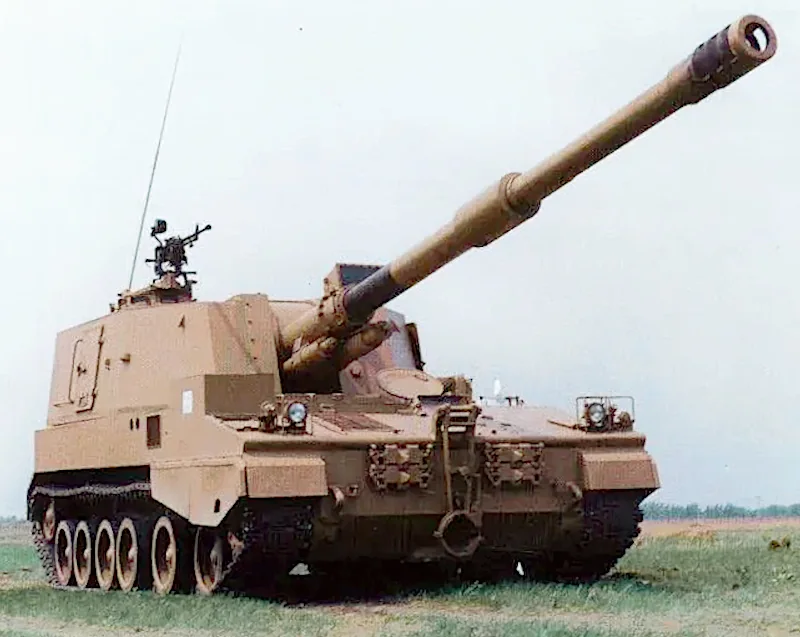
Development and design
The U.S. Army ODIN index identifies PLZ-45, also called Type 88, as a NORINCO 155 mm self-propelled howitzer developed during the 1990s for export. That description establishes the program’s reported market and period. It does not establish that competition caused a particular chassis, gun or support-package decision, nor does it make PLZ-45 an interchangeable designation for PLZ-83. 4
Vehicle configuration
A front-engine tracked chassis supports a large rear turret and a five-person crew. Weaponsystems.net describes a 525-horsepower diesel and conventional tracked running gear. The layout provides room for thirty rounds, semi-automatic handling equipment, sights, and communications while preserving full turret traverse and cross-country mobility expected of a modern mechanized artillery system. 1, 2, 3
Gun and ballistic performance
The PLZ-45 used a 155 mm gun with a 45-caliber barrel, giving Chinese industry a system oriented toward the international 155 mm market. Published range figures vary by projectile, so standard, extended-range and base-bleed ammunition should not be combined into one performance number. Sharing a nominal caliber with NATO equipment also does not establish universal ammunition interchangeability; the approved projectile and propelling-charge combination still matters. 1, 2, 3
Ammunition handling and sustained fire
Open sources describe about thirty rounds onboard, with twenty-four associated with the semi-automatic loading arrangement. A short-term rate around four to five rounds per minute and a lower sustained rate are commonly cited. The semi-automatic approach reduced crew burden without requiring the complexity of the fully automated turret architecture that would appear in later Chinese systems. 1, 2, 3
Fire control and artillery networking
ODIN describes integrated laying, navigation, and position-determination functions. Army Guide also presents the PLZ-45 as part of a package that included command, reconnaissance, radar, and support vehicles. This broader system was essential to export credibility because long-range guns require accurate target information, communications, and logistics just as much as they require ballistic performance. 1, 2, 3
Tracked mobility
The vehicle’s tracked chassis is commonly credited with a maximum road speed around 55 km/h and a road range around 450 km. These numbers are typical of heavy tracked artillery. The important characteristic was the ability to accompany mechanized formations tactically while carrying the crew, ammunition, and gun inside one protected platform capable of leaving a firing position quickly. 1, 2, 3
Crew protection and survivability
Steel armor protects the crew from small arms and fragments, not from tank cannon or modern anti-armor weapons. The design relies on distance and movement for survival. For export customers, the enclosed vehicle also offered improved crew endurance and protected internal electronics compared with exposed gun mounts, while retaining the maintenance demands of a tracked armored vehicle. 1, 2, 3
Support vehicles and logistics
PLZ-45 was marketed with support vehicles rather than as a lone howitzer. Army Guide describes command and ammunition-support elements that illustrate the system-level approach. Export customers needed training, spares, ammunition, barrel support, fire-control integration, and repair capacity for decades. The support package was therefore a major part of the weapon’s practical value and commercial competitiveness. 1, 2, 3
Service history
Kuwait and Saudi Arabia are prominent foreign users in published PLZ-45 histories. These export sales gave the program a different service identity from the primarily domestic PLZ-83. Public descriptions of wider service and customer configurations are less uniform, so no comprehensive current operator or delivery census is asserted. The relationship to later Chinese 155 mm development is an industrial lineage, not proof that the PLA fielded every export configuration unchanged. 1, 2, 3
Variants and modernization
The PLZ-45 was offered as part of a family of artillery and support vehicles rather than through a large number of clearly documented gun variants. Differences among export customers are more likely to involve communications, ammunition, and support arrangements than a wholly different core chassis. Later PLZ-05 development represented the more substantial technical break toward a 52-caliber and more automated system. 1, 2, 3
Industrial context
The program demonstrated that China could design, manufacture, and export a high-value tracked 155 mm artillery system with modern fire control and support vehicles. Foreign sales gave Chinese industry experience in customer training, long-term spares, international ammunition standards, and competitive trials. Those lessons helped move China from a supplier of simpler weapons toward a producer of complete modern land systems. 1, 2, 3
Historical place
PLZ-45 connected Chinese tracked-artillery development with export demand for a modern 155 mm system. Its gun, support vehicles and customer training requirements formed a broader program than the howitzer alone. It followed the domestic PLZ-83 generation but used a different caliber and configuration, while later PLZ-05 development introduced another distinct stage rather than merely renaming the export vehicle. 1, 2, 3
Sources and further reading
- U.S. Army ODIN — PLZ-45 / Type 88
- Weaponsystems.net — PLZ45
- Army Guide — PLZ-45
- U.S. Army ODIN: PLZ-45 / Type 88, indexed excerpt (indexed asset-page evidence only)
Visit an Armor Museum
Explore the worldwide museum directory to find armored vehicles, collections, and visitor-planning information.
Browse armor museums