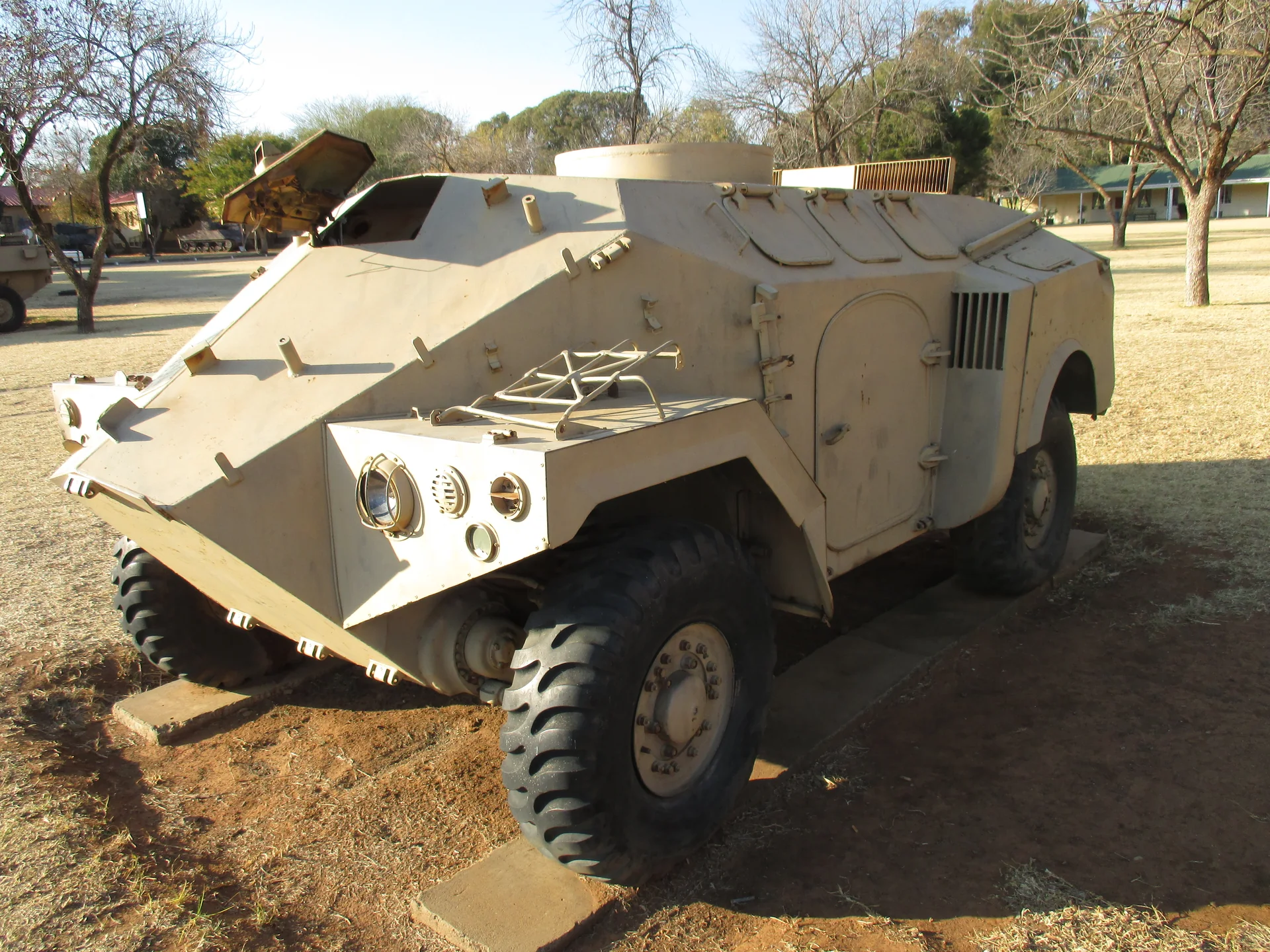
Development and requirement
Panhard explored an amphibious troop carrier related to the AML armored car and eventually produced the M3 for export even though the French Army did not adopt it as its standard APC. The vehicle entered production in the early 1970s and found customers that valued a small, relatively simple wheeled armored carrier. 1, 2
Panhard M3 developed the idea of an armored troop carrier using automotive commonality with the AML armored car. Common components did not produce identical vehicles: the M3 needed a taller enclosed volume and access suitable for passengers, rather than simply the AML’s reconnaissance weapons arrangement. Its export-carrier identity is also important. A design can find foreign customers without becoming its producing country’s standard APC. Describing the M3 as an adopted French fleet-wide troop carrier would therefore confuse a national origin with a domestic service decision. 1, 2
Design, protection, and mobility
The M3 used many automotive components related to the AML but placed them beneath a taller, box-like armored hull with side and rear doors for troops. The baseline vehicle carried light machine-gun armament, while alternate turrets and specialized mission equipment were offered. Its compact 4x4 arrangement favored road speed and logistical simplicity over the cross-country performance of larger 6x6 or 8x8 vehicles. 1, 2
The wheeled character of the Panhard M3 is central to how it was intended to be used. Wheeled armored vehicles generally trade some soft-ground and obstacle performance for road speed, range, reduced automotive complexity, and easier long-distance movement without heavy transporters. That trade is especially valuable to reconnaissance, security, and rapidly moving infantry formations, where arriving first, screening a broad frontage, or shifting quickly between sectors can matter as much as maximum armor thickness. Tires, driveline arrangement, suspension travel, and vehicle weight therefore become tactical questions rather than engineering trivia: damage that slows the vehicle can also reduce the unit's ability to observe, disengage, reinforce, or deliver troops on time. 1, 2
As a personnel carrier, the Panhard M3 is fundamentally organized around protected movement rather than tank-style direct combat. The troop space, embarkation route, seating, communications, and ability to load equipment are central to the vehicle's usefulness. The published configuration summarized here lists 2 crew + infantry section. Armor on an APC is intended to reduce vulnerability to common battlefield threats and allow soldiers to move through areas that would be far more dangerous in trucks, but the carrier still depends on tactics, terrain, supporting fires, and dismounting at the right point. A carrier that is treated as a tank simply because it is armored is likely to be exposed to threats its design never intended to absorb. 1, 2
Firepower and battlefield role
The M3’s light armament belongs to a troop-carrier mission, but the family was not tied to one universal turret. Alternate weapon installations and specialist equipment changed what an individual vehicle could do and how its interior could be used. Those configurations should be identified by the operator and variant rather than assigned to every M3. Shared AML automotive ancestry is no reason to import an AML gun installation into the baseline carrier’s specification. The passenger compartment, exits and fitted equipment are the relevant starting points. 1, 2
Service, variants, and modernization
M3s were exported to a number of African, Middle Eastern, and other users in troop-carrier and specialized versions. The family illustrates a different path from large national APC programs: a commercial export vehicle designed around proven components and adaptable weapon fits. 1, 2
M3 service needs to be followed through its export operators and their chosen configurations. A customer could employ the carrier for infantry movement or adopt a specialized version, and the two uses do not establish identical armament or seating. The retained research gives the broad export context but does not yet provide a source-backed country-by-country sequence. It also does not establish that every offered turret or conversion entered service. Procurement, demonstrations and operational employment should remain separate events until a dated record connects them. 1, 2
How the vehicle fits the formation
In a formation, the Panhard M3 is a mobility system for people as much as it is an armored vehicle. Its value is measured by whether troops arrive together, with their weapons and communications intact, at the place and time the commander needs them. The carrier can provide local fire support and protection during movement, but the dismounted soldiers remain the element that clears buildings, occupies complex terrain, searches positions, and performs tasks that a vehicle cannot. That relationship is why APC tactics revolve around the choice of when to remain mounted, when to dismount, and how closely the carrier should follow the infantry once the fight becomes close. 1, 2
Strengths, limitations, and family boundaries
The M3 is grouped as an APC even though it shares ancestry with the AML armored car. The AML remains a reconnaissance/armored-car family; chassis commonality does not make the M3 a scout car. 1
The M3 demonstrates how a manufacturer could turn automotive commonality into a different armored vehicle. The AML relationship concerns ancestry and support, while the troop-carrying hull defines the M3’s purpose. That distinction is more useful than ranking the two as competing versions of the same combat role. The M3’s small four-wheeled configuration also differed from the larger VAB and Piranha families. Comparisons should keep their passenger arrangements and intended work in view instead of treating every export APC as an equivalent armored box. 1, 2
Family names can also obscure important differences. A common hull or manufacturer does not mean every derivative belongs in the same operational category. Command posts, mortar carriers, antitank vehicles, recovery vehicles, reconnaissance versions, air-defense systems, and direct-fire variants may share engines and running gear while performing fundamentally different tasks. For that reason the Armor Archive keeps the Panhard M3 tied to its lineage but classifies individual branches by what they actually do on the battlefield. That approach preserves engineering relationships without turning one successful chassis into an all-purpose label that hides the history of the specialized vehicles built from it. 1, 2
Sources and further reading
References and further reading are listed below. Image identification, credit and reuse terms remain with each photograph.
Visit an Armor Museum
Explore the worldwide museum directory to find armored vehicles, collections, and visitor-planning information.
Browse armor museums