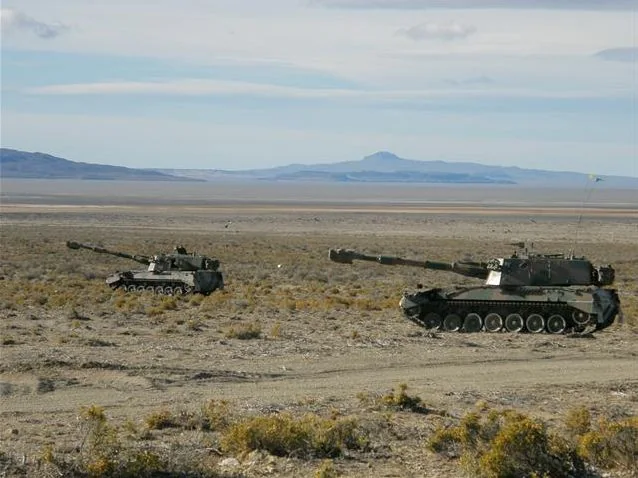
Development and design
Palmaria originated as an Italian private-venture artillery project rather than as the centerpiece of a large Italian Army procurement program. Weaponsystems.net and the general historical record place development from the late 1970s into the beginning of the 1980s and identify OTO Melara as the developer. Developing for export gave the project a different commercial logic from systems tied tightly to one national doctrine: it needed to offer a complete, competitive package to states seeking modern self-propelled artillery without requiring a wholly new industrial ecosystem. 1, 2
A conventional tracked hull with a large artillery turret
Palmaria adopted the familiar postwar arrangement of a tracked chassis carrying a fully rotating turret at the rear. Weaponsystems.net describes the vehicle as mechanically related to the OF-40 tank but adapted for the volume and weight requirements of artillery. The turret housed the 155 mm weapon, crew positions, and much of the ammunition-handling system. This gave Palmaria a more protected and self-contained fighting compartment than open-topped or truck-mounted artillery. 1
The 155 mm/41 artillery system
Published technical accounts describe Palmaria with a 155 mm, 41-caliber gun and mechanized projectile handling. The gun and ammunition arrangement belong to the late-Cold-War generation of enclosed artillery vehicles. An internal ready supply supported initial firing, while continued use depended on replenishment and the work of the detachment. Loading assistance reduced repetitive handling but did not turn Palmaria into a later-style uncrewed turret system. 1, 2
The cited secondary technical profile identifies a 155 mm, 41-caliber weapon with mechanized loading, thirty rounds carried and compatibility with NATO-pattern ammunition. Those details also reinforce the earlier correction of an inherited L39/L41 ambiguity: this archive uses the 41-caliber description for Palmaria while keeping ammunition-dependent range figures qualified. 1
Service history
Palmaria is unusual among notable European self-propelled howitzers because its identity is primarily tied to export users. Weaponsystems.net identifies Libya and Nigeria as principal operators. Italy’s own artillery modernization followed other paths, so the vehicle did not acquire the large domestic-service narrative associated with systems such as the French AuF1 or German PzH 2000. Its history instead illustrates how export demand can sustain a vehicle that never becomes a signature weapon of its country of origin. 1
Argentina's Ministry of Defense describes its VCA 155 Palmaria program as emerging from the TAM family during the 1980s, using a modified TAM chassis with the OTO Melara Palmaria artillery system. A separate official training report documents VCA Palmaria vehicles with Grupo de Artillería Blindado 11. These records support the turret/system relationship and continuing Argentine service without treating the Argentine chassis as identical to the Italian Palmaria vehicle. 3, 4
The Palmaria turret and Argentina’s VCA
The Palmaria story extends beyond complete Italian-built vehicles because the turret was adapted to Argentina’s VCA self-propelled artillery program. Weaponsystems.net describes the VCA as combining a Palmaria-derived turret with a chassis based on Argentina’s TAM armored-vehicle family. This created a hybrid national system: Argentine automotive commonality beneath an artillery turret derived from Italian work. 1
OF-40-derived automotive technology
Palmaria’s chassis belonged to the same broad export-oriented automotive lineage as the OF-40 tank. Weaponsystems.net describes a 750-horsepower-class engine and a vehicle weight in the mid-forty-ton range, figures consistent with the broader secondary record of the vehicle. That combination gave the artillery system the mobility expected of a tracked armored vehicle while carrying a large turret and ammunition supply. 1, 2
Mechanization inside an armored fighting compartment
Published descriptions distinguish the personnel carried in Palmaria from the wider gun detachment needed to sustain artillery operations. Exact crew totals can reflect that difference, so a single unqualified number is not used here. The enclosed fighting compartment protected its occupants from weather, small-arms fire and fragments. It did not turn an export artillery vehicle into a tank intended to exchange direct fire with enemy armor. 1, 2
Italy’s export-oriented armored vehicle business
Palmaria was part of a wider Italian effort to compete in the international armored-vehicle market. OTO Melara had long experience with artillery and turrets, while the OF-40 tank project provided an export-focused tracked chassis lineage. Combining those capabilities allowed the company to offer customers a family of heavy vehicles without depending on adoption by the Italian Army as the sole basis for production. 1, 2
Between first-generation postwar howitzers and 52-caliber systems
Palmaria was an export-oriented 155 mm system developed by OTO Melara around the OF-40 automotive family rather than an Italian Army standard howitzer. Weaponsystems.net describes it as a private-venture program developed from the late 1970s into the early 1980s. That context explains why the vehicle's history is tied to export customers and to turret applications such as the Argentine VCA rather than to a long Italian domestic service career. 1
Historical place
Palmaria's history is tied to export production rather than adoption as the Italian Army's principal self-propelled howitzer. Its turret also contributed to Argentina's VCA program on a different automotive base. Those two paths show how a gun-and-turret design can travel independently of the original complete vehicle, creating related systems whose chassis specifications must remain separate. 1, 2
Sources and further reading
References and further reading are listed below. Image identification, credit and reuse terms remain with each photograph.
- Weaponsystems.net, Palmaria (secondary source; not primary certification)
- Wikipedia — Palmaria (artillery)
- Argentina — Ministry of Defense, “Los Dragones vuelven a rugir”
- Argentina — operational training of the XI Mechanized Brigade
Visit an Armor Museum
Explore the worldwide museum directory to find armored vehicles, collections, and visitor-planning information.
Browse armor museums