Concept and development
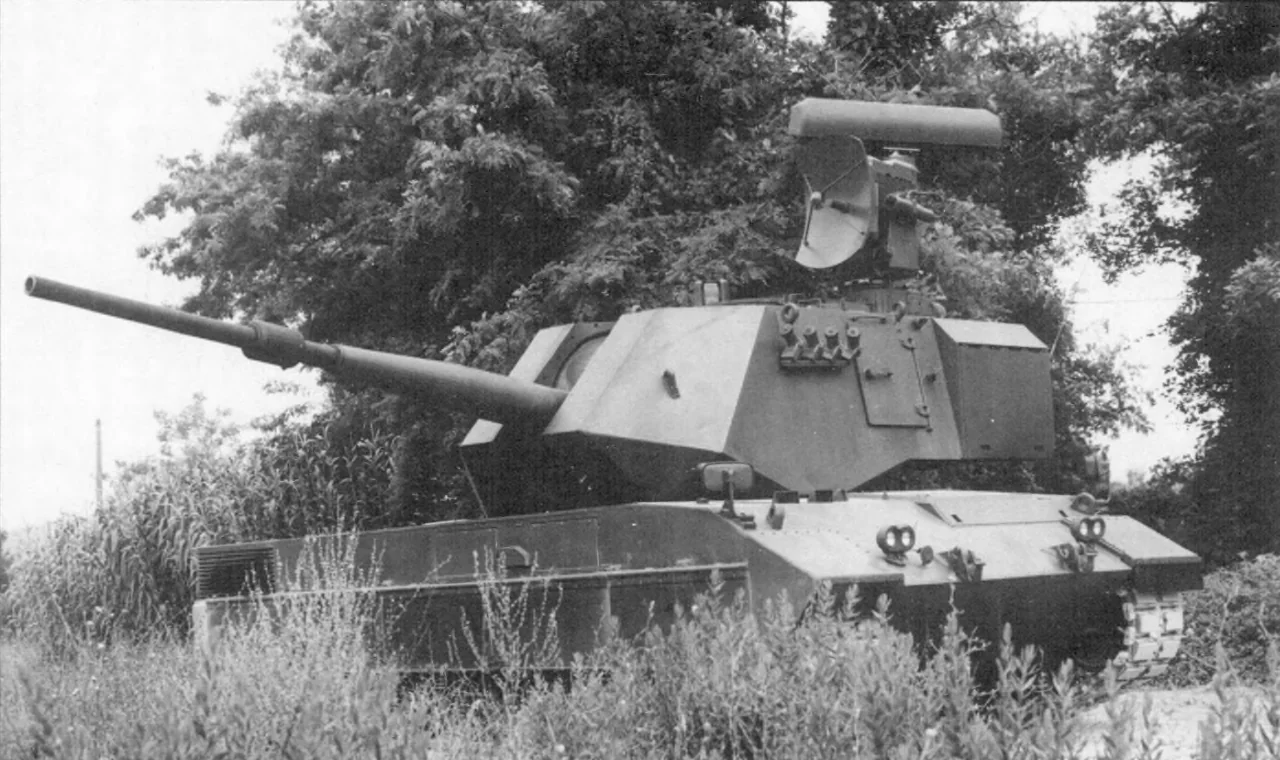
OTOMATIC grew from OTO Melara’s effort to apply the company’s successful rapid-fire 76 mm naval gun technology to land-based air defense. Tank Encyclopedia traces the concept to the late 1970s, with a Palmaria-based prototype appearing in the early 1980s and later work using a Leopard 1-derived chassis. The central idea was unusual for self-propelled anti-aircraft artillery: instead of many smaller projectiles at very short range, OTOMATIC would use a much larger 76 mm shell, high rate of fire, and radar-directed fire control to engage aircraft and helicopters farther from the protected formation. 1, 2
The project was largely an industrial development effort rather than the production of a vehicle already accepted for a settled Army requirement. It explored a heavy integrated turret but did not progress to a service fleet. SIDAM 25 was fielded in Italy during the same broad period, yet these outcomes alone do not establish a single head-to-head selection or certify every claim made for the prototype. The distinction between a demonstrator, a tested system and an accepted production vehicle remains essential. 1, 2
A contemporary U.S. Army ARMOR article from March–April 1989 described OTOmatic as a mobile armored air-defense system built around the 76/62 automatic gun, with search and tracking radars plus electro-optical backup. The period article is valuable because it documents how the concept was being presented during its test era rather than reconstructing the project only from later summaries. 3
Turret and chassis architecture
The OTOMATIC air-defense system was centered on a large turret containing the 76 mm gun, automatic ammunition handling, fire-control equipment, and crew stations. That turret demanded a tank-class carrier rather than a light armored-personnel-carrier chassis. Early integration used a Palmaria/OF-40 family base, while a later demonstrator used a Leopard 1-derived hull. The different chassis are a reminder that OTOMATIC was fundamentally a turret-and-system concept under development, not a standardized production vehicle with one final automotive configuration. 1, 2
WeaponSystems lists a Leopard-based example at roughly 47 tonnes with a crew of four. The mass was a direct consequence of the concept: a 76 mm automatic weapon generates greater recoil and requires larger ammunition than 20–35 mm anti-aircraft guns, while search radar, tracking radar, electronics, and automated loading add further weight and volume. The result had the mobility of a main-battle-tank class platform rather than the compact footprint of SIDAM. That gave the turret a stable firing base but raised fuel, transport, maintenance, and acquisition costs. 1
The 76 mm automatic gun
OTOMATIC’s 76 mm/L62 gun was its defining feature. WeaponSystems gives a maximum rate around 120 rounds per minute, extraordinarily high for a weapon of this caliber and consistent with the rapid-fire naval gun family from which the land concept drew. The larger projectile promised greater destructive effect per hit and a longer useful engagement reach than conventional SPAAG cannon. The turret carried a substantial ready supply in automated stowage, allowing multiple short engagements without the crew manually handling every round. 1
The naval origin explains the attraction of a large rapid-fire mechanism, but naval and land mountings are different systems. A ship’s magazine arrangement, sensors and later ammunition qualifications cannot be transferred automatically to a tracked prototype. OTOMATIC’s history concerns the gun, feed system and ready supply actually installed in its land turret. The continuing development of naval 76 mm equipment provides context for the technology, not retrospective proof of the prototype’s performance. 2
Radar and fire-control integration
The prototype combined search and tracking radars with the gun turret so the vehicle could perform its own target acquisition and engagement calculations. This was central to the claim that OTOMATIC could operate at ranges where visual-only aiming would be insufficient. A dedicated surveillance set searched for potential targets, while tracking sensors supported the precise fire-control solution required for a relatively small number of large-caliber projectiles to intercept a fast aircraft. Electro-optical equipment provided an additional channel and helped reduce total dependence on active radar. 1, 2
Combining the sensors and weapon on one carrier was intended to reduce dependence on separately positioned directors, but it also concentrated maintenance requirements. Radar equipment, processors, powered gun control, ammunition handling and the automotive system all had to function together. Sensor installation did not eliminate terrain masking or the need for warning and identification. The prototypes show the scale of the integration task; they do not establish sustained field reliability or an independently demonstrated advantage over a distributed air-defense arrangement. 1, 2
Mobility, protection, and logistics
Using tank-derived chassis gave OTOMATIC cross-country mobility compatible with armored forces and enough payload for the heavy turret. The Leopard 1-based demonstrator in particular offered a mature automotive system with good tactical mobility for its era. Protection, however, was never the sole design objective. The platform needed to survive fragments and battlefield hazards while moving with the supported force, but its larger concern was keeping a complex radar and ammunition system functioning. A disabled sensor or autoloader could neutralize the vehicle’s primary mission even if the hull remained mobile. 1, 2
Logistics were a more serious obstacle than a photograph of the prototype suggests. Seventy-six-millimetre ammunition is bulky compared with 20–35 mm rounds, and a rapid-fire weapon can consume it quickly during repeated engagements. A tank-class chassis also carries the fuel and maintenance demands of heavy tracked mobility. For an army choosing among air-defense investments, OTOMATIC therefore represented not just the price of an advanced turret but an enduring requirement for ammunition supply, radar technicians, automotive spares, transport capacity, and specialized training. 1, 2
Trials and procurement outcome
OTOMATIC did not become an operational fleet. Retained accounts describe prototype construction and testing but no series service program. Cost and the support demands of the concept feature in secondary explanations of the outcome; they are not treated as a complete official decision record. The vehicle should therefore be recorded as a prototype development rather than credited with the reliability, effectiveness or deployment experience of a system accepted by troops. 1, 2
The lack of a service fleet places limits on comparison. A prototype can demonstrate particular mechanisms or trial events without establishing sustained field availability, wartime ammunition demand or performance under electronic attack. No such operational record is assigned here. Equally, the absence of service does not erase the hardware that was built: the historical task is to describe the prototype installations and their documented tests without upgrading design intent into demonstrated capability. 1, 2
The same period account describes OTOmatic as a system intended for defense of maneuvering troops and rear-area targets against aircraft and air-launched weapons, with a secondary ability to engage light armor. It supports the design intent and test-era configuration; it does not establish an operational procurement decision, a combat record, or a particular political reason why no series fleet followed. 3
Prototype configurations and later echoes
Two prototype configurations are most often discussed: an earlier installation on a Palmaria/OF-40 related chassis and a later Leopard 1-based demonstrator. The change shows that the turret concept was being evaluated independently of one hull and that OTO Melara was seeking a carrier suitable for export or national adoption. It also explains why published dimensions, weights, and automotive details can differ. A single specification table that mixes figures from both demonstrators risks creating a vehicle that never existed in exactly that form. 1, 2
The program did not produce a direct production successor, but the idea of large-caliber, programmable, radar-directed guns for air defense has periodically reappeared as unmanned aircraft and precision weapons increase demand for lower-cost interceptors. That modern interest should not be projected backward as proof that OTOMATIC was merely “ahead of its time.” Technology, sensors, ammunition, networking, and threat density have all changed. The legitimate historical point is narrower: the prototype explored an engagement regime between classic SPAAG cannon and missile systems by using an unusually large automatic gun. 1, 2
Why the concept was difficult
The 76 mm concept created substantial packaging demands. A large gun, ammunition, recoil mechanism and automatic feed required a large turret; radar and fire control added electrical and maintenance requirements; and a heavy carrier added its own transport and support needs. These are visible engineering tradeoffs, not a complete explanation of the procurement outcome. Without a fielded fleet or the full decision record, neither the projected capability nor the apparent expense should be treated as a measured operational comparison with other systems. 1, 2
Ammunition economics also cut both ways. A large shell can carry more explosive and potentially require fewer hits, but each round occupies more vehicle volume and costs more to move and replenish. Against aircraft the fire-control problem remains demanding, especially when target maneuvers, clutter, and electronic countermeasures are considered. The system’s prototype status means those operational trade-offs were never fully resolved through years of unit service. OTOMATIC therefore illustrates the difference between demonstrating a credible engineering solution and producing a sustainable military capability. 1, 2
Historical place
OTOMATIC occupies a distinctive place in armored air-defense history because it pushed the self-propelled anti-aircraft gun toward a caliber normally associated with naval mounts and field artillery. By integrating high-rate 76 mm fire, radar search, radar tracking, and automated ammunition handling on a tracked carrier, OTO Melara demonstrated that a land vehicle could attempt engagements beyond the envelope of conventional gun-based SPAAGs. The prototype is consequently valuable as evidence of what 1980s Italian industry could integrate, even though the Army chose not to buy it. 1, 2
OTOMATIC remained a development project rather than the basis of an operational gun regiment. Its historical interest lies in the attempt to combine a large automatic cannon, radar equipment and armored mobility on a land vehicle. The retained accounts do not establish a documented head-to-head procurement decision in which SIDAM defeated OTOMATIC, nor do they justify assigning one decisive reason for non-adoption. Its prototype history and the service history of SIDAM should remain separate until contemporary evaluation and procurement records connect them. 1, 2
Sources and further reading
- WeaponSystems.net , OTOMATIC
- Tank Encyclopedia , OTOMATIC
- U.S. Army ARMOR, March–April 1989 — “Adapting the 76-mm Navy Deck Gun to the Main Battle Tank Chassis”
Visit an Armor Museum
Explore the worldwide museum directory to find armored vehicles, collections, and visitor-planning information.
Browse armor museums