Requirement and development
By 1943-44 German armored formations increasingly needed anti-aircraft weapons that could remain close to tanks while reacting faster than towed guns. Möbelwagen offered a 37 mm weapon but required its armored sides to be lowered, while Wirbelwind solved reaction time with a rotating turret but retained the shorter-ranged 20 mm caliber. 1, 2
Ostwind was developed at Ostbau Sagan in 1944 under the same broad effort that produced Wirbelwind. A prototype using a refurbished Panzer IV chassis was completed in the summer, tested with the other Flakpanzer designs, and helped prompt an August 1944 order for a much larger production run than German industry ultimately delivered. 1, 2
Panzer IV conversion and turret layout
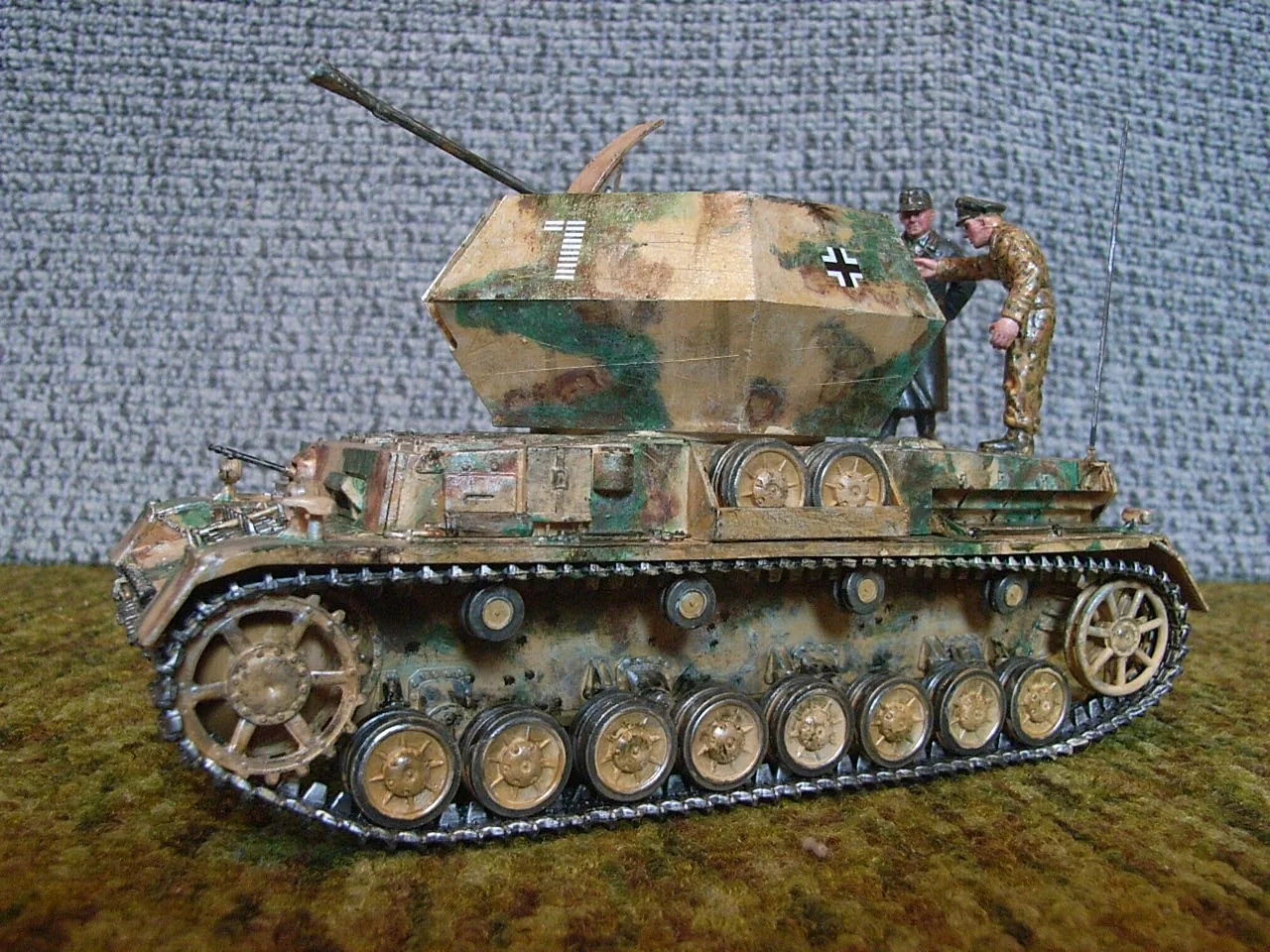
The vehicle retained the Panzer IV automotive base and much of the hull arrangement, replacing the tank turret with a tall six-sided anti-aircraft turret. The new turret was open at the top to preserve observation, gun elevation, ventilation, and working space around the 37 mm weapon. 1, 2
The conversion illustrates why existing tank hulls were attractive in 1944: they provided tracks, armor, radios, and a proven drivetrain without waiting for a clean-sheet chassis. At the same time, fitting a high-angle weapon and several crewmen into the existing turret-ring area imposed tight working conditions and limited ammunition stowage. 1, 2
The 3.7 cm Flak 43
Ostwind’s principal change from Wirbelwind was the 3.7 cm Flak 43. The larger projectile offered greater destructive effect and useful reach than 20 mm fire, which mattered as Allied fighter-bombers became faster, tougher targets and attack windows became brief. 1, 2
The Flak 43 used clips rather than a continuous belt, so sustained fire depended on loaders maintaining a supply to the gun. Its rate of fire was lower than the four-gun Wirbelwind mount, but each hit carried substantially more effect; the design therefore represented a deliberate exchange of volume for caliber and engagement reach. 1, 2
Observation and fire control
Ostwind remained an optically aimed gun system. The open turret improved all-around visibility and allowed the crew to search the sky directly, but there was no radar or centralized electronic fire-control system on the vehicle. Effectiveness therefore depended heavily on warning, crew drill, visibility, and rapid target estimation. 1, 2
That arrangement suited the technology and production conditions of late-war Germany but imposed severe limits against fast, fleeting targets. A self-propelled mounting solved the problem of getting the weapon to the right place; it did not solve the separate problem of detecting an aircraft early and calculating a high-quality firing solution. 1, 2
Protection and crew exposure
The Panzer IV hull provided protection and mobility superior to many truck-mounted antiaircraft weapons. The turret’s sloped plates shielded the crew from small-arms fire and fragments from the sides, yet the roof had to remain open for the anti-aircraft mission and the crew was still exposed from above. 1, 2
This compromise was common among wartime self-propelled anti-aircraft guns. Full overhead armor made observation, ventilation, loading, and high-angle movement more difficult, while an entirely unprotected mount was vulnerable near the front. Ostwind chose partial armored enclosure rather than complete protection. 1, 2
Mobility and logistical commonality
Using the Panzer IV chassis allowed Ostwind to move cross-country with armored units and to draw on a maintenance system already supporting large numbers of related vehicles. Its road speed and range were broadly those of the late Panzer IV family rather than those of a purpose-built light anti-aircraft carrier. 1, 2
Commonality was especially important in 1944-45, when Germany faced fuel shortages, bombing, transport disruption, and an expanding variety of armored types. Even so, a specialized Flakpanzer still consumed engines, tracks, transmissions, and repair capacity that were also urgently required by tanks and assault guns. 1, 2
Production and accounting limits
Plans called for far more Ostwinds than were actually completed. Bombing, evacuation of factories, material shortages, competing Panzer IV demands, and the rapid military collapse of early 1945 repeatedly disrupted schedules and shifted assembly between organizations. 1, 2
Modern reconstructions commonly place completed production in the low forties, but contemporary documentation is fragmentary enough that totals differ. The important operational point is scale: Ostwind appeared in numbers too small to provide comprehensive protection to German armored formations, regardless of the exact total chosen. 1, 2
Contemporary U.S. intelligence in March 1945 identified 37 mm Flak 43 guns on Panzer IV chassis. The handbook does not establish how many of those vehicles were Ostwinds, as distinct from other installations. A generic recognition entry cannot resolve the later production-accounting dispute. 4
Operational service
Secondary histories report prototype use during 1944 and limited deliveries of production Ostwinds in the final months of the war. Those are different categories of evidence. A reported prototype appearance does not establish that a planned production order was completed, and an order total cannot be substituted for the number of finished vehicles delivered to units. 1, 2
A vehicle such as Ostwind could make a local air attack more dangerous, but it could not compensate for Germany’s broader loss of air superiority. Its effect was tactical: increasing the chance that a formation had an immediately ready gun nearby and forcing attacking aircraft to respect defended approach routes. 1, 2
Limits of the design
Ostwind’s larger gun improved reach and destructive power compared with Wirbelwind, but the single barrel delivered less projectile volume and still relied on manual optical engagement. The open turret exposed the crew, and the Panzer IV chassis imposed finite space for men, ammunition, and traverse mechanisms. 1, 2
The larger problem was timing. A useful design arrived when German production and logistics could no longer equip units in depth. Even a technically sound Flakpanzer could not be decisive when only small numbers reached formations facing overwhelming Allied air power and rapidly shrinking industrial resources. 1, 2
Historical place
The March 1945 U.S. handbook includes a 37 mm Flak 43 on a Panzer IV but does not identify it as Ostwind. That entry supplies contemporary recognition of the broad weapon-and-chassis combination, not evidence of Ostwind acceptance, deliveries or combat service. 4
Ostwind combined the rotating-turret arrangement with a single 37 mm automatic gun. Its history is constrained by incomplete production and delivery records, so completed vehicles, prototypes and orders must remain separate. The design is a distinct part of the Panzer IV anti-aircraft family, without requiring a claim that it became a widely available replacement for earlier vehicles. 1, 2
Sources and further reading
- Tank Encyclopedia — Flakpanzer IV (3.7 cm Flak 43) Ostwind
- Tank Encyclopedia — Panzer IV family
- The Tank Museum Shop — Panzer Tracts No. 12-1 Flakpanzer IV description
- U.S. War Department: TM-E 30-451, March 1945, VII/V/5, transcribed text
Visit an Armor Museum
Explore the worldwide museum directory to find armored vehicles, collections, and visitor-planning information.
Browse armor museums