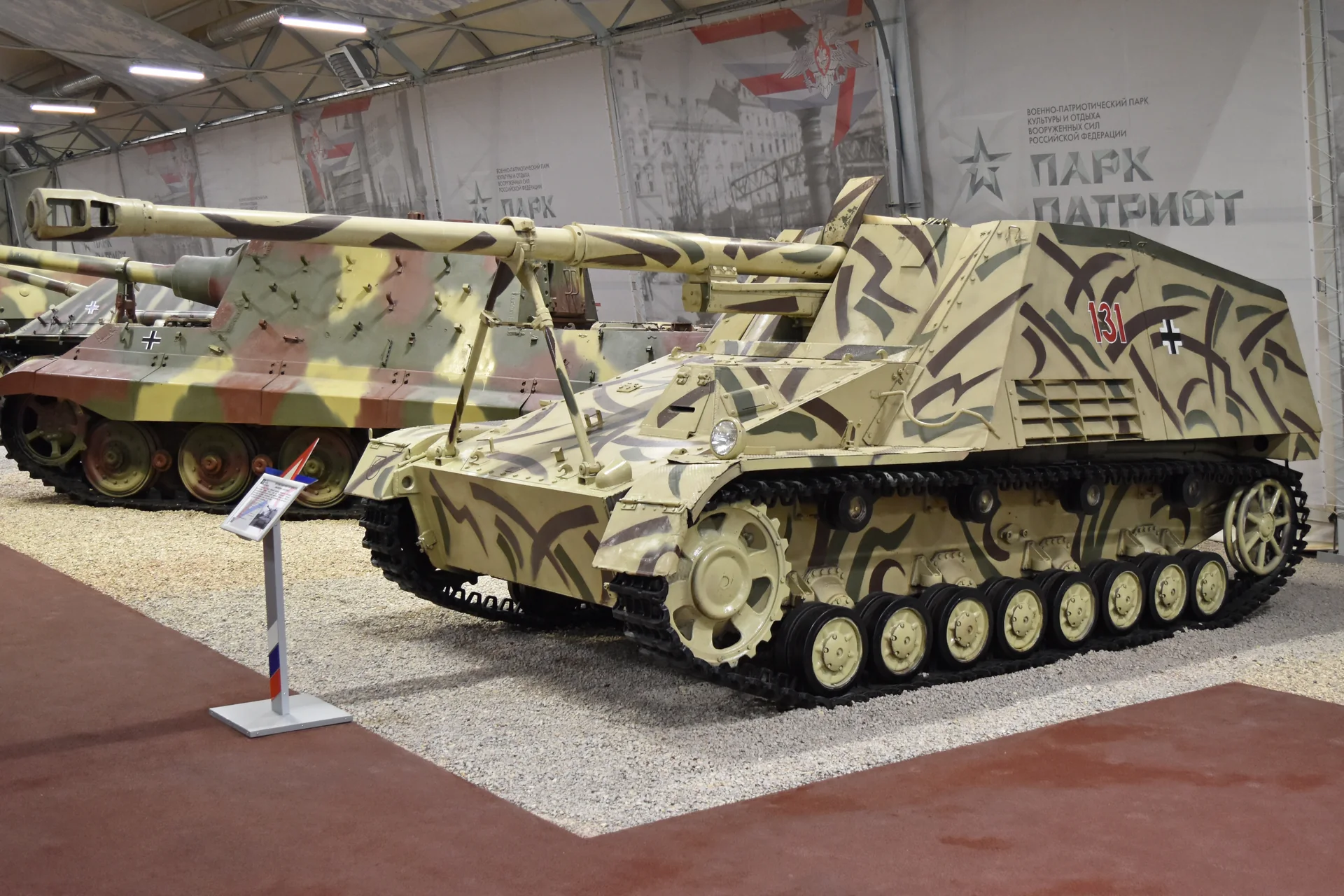
Requirement and development
The Nashorn grew from the urgent need to make the new long 8.8 cm PaK 43 mobile before a more sophisticated protected chassis was available. Alkett developed a Geschützwagen using components from both Panzer III and Panzer IV production, creating a long hull with the engine moved forward and a rear fighting compartment. The design was deliberately expedient: it accepted a high silhouette and minimal armour in order to carry a gun that existing German medium tanks could not yet mount. Early vehicles were known as Hornisse; the Nashorn name was introduced later without representing a fundamental mechanical redesign. Production began in 1943 and continued in modest numbers into the final war years. 1, 2
The March 1945 U.S. handbook identifies the Nashorn by both its newer and earlier names and describes the III/IV hybrid chassis carrying the 8.8 cm PaK 43/1. This wartime identification is distinct from the history of a particular restored vehicle or a modern demonstration appearance. 3
Layout and engineering
Nashorn mounted the 8.8 cm Pak 43/1 in a high, open fighting compartment on the Geschützwagen III/IV chassis. The engine lay centrally, leaving the gun crew's working space toward the rear. The U.S. 1945 handbook describes five crewmen and thin superstructure protection. The size of the weapon therefore should not be mistaken for the protection of a heavy tank: the vehicle carried a heavy antitank gun on a much lighter, openly protected platform. 3
Armament and direct-fire role
The 8.8 cm PaK 43/1 L/71 was the reason the Nashorn existed. The weapon gave German units a mobile antitank gun capable of engaging heavily protected Allied vehicles well beyond the range at which many earlier German tank guns were comfortable. Its high-explosive ammunition also provided useful direct-fire support. The gun had only limited traverse and the vehicle carried a finite ammunition supply in the rear compartment, so crew efficiency and vehicle orientation mattered. Rather than attempt to balance the gun with heavy armour, designers accepted a lightly protected carrier. The result was a platform whose offensive power was disproportionate to its defensive protection and whose effectiveness depended heavily on how it was employed. 1, 2
Protection and survivability
Nashorn protection was intentionally light. The lower hull provided basic armored protection, while the tall superstructure was thin and open at the top and rear. This saved weight and allowed the chassis to carry the PaK 43, but it meant the crew could not trade fire safely with tanks, artillery, or infantry at close range. Even small-caliber weapons and fragments could become dangerous from the side or above. The design therefore relied on distance, concealment, and the gun’s reach rather than armour. This approach made sense as an interim solution but also explains why later German Jagdpanzer development moved toward lower, enclosed casemate vehicles such as the Jagdpanther. 1, 2
Mobility, reliability, and logistics
The Panzer III/IV composite chassis was created specifically to carry large self-propelled weapons and provided workable mobility for a vehicle of roughly twenty-four tonnes. It was mechanically less overburdened than the Ferdinand or Jagdtiger and could be supported with many components already familiar from German medium-tank families. The high silhouette and long hull, however, made concealment and movement in close terrain more awkward. Cross-country mobility and recovery remained important because the vehicle’s thin armour offered little protection if it became trapped or immobilized. The Nashorn’s operational concept therefore depended on maintaining enough mobility to exploit the long gun without being forced into the sort of close engagement for which it was poorly protected. 1, 2
Variants, production, and naming
The principal naming change was from Hornisse, or “Hornet,” to Nashorn, or “Rhinoceros.” The change occurred during production and should not be mistaken for a new vehicle generation. Detail modifications appeared over time, as with most wartime German vehicles, but the basic chassis, open superstructure, and 8.8 cm gun remained consistent. The same Geschützwagen III/IV chassis family also supported the Hummel self-propelled howitzer, illustrating how Germany used a common automotive base for two very different artillery and antitank roles. Surviving Nashorns are extremely rare, and restored examples may contain replacement mechanical components that should not be treated as original wartime specification. 1, 2
Operational service
The Nashorn’s open-topped fighting compartment and long 8.8 cm gun produced a vehicle whose strengths and weaknesses were tightly linked. A contemporary U.S. intelligence handbook classified it as a tank destroyer and described the weapon and lightly protected open fighting compartment, while the Tank Museum’s current restoration account shows how few examples survive. The surviving ‘Phoenix’ vehicle is evidence for preservation history, not proof that every wartime Nashorn shared every detail now visible on that restored chassis. 2, 3
The Tank Museum’s 2026 account concerns restoration and public operation of one surviving Nashorn, including its modern recovery from a destructive fire. It is valuable for provenance and survival, not for assigning wartime production details to every vehicle. Wartime technical claims in this profile therefore remain anchored separately to the U.S. handbook and the secondary vehicle history rather than being inferred from the restored example alone. 2, 3
Limitations and tradeoffs
The Nashorn’s tall silhouette and thin open superstructure were serious disadvantages. Crews were vulnerable to artillery fragments, infantry weapons, air attack, and any tank or antitank gun that could return fire. The fixed mount offered limited traverse, requiring hull movement for large changes in direction, and the vehicle was not suitable for absorbing punishment in close support. Its strengths were concentrated almost entirely in gun performance and adequate mobility. This imbalance made tactical discipline essential. The design worked best when it could use range and concealment, but wartime conditions did not always provide that luxury, which is why Germany pursued lower and better protected Jagdpanzer designs. 1, 2
Assessment and related development
Nashorn placed a long 88 mm gun on a mobile but lightly shielded platform. Its tall open compartment was a different solution from an enclosed Jagdpanzer. The combination explains both its antitank potential and the need to distinguish weapon performance from crew protection. A powerful gun did not make its carriage a heavily armored vehicle. 1, 2, 3
Sources and further reading
References and further reading are listed below. Image identification, credit and reuse terms remain with each photograph.
- Tank Encyclopedia — Nashorn (Sd.Kfz.164)
- The Tank Museum — Nashorn Appearing at Tiger Day
- U.S. War Department, TM-E 30-451 (March 1945), VII.V.4(a): Nashorn — transcription hosted by Lone Sentry
Visit an Armor Museum
Explore the worldwide museum directory to find armored vehicles, collections, and visitor-planning information.
Browse armor museums