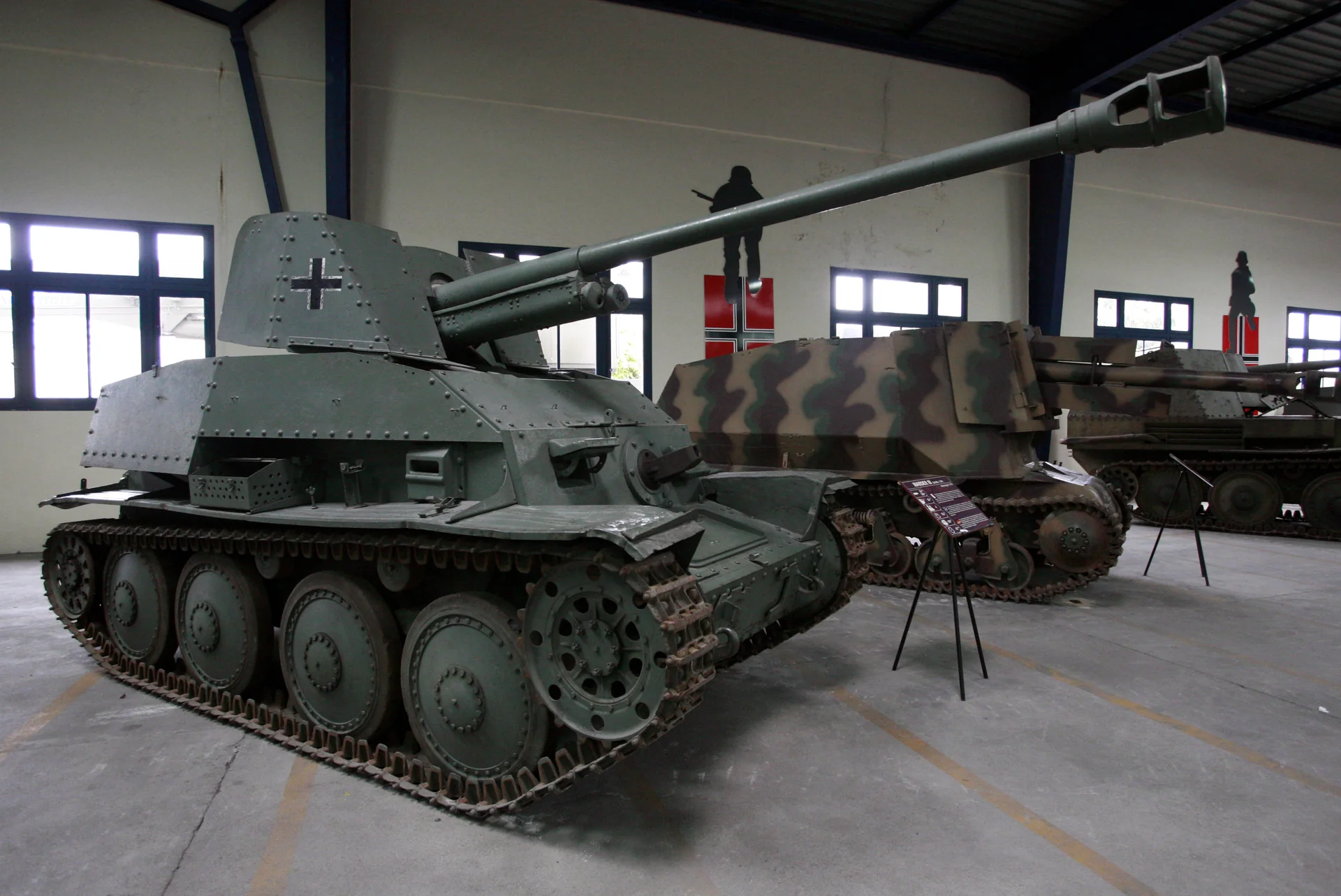
Requirement and development
The 38(t) chassis offered Germany an existing production base for a stronger antitank weapon than its original light-tank armament. Development used a converted captured Soviet gun before the German PaK 40 became the principal weapon. This was adaptation under pressure, not the clean-sheet design of a new tank. 1
The industrial attraction is straightforward: a useful hull and an effective gun can have longer lives than the original vehicle that joined them. Combining them reduces the number of major components that must be developed simultaneously. It does not, however, remove the integration work or make the finished machine equivalent to a purpose-built armored fighting vehicle. 1, 2
Layout and engineering
The Marder III family used Czech Panzer 38(t)-related automotive components, but its fighting-compartment arrangements changed substantially. A wartime U.S. Ordnance description of an early 75 mm installation records removal of the original tank turret and upper plates, a new gun shield open above and behind, and a Praga gasoline engine. That description is useful for the examined rear-engined configuration; it should not be transferred unchanged to the later Ausf. M, whose engine and gun compartment were rearranged. 2, 3
Armament and direct-fire role
The captured 76.2 mm installation and the German 75 mm PaK 40 were distinct weapons with distinct ammunition arrangements. The wartime American ordnance description of the PaK 40 carrier identifies a restricted-traverse antitank gun mounted on the Czech chassis, rather than a turreted tank weapon. 1, 2
A 1945 U.S. Office of the Chief of Ordnance description of the Sd.Kfz.138 records the 7.5 cm PaK 40/3 on the Czech Panzer 38(t) chassis. It describes the gun shield as only 10–15 mm thick and open at the top and rear, with protection little better than a field piece. The same account gives a probable crew of four and notes that the conversion retained road performance broadly comparable to the parent chassis. Because it is wartime Allied technical intelligence, its measurements are valuable but should still be distinguished from German factory acceptance records. 2
The same U.S. ordnance account gives the gun approximately 65 degrees of total traverse and records a Praga six-cylinder gasoline engine. Those observations help define the Sd.Kfz.138 configuration without collapsing the earlier captured-Soviet-gun Marder III and later PaK 40 variants into one specification. The source’s wording ‘probably 4’ for crew size is retained as uncertainty rather than silently converted into an exact factory value. 2
Protection and survivability
The American examination describes the Sd.Kfz. 138 gun shielding as thin and open above and behind. It offered a measure of protection against fragments and small-arms fire, but did not enclose the crew like a tank turret or a fully armored casemate. 2
The distinction is fundamental to the vehicle’s classification. A powerful gun does not imply protection suitable for the same situations as a heavily armored assault vehicle. Exposure, visibility, and workspace were connected compromises, not separate specifications that can be ranked without considering how the crew occupied the fighting compartment. 1, 2
Mobility, reliability, and logistics
The 38(t) automotive foundation was useful, but its reputation should not become a blanket claim of trouble-free service. Archival research records transmission and suspension complaints, while North African operation exposed particular engine difficulties. Reliability depended on conditions, maintenance, and the stresses of the gun-carrier conversion. 1
The captured-gun and PaK 40 versions also illustrate two different kinds of commonality. A shared chassis could simplify some vehicle support while different weapons complicated ammunition and gun maintenance. An army could gain mobility immediately and still inherit a mixed support burden behind the front. 1, 2
Variants, production, and naming
Sd.Kfz. 139 identifies the captured-gun branch; Sd.Kfz. 138 identifies the PaK 40 branch discussed here. Ausf. H and Ausf. M are not interchangeable layout descriptions. Nor should the later enclosed Jagdpanzer 38 be treated as another Marder III mark merely because the designs belong to the broader Czech industrial lineage. 1
A family-level total without an explanation of its categories is less useful than correctly identifying which vehicle a document, photograph, or unit return actually describes. 1, 2
Operational service
Marder III vehicles entered wartime service as mobile antitank equipment. Early captured-gun examples served in North Africa as well as on the Eastern Front; the broader family continued to appear as later versions became available. Service descriptions should identify the variant wherever the evidence permits. 1
The contemporary American description is valuable evidence of how an opposing army understood the captured vehicle. It is not a complete German employment history. Neither an intelligence entry nor a single unit account should be made to represent every theater, year, or production version. 1, 2
Limitations and tradeoffs
The design joined three constraints: a light-tank-derived chassis, a relatively large antitank gun, and an exposed crew compartment. Rearranging those elements could improve the package without eliminating its basic compromises. Marder III should therefore be assessed as a gun carrier that made an important weapon mobile, not as a failed attempt to provide every capability of a medium tank. 1, 2
Assessment and related development
The Marder III line demonstrates how extensively one automotive family could be rearranged. An early vehicle with its engine at the rear and a later Ausf. M did not give the gun crew the same working space. The Czech chassis ancestry is common, but it cannot substitute for identifying the exact weapon and layout. 1, 2, 3
Sources and further reading
References and further reading are listed below. Image identification, credit and reuse terms remain with each photograph.
- Tank Archives — Marder III: German Tank Destroyer on a Czech Chassis
- U.S. Office of the Chief of Ordnance — Sd.Kfz. 138 on Czech chassis
- U.S. War Department, TM-E 30-451 VII.V.6: self-propelled artillery list (March 1945), transcription
Visit an Armor Museum
Explore the worldwide museum directory to find armored vehicles, collections, and visitor-planning information.
Browse armor museums