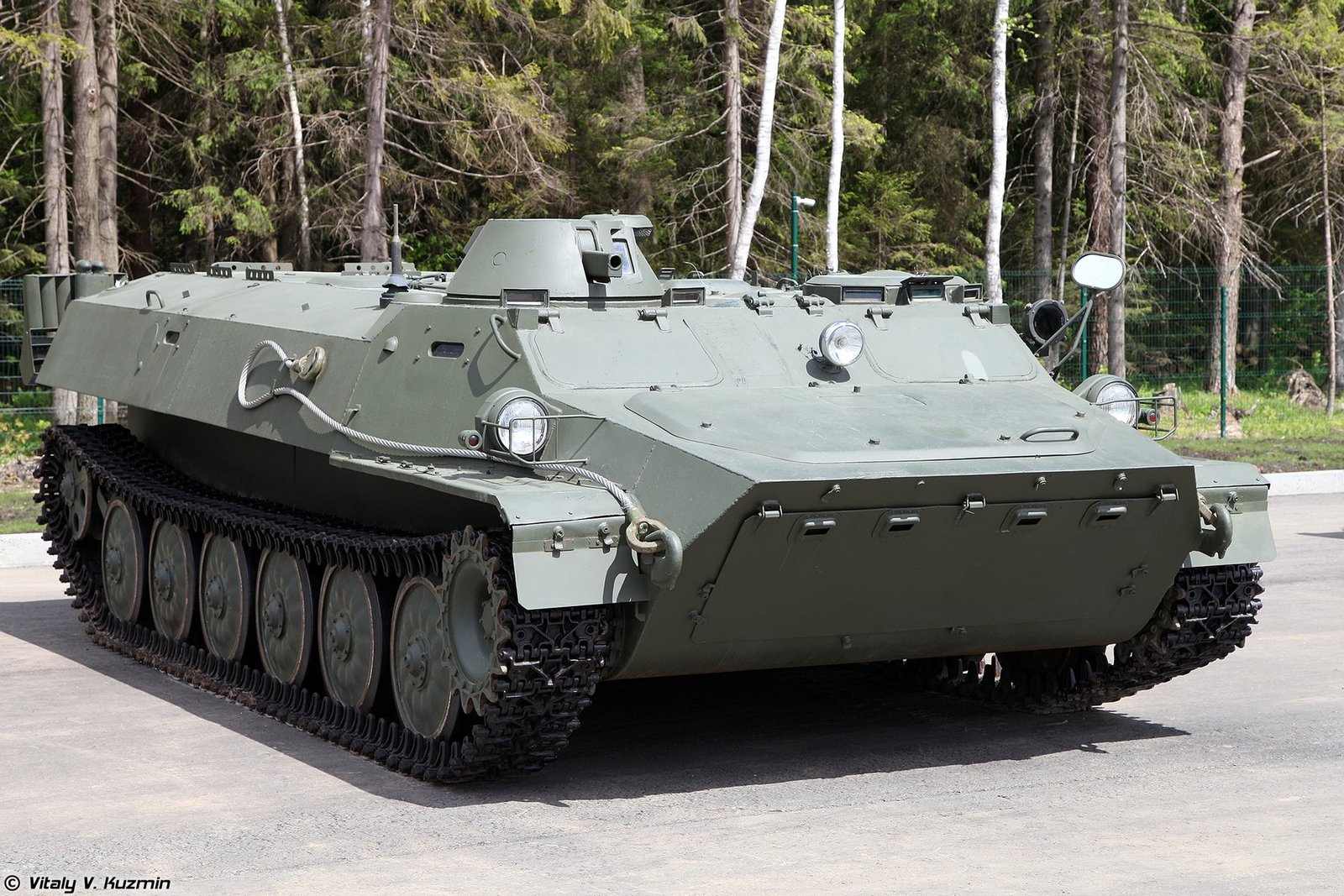

Development and requirement
The Soviet requirement that produced MT-LB focused on replacing older artillery tractors with a light, mobile, amphibious armored vehicle able to tow weapons, carry crews, and move cargo across difficult ground. The armored MT-LB entered production in the early 1970s and quickly proved useful far beyond the original tractor mission. 1, 2
Design and fighting role
MT-LB uses a low, lightly armored tracked hull with substantial internal volume and good soft-ground mobility. Its standard armament is modest, reflecting its transport and support origins. The same chassis became a foundation for command posts, electronic warfare systems, air defense, artillery-related vehicles, and locally improvised combat configurations. 1, 2
Service and evolution
The family spread throughout Warsaw Pact and client forces and has remained common in post-Soviet armies. Its low ground pressure, simple construction, and adaptability made it especially valuable in snow, marsh, and poor terrain. Modern conflicts have produced many field modifications, but those should not be mistaken for one standardized fighting version. 1, 2
Archive boundaries
MT-LB is included as an APC/multipurpose carrier but not treated as a conventional IFV. Air-defense, artillery, missile, and electronic-warfare derivatives belong under their actual mission categories while retaining MT-LB lineage. 1
Sources and further reading
Representative source set used for this profile. Primary image source and reuse terms are listed with the image.
- U.S. Army TRADOC ODIN Worldwide Equipment Guide — MT-LB
- U.S. Army TRADOC ODIN Worldwide Equipment Guide — BTR-80