Development and requirement
Romania used the BMP-1 concept as the starting point for a domestically produced infantry fighting vehicle tailored to national production and operational requirements. 1
The Romanian MLI-84 family cannot be represented adequately by transferring a BMP-1 specification and changing the country name. The cited sources identify national automotive changes and a later modernization involving both propulsion and the weapons installation. Those stages require separate descriptions. The original vehicle’s configuration does not establish what a modernized MLI-84M carried, while the existence of the later version does not prove that every earlier hull was rebuilt. National production and subsequent conversion are related, but they are not the same historical event. 1
Design, protection, and mobility
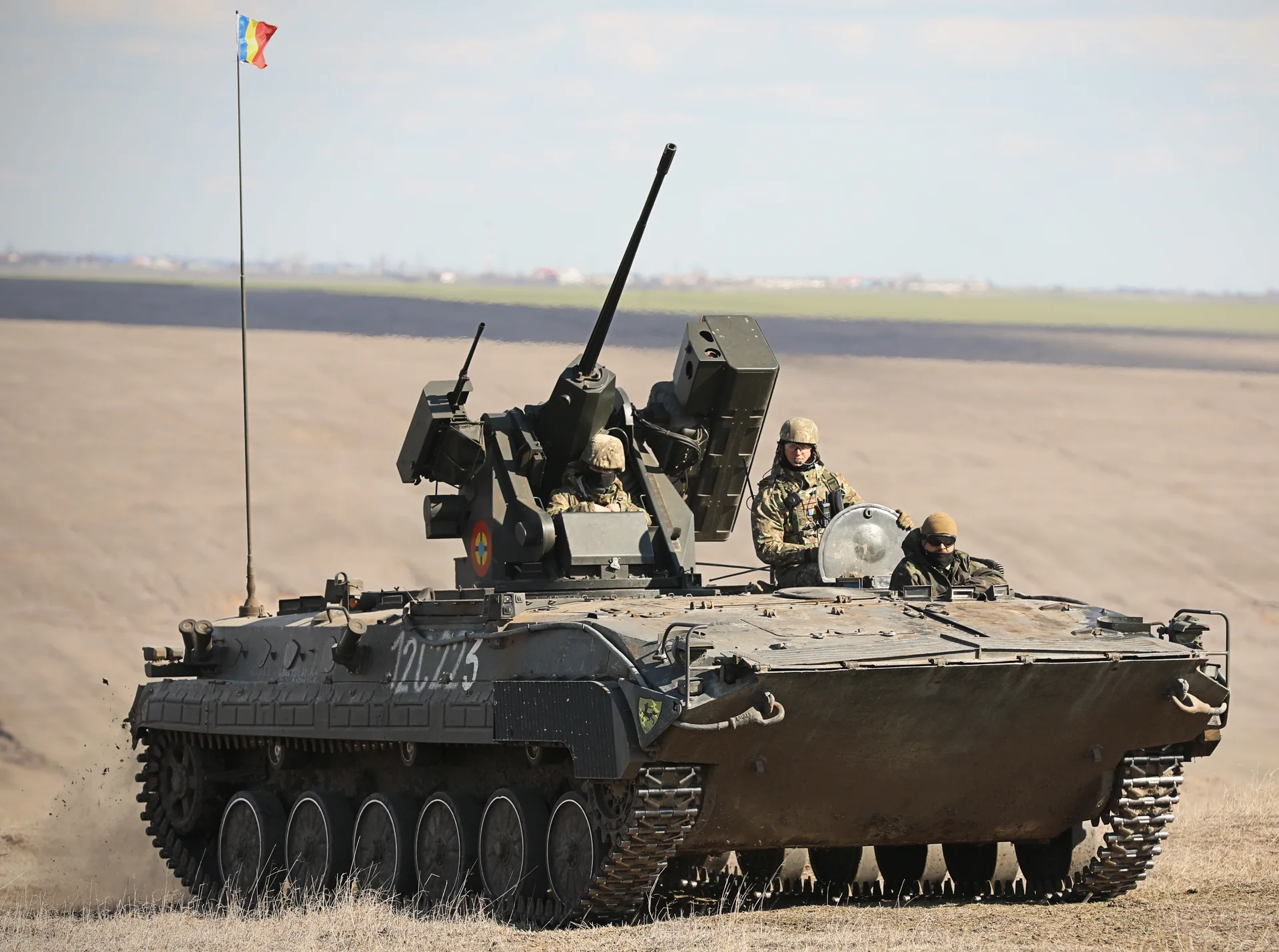
The MLI-84 retained the low-profile tracked IFV layout but used Romanian automotive components and local changes. Later MLI-84M/M1 upgrades substantially altered propulsion and the turreted weapons system. 1
The tracked layout of the MLI-84 Family emphasizes cross-country mobility and the ability to remain with armored formations away from improved roads. Tracks spread vehicle weight over a larger contact area and help negotiate soft ground, broken surfaces, and obstacles, but they bring higher maintenance demand and more mechanical wear than an equivalent wheeled carrier. For crews and infantry, this means mobility is inseparable from sustainment: track condition, suspension components, fuel, recovery support, and route selection all affect whether the vehicle can deliver its combat function when required. The design is therefore a compromise between tactical mobility and the logistical cost of preserving that mobility over time. 1
Protection and internal volume are especially difficult problems in an infantry fighting vehicle because the hull must serve both a vehicle crew and a dismounted fighting element. The troop compartment needs usable space, access routes, ammunition stowage, communications, and enough separation from fuel and mechanical systems to make the vehicle practical in repeated operations. Adding armor improves resistance to fragments and direct fire, but it also increases weight and can reduce mobility, amphibious margin, payload, or growth capacity. As threats change, many IFV modernization programs therefore become exercises in managing accumulated weight and electrical demand as much as in fitting a new gun or sight. 1
Firepower and battlefield role
Firepower on the MLI-84 Family has to be read through its mission rather than by caliber alone. Armored carriers and fighting vehicles use their weapons to protect movement, suppress opposition, cover dismounts, and create enough local advantage for the formation to continue its task. The usefulness of that weapon depends on sights, stabilization where fitted, ammunition, crew training, and the ability to detect a target before the vehicle is itself exposed. The vehicle's combat value therefore comes from the integration of mobility, protection, observation, communications, and weapon effect rather than from a single specification in isolation. 1
Service, variants, and modernization
Modernization kept the vehicle relevant after the Cold War by replacing legacy firepower and improving mobility. The result is a good example of a Warsaw Pact-era platform evolving toward NATO-compatible systems. 1
MFA Mizil’s catalog identifies an MLI-84M infantry fighting vehicle and separate command, medical-evacuation, technical-evacuation and communications products on that chassis. It also lists the OWS 25R weapon station. The cited manufacturer pages mainly provide headings and galleries, not a technical data set or an operator acceptance history. These listings therefore establish the manufacturer’s product relationships, not the number of conversions completed, the equipment of every Romanian unit or the performance of a particular armament installation. 2
MFA Mizil's own history supplies a dated modernization sequence that the earlier catalog-only citation could not. It records the company's 1996 selection for the MLI-84 upgrade competition, OWS-25R turret work from 1998 to 2004, manufacture of 101 MLI-84M vehicles and 28 derivative chassis from 2001 to 2010, and later Spike-launcher integration work. These are manufacturer program figures, not a claim that every Romanian MLI-84 received the same configuration. 3
How the vehicle fits the formation
In combined-arms employment, the MLI-84 Family is not an independent substitute for tanks, infantry, artillery, engineers, or air defense. Its purpose is to connect protected mobility with the infantry's ability to seize and hold ground. The mounted crew can observe and engage while the dismounted element deals with terrain and threats that cannot be solved from inside the hull. Effective use therefore depends on coordination: tanks provide heavier direct fire and protection, artillery and mortars suppress or isolate, engineers open routes, and the infantry fighting vehicle moves soldiers while contributing its own sensors and weapons. The platform is most effective when those capabilities overlap rather than when it is sent forward alone. 1
Strengths, limitations, and family boundaries
MLI-84 remains an IFV throughout its modernization path because troop carriage and mounted infantry support remain central. It is linked to BMP ancestry but kept as a distinct national family. 1
MLI-84 modernization is historically significant because it connects a BMP-derived national vehicle with later Romanian equipment decisions. The story depends on what was actually changed, not on a general assertion that any new turret made the entire fleet “NATO-compatible.” Compatibility can concern ammunition, communications or support and needs its own evidence. The cataloged specialist derivatives also remain different vehicles in mission terms. A medical or command installation should not inherit the IFV’s weapon description simply because the manufacturer identifies an MLI-84M chassis relationship. 1
Family names can also obscure important differences. The recorded lineage relationship is BMP-1-derived national design. A common hull or manufacturer does not mean every derivative belongs in the same operational category. Command posts, mortar carriers, antitank vehicles, recovery vehicles, reconnaissance versions, air-defense systems, and direct-fire variants may share engines and running gear while performing fundamentally different tasks. For that reason the Armor Archive keeps the MLI-84 Family tied to its lineage but classifies individual branches by what they actually do on the battlefield. That approach preserves engineering relationships without turning one successful chassis into an all-purpose label that hides the history of the specialized vehicles built from it. 1
Sources and further reading
References and further reading are listed below. Image identification, credit and reuse terms remain with each photograph.
- MLI-84 reference overview
- MFA Mizil: company and military-product catalog (catalog listing only; not technical certification)
- MFA Mizil — company history and MLI-84M production/upgrade program
Visit an Armor Museum
Explore the worldwide museum directory to find armored vehicles, collections, and visitor-planning information.
Browse armor museums