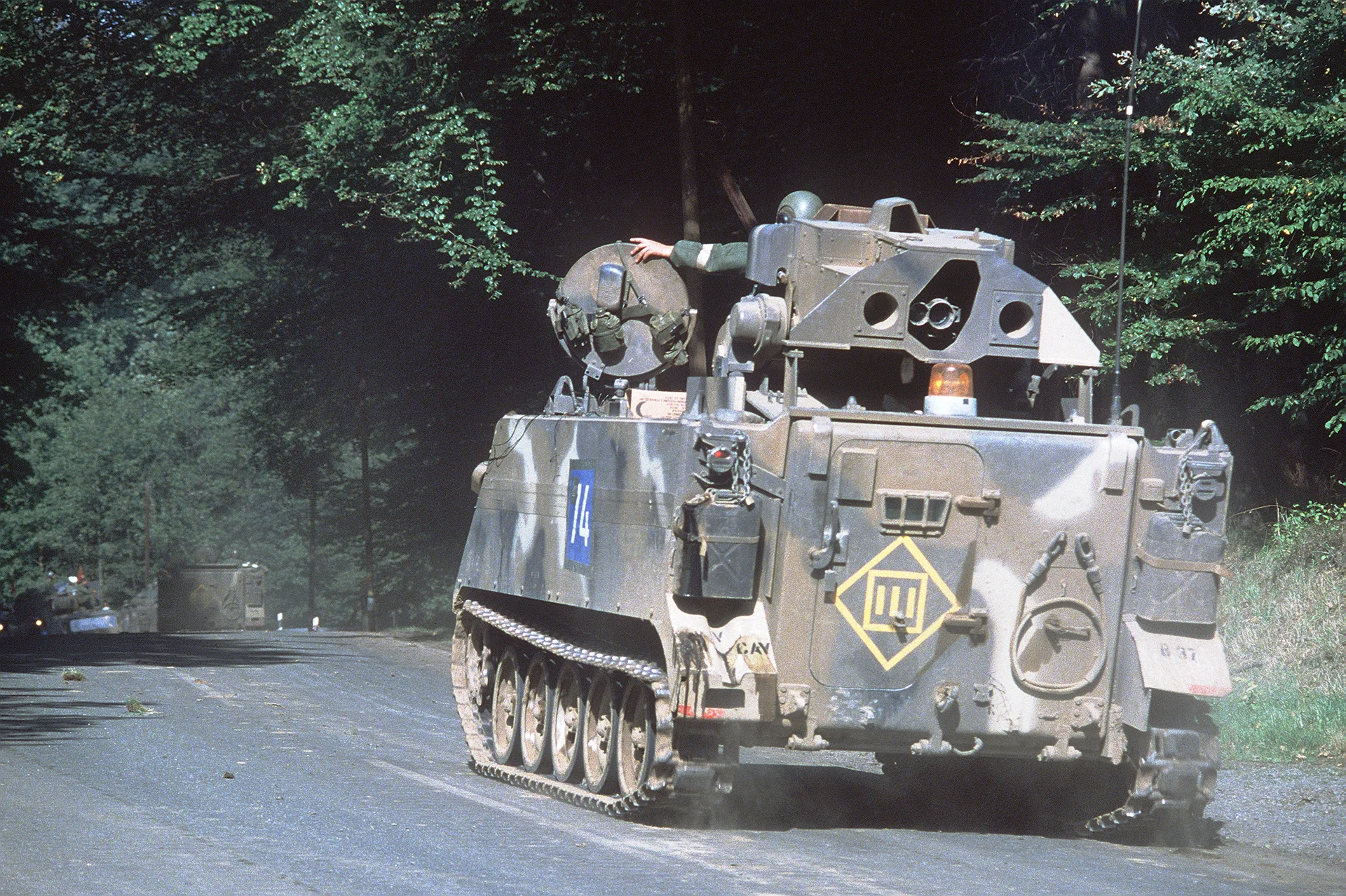
Development
The design answered a useful distinction in mechanized warfare: transporting an antitank team was not the same as integrating its weapon into a protected vehicle. The ITV placed the launcher, observation equipment, controls, and missile stowage around a dedicated crew. Its engineering therefore concentrated on the relationship between the carrier and weapon rather than on creating a new general-purpose armored hull. 1, 3
Layout and crew
The U.S. Army ODIN record describes the M901 as an M113-based carrier with a dual M220 TOW launcher that could be elevated above the hull for firing and lowered for travel and reload. The mechanism allowed the crew to replenish the launcher from under armor by tilting the installation toward the hull. That protected reload arrangement was a defining part of the ITV architecture, not simply a visual feature of the raised launcher. 5
The squad leader had an observation instrument separate from the gunner's sighting equipment. The Army manual's illustrated periscope shows its own viewing controls and a direction indicator around the field of view, relating the observed direction to the front of the carrier. The arrangement allowed the crew leader to orient himself without treating the launcher head as the vehicle's only means of looking out. The manual even identifies a humidity indicator, a reminder that maintaining optical equipment was part of sustaining the vehicle. 6
Armament
In the historical systems described by the Army, TOW meant tube-launched, optically tracked, wire-guided. Guidance depended on the launcher’s tracking equipment and a command connection to the missile; it was not a fire-and-forget weapon. TOW 2 introduced revised electronics and sighting arrangements. Those changes concern the missile system and its supporting equipment, not a universal transformation of every M113-based carrier into the same model. 2
Crew protection
The Army characterized ITV protection in terms of small-arms fire and artillery fragments. That is an important limit: carrying an antitank weapon did not give the carrier the defensive qualities of the vehicles it might oppose. Separating the launcher from the crew compartment offered a different design approach from a conventional manned gun turret, but it did not remove the need to protect the hull, exposed equipment, and supporting crew. 1
Mobility and support
An established carrier family offered a broad automotive support base, although specialist weapon maintenance remained necessary. The Army's 1996 Weapons Systems Handbook included M901A3 among seven M113A2 variants being converted to the A3 RISE package. That modernization belongs to the A3 generation. It should not be used to assign a later powerpack or driver arrangement retrospectively to the original ITV or every export vehicle. 3, 4
Versions and conversions
The Army’s M901-series chapter distinguishes the original M901 with the M220A1 TOW installation from the M901A1 with M220A2 TOW 2. The later M901A3 designation identifies a further carrier-based development. These labels are more useful than a single undifferentiated specification table: missile electronics, launcher equipment, automotive components, and customer modifications need not all change together. 1, 2, 3
Variant differences also appear in the stowage drawings rather than just in an external silhouette. The M901 layout lists nightsight coolant cartridges and batteries; the corresponding M901A1 labels identify a nightsight battery power conditioner and its batteries. Changes in the sight therefore changed items that the crew carried and maintained inside the hull. The drawing is evidence for those particular installations, not a license to apply one sight's capabilities or support requirements to every M901-series vehicle. 6
Service history
The detailed Army treatment of individual crew responsibilities and combined carrier-and-weapon upkeep establishes the ITV as a fielded system rather than an experimental launcher proposal. Its operational identity was that of a specialized antitank element. The four crew roles also show why an automated-looking launcher should not be mistaken for an uncrewed vehicle: observation, vehicle operation, ammunition handling, and system maintenance remained human responsibilities. 1
Operating constraints
The architecture joined two different kinds of availability: a serviceable tracked carrier and a functioning guided-weapon installation. Either could limit the vehicle’s usefulness. Similarly, the distinction between a launcher’s ready missiles and the carrier’s additional stowage matters when interpreting published ammunition totals. These are consequences of the design, not evidence that every ITV suffered the same reliability problem or that one reported capacity applied to all later modifications. 2, 3
Design legacy
The M901 illustrates a broader armored-vehicle development pattern: a widely supported chassis can become a highly specialized combat system without acquiring a new automotive identity. Its historical importance lies in that integration of protection, observation, guided armament, and mechanized mobility. Understanding the ITV as a missile carrier, rather than as either a troop transport or a miniature tank, makes its distinctive compromises easier to interpret. 1, 3
Sources and further reading
- U.S. Army, FM 23-34, Chapter 4: M901-Series Improved TOW Vehicle
- U.S. Army, FM 23-34, Chapter 1: TOW Weapon System
- GlobalSecurity: M901A3 Improved TOW Vehicle
- U.S. Army, 1996 Weapons Systems Handbook — M113 Family of Vehicles (FOV)
- U.S. Army ODIN — M901 ITV American Anti-Tank Guided Missile Carrier (indexed asset-page evidence only)
- U.S. Army M901 manual plates reproduced by American Fighting Vehicle Database
Visit an Armor Museum
Explore the worldwide museum directory to find armored vehicles, collections, and visitor-planning information.
Browse armor museums