Development
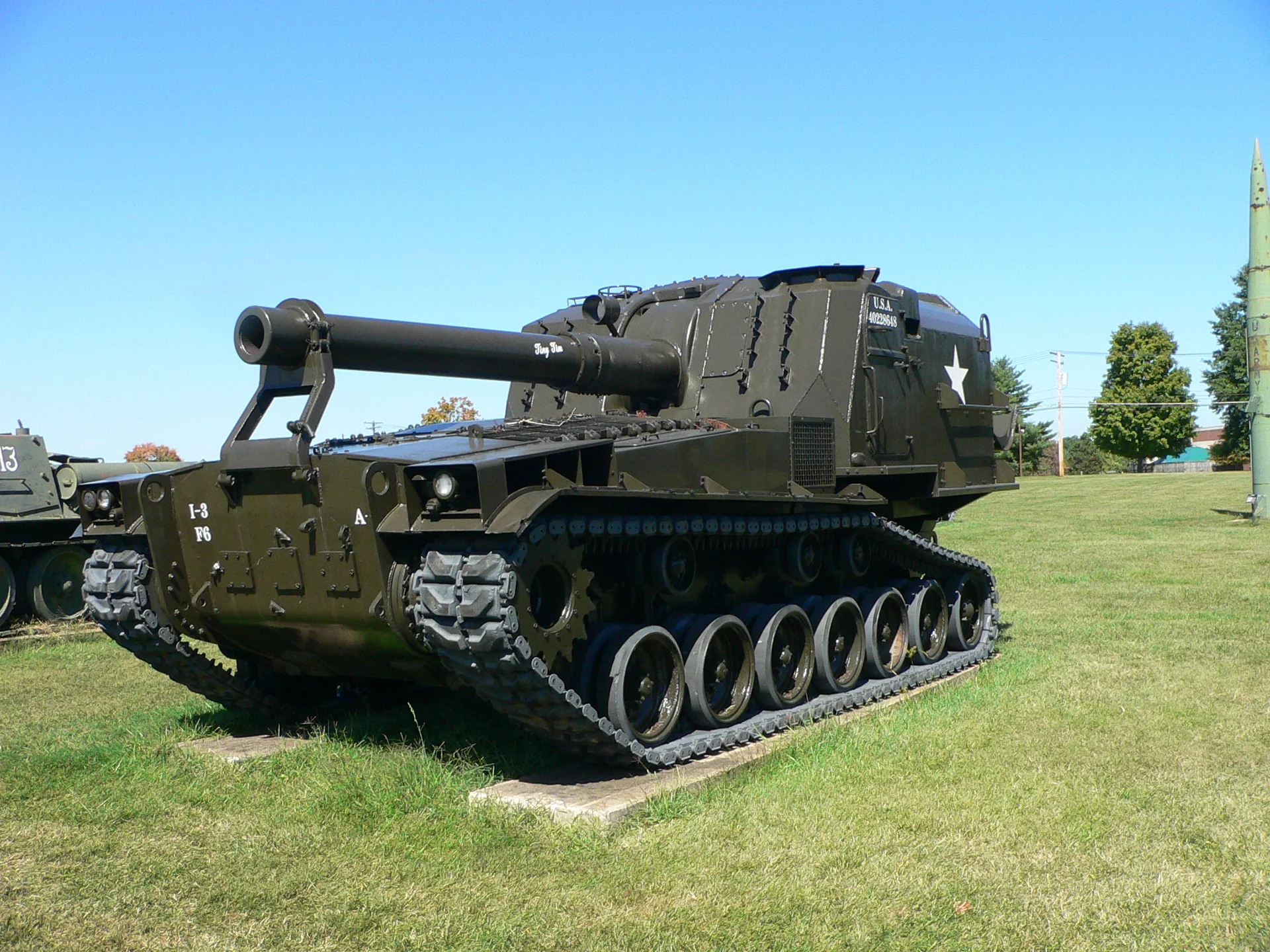
The M53 and M55 were conceived when the Army was trying to combine the mobility of armored formations with the reach and destructive power of heavy artillery. Rather than use an open deck like the wartime M40/M43, designers placed the crew and weapon in a large armored turret on a chassis derived from components of the M46 and M47 Patton tank family. The M53 carried a 155 mm gun; the M55 used an 8-inch howitzer. Their shared platform allowed the Army to field two heavy calibers with substantial common automotive and turret machinery. 1, 2, 3
A front power pack and a rear turret large enough for the whole crew
The family reversed the normal tank arrangement. Engine, transmission, and drive sprockets were at the front, while the large artillery turret sat at the rear. All six men carried on the vehicle, including the driver, were located in the turret. The driver occupied the left-front corner and the gunner the right-front area, with the remainder of the detachment behind them. This put the crew under armor and kept the rear of the vehicle available for the gun mount, ammunition, loading equipment, and the large recoil spade. 1, 4
Two calibers on a common M86 mount
The M53 mounted the 155 mm Gun M46, while the M55 mounted the 8-inch Howitzer M47. The M86 mount was designed to accept either ordnance, and ammunition stowage components could also be changed for the different calibers. That commonality was more than a catalog convenience: it made conversion of Army M53s to M55s technically feasible and anticipated later American interest in common artillery carriages with interchangeable heavy weapon installations. 1, 2, 4
Crew protection
The armored turret was a major departure from the open M40 and M43 platforms. It gave the six occupants overhead shelter and a more enclosed workplace for travel and firing. The Army's Rock Island Arsenal history describes protection against small-arms fire and artillery effects. That should not be mistaken for tank-level protection or a guarantee of safety against radioactive contamination under every condition. 3
Mobility and support
The M53 weighed roughly 100,000 pounds, about 45.4 metric tonnes, and the M55 was in the same very-heavy class. Their running gear and power train drew from the Patton family, with later production incorporating improved AV-1790-series engines and CD-850 transmissions as those components matured. This gave the artillery family genuine tracked mobility, but the sheer mass of the vehicles complicated strategic transport, bridging, recovery, and movement compared with lighter systems. 1, 2
Six aboard, a larger section around them
The M53 and M55 carried six men in the vehicle, but period field manuals depict a larger complete gun section supported by an accompanying truck. This distinction mirrors other self-propelled artillery systems of the era. The vehicle could move the weapon and its immediate crew under armor, yet sustained artillery operations still required additional personnel, ammunition transport, communications, and maintenance beyond the turret itself. 1, 4
Service history
The M55 served as a U.S. heavy self-propelled howitzer in the 1950s and 1960s. Rock Island Arsenal's history associates it with general artillery support and support for armored columns. Its tracked chassis and enclosed turret addressed the movement and crew-protection concerns of the period. A complete unit nevertheless needed ammunition vehicles, maintenance facilities and supporting personnel beyond the six men carried in each howitzer. 3
Rock Island Arsenal's exhibit history gives the M55 a six-person crew and describes the system as general artillery support that could accompany armored columns. It also attributes production to Pacific Car and Foundry and places the first systems near the end of the Korean War period. Because this is an Army exhibit history rather than a production ledger or acceptance dossier, those dates are used as program context rather than precision manufacturing milestones. 3
Operating constraints
The M53/M55 family solved several problems of wartime heavy self-propelled artillery. It enclosed the crew, integrated powered weapon handling, and used a modern tank-derived drivetrain. Yet those gains produced a system close to fifty tons with only limited turret traverse. By the later 1950s, the Army increasingly valued lighter systems that could move more readily by air and across the theater while still carrying the same heavy calibers. 1, 2, 3
Design legacy
The M53/M55 family represents a brief enclosed-turret stage between Second World War open heavy gun carriers and the lighter M107/M110 generation. The Army's Rock Island Arsenal history identifies the M55 as the 203 mm version on the same basic platform as the M53 and places it in 1950s and early-1960s service before replacement by the M110. That sequence helps explain why the Army first valued crew enclosure, then accepted a much more exposed heavy-artillery design to reduce weight and improve transportability. 3
Sources and further reading
References and further reading are listed below. Image identification, credit and reuse terms remain with each photograph.
- AFV Database — 155mm Self-propelled Gun M53
- AFV Database — 8-inch Self-propelled Howitzer M55
- U.S. Army, Rock Island Arsenal Self-Guided Tour: M55 8IN Heavy Howitzer (indexed asset-page evidence only)
- AFV Database — M53/M55 technical-manual image and layout archive
- U.S. Marine Corps — U.S. Marines in Vietnam: The Defining Year, 1968
- U.S. Army / Center of Military History — King of Battle: A Branch History of the U.S. Army's Field Artillery
Visit an Armor Museum
Explore the worldwide museum directory to find armored vehicles, collections, and visitor-planning information.
Browse armor museums