Development and multinational origins
The Army’s Redstone chronology dates the General Support Rocket System request for proposals to 12 December 1975. Boeing and Vought received prototype contracts in September 1977. A four-country memorandum involving the United States, Germany, France and the United Kingdom followed in July 1979, before the program became MLRS on 16 November. Vought was selected on 29 April 1980. These milestones separate competition and international organization from later production and unit fielding. 1
Launcher and tracked carrier
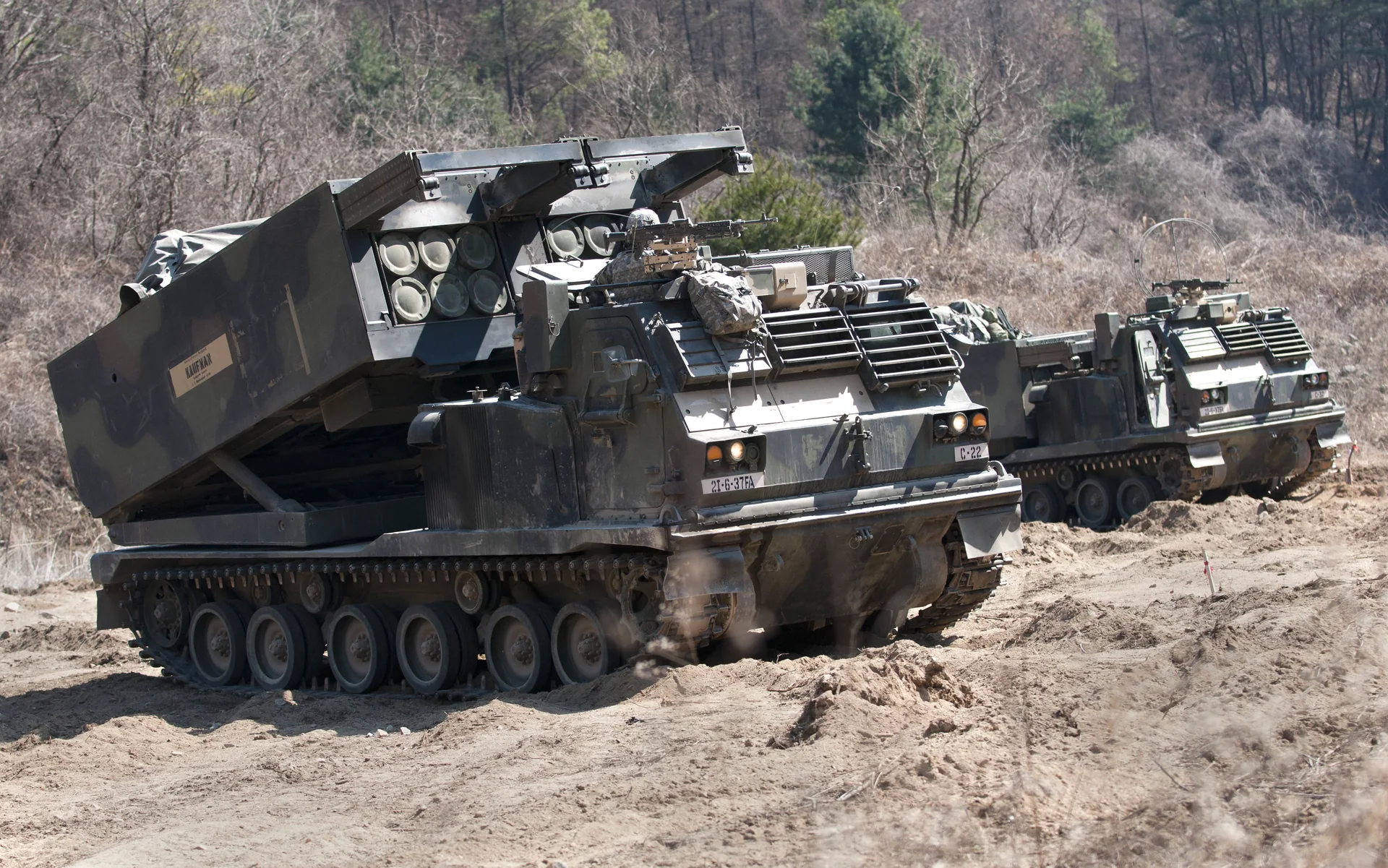
M270 combines an armored three-person cab, tracked automotive components derived from the broader Bradley family, and a rear launcher-loader module holding two ammunition pods. The crew can operate much of the system from under armor. The configuration was intended to keep rocket artillery mobile with heavy formations while simplifying the handling of ammunition compared with older exposed rail launchers. 1, 2
Modular launch pods
The twin sealed-pod arrangement is the design feature that gave M270 exceptional growth potential. A pod can contain different compatible rocket or missile families, while the launcher handles standardized containers rather than loose rounds. This approach accelerated reload handling and created a physical interface that later munitions could exploit without redesigning the entire carrier and launcher every time ammunition changed. 1, 2
Evolution of the munition family
The original concept emphasized large salvos of unguided rockets for massed battlefield fire. Over time, guided rockets and larger tactical missiles expanded the launcher’s mission toward precision and greater range. Current Lockheed Martin material presents M270 as a carrier for several modern munition families. The historical transition is important because it changed the effect delivered by the same basic launcher architecture rather than replacing that architecture outright. 1, 2
Fire control and digital modernization
Early 1980s electronics could not indefinitely support new navigation, communications, and guided munitions. The M270A1 modernization therefore improved fire control and launcher performance, while the M270A2 adds a Common Fire Control System. Digital compatibility became critical because new ammunition requires more than physical fit: the launcher must identify, communicate with, and safely control each approved weapon through its software and interfaces. 2
Tracked mobility
The tracked chassis was chosen so MLRS units could accompany armored and mechanized formations in the Central European environment for which the system was originally designed. Tracks provide cross-country mobility and a stable heavy carrier, though at the cost of maintenance, fuel use, and strategic transport burden. Those tradeoffs later helped create a complementary role for wheeled HIMARS rather than making M270 automatically obsolete. 1, 2
Crew protection and survivability
The armored cab protects the small crew from fragments and small-arms fire during movement and operation. Later M270A2 recapitalization adds an Improved Armored Cab, reflecting changing protection expectations. The launcher remains a high-value artillery system rather than a front-line fighting vehicle; survival depends on dispersion, movement, concealment, and reducing the time spent at a location that may be detected after firing. 2
Ammunition supply and sustainment
MLRS ammunition is packaged to simplify launcher handling, but the logistics burden remains substantial. Loaded pods must be transported, stored, inspected, and moved forward while launchers also require fuel, tracks, engines, electronics maintenance, and recovery support. A fast-firing launcher can exhaust its immediate ammunition far sooner than a rear-area system can replace it if the resupply organization is weak, making logistics central to real combat endurance. 1, 2
Operational service
M270 units spread through U.S. and allied forces during the final decade of the Cold War and first saw major combat use in the 1991 Gulf War. The system continued through later operations as its ammunition shifted toward guided effects. Its longevity reflects repeated modernization rather than an unchanged 1983 configuration, with electronics, protection, automotive components, and approved weapons evolving over several decades. 1, 2
The same chronology records production qualification on 4 February 1983, the first tactical battery at Fort Riley on 31 March, full-scale production approval on 14 April and type classification on 21 April. It then dates the first overseas battery, with the 8th Infantry Division in Germany, to 1 September 1983. The sequence explains why references can assign different 1983 dates to the system without necessarily disagreeing: battery readiness, classification and overseas fielding are different events. 1
International family
Multinational development produced a wide international user base and national derivatives such as Germany’s MARS modernization path. Different fleets have not remained identical, but shared launcher architecture, ammunition standards, and industrial knowledge created a distributed sustainment base. This alliance dimension became increasingly important as countries refurbished older launchers and coordinated modern ammunition compatibility across several national armies. 1, 2
M270A1 and M270A2 modernization
M270A2 recapitalization combines automotive, cab and fire-control changes rather than merely replacing worn parts. On 14 April 2025, Lockheed Martin reported the first M270A2 launch of Precision Strike Missile during a short-range production-qualification test at White Sands. That dated event documents a launcher/munition integration milestone, not qualification of every older M270 configuration or completion of a whole-fleet conversion. 3
Historical place
The M270 family connects the original unguided-rocket system with later guided rockets and tactical missiles through two modular pod positions and successive fire-control standards. The carrier's continuity can obscure substantial changes inside the launcher. National versions, M270A1 and M270A2 therefore need to be identified separately whenever a particular munition, armored cab or electronic interface is described. 1, 2, 3
Sources and further reading
- U.S. Army Redstone Arsenal: MLRS historical chronology
- Lockheed Martin — Multiple Launch Rocket System (M270)
- Lockheed Martin — First-time M270A2 launch of Precision Strike Missile (14 April 2025)
Visit an Armor Museum
Explore the worldwide museum directory to find armored vehicles, collections, and visitor-planning information.
Browse armor museums