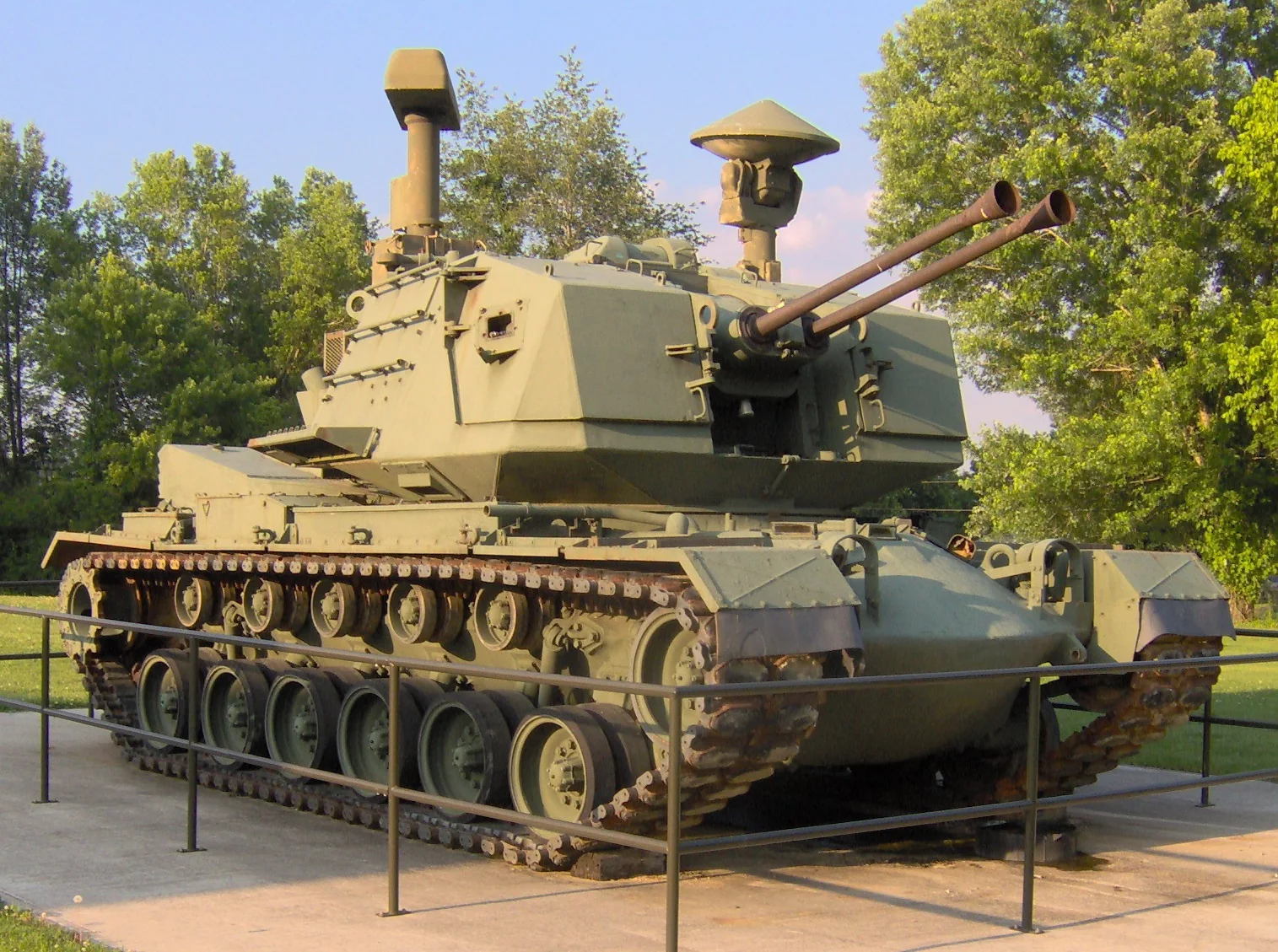
The DIVAD requirement
During the 1970s the Army sought a mobile gun system able to protect armored divisions from low-flying aircraft and attack helicopters. Existing Vulcan and Chaparral systems covered parts of the threat but did not provide the desired combination of range, reaction time, mobility, and all-weather fire control. 1, 2, 3, 4
DIVAD was deliberately structured as an accelerated acquisition program. Competitors were encouraged to use existing components and mature technology so a replacement could reach units quickly. That schedule reduced development time but also transferred integration risk into testing and early production. 1, 2, 3, 4
Competition and selection
The competition produced different gun-and-radar approaches on existing tank chassis. Ford Aerospace’s design, selected in 1981 and later designated M247 Sergeant York, used twin 40 mm Bofors L/70 cannon in a new turret on rebuilt M48A5 hulls. 1, 2, 3, 4
Using a proven chassis and established cannon did not make the complete weapon system mature. The difficult work lay in integrating search radar, tracking radar, optics, fire control, turret drives, ammunition handling, crew interfaces, and a ground vehicle into a reliable system that could operate amid clutter and maneuver. 1, 2, 3, 4
Twin 40 mm gun system
The M247’s twin 40 mm cannon gave it a heavier projectile and greater engagement reach than the M163 Vulcan it was intended to supersede. Ammunition options and rapid automatic fire were meant to give the system a credible chance against helicopters and low-flying fixed-wing aircraft. 1, 2, 3, 4
The guns were only one part of the design. DIVAD’s promise depended on detecting a target, deciding it was hostile, tracking it, and placing effective fire before the aircraft could complete a stand-off attack. The program therefore had to be judged as an integrated sensor-and-weapon system rather than simply as a pair of powerful cannon. 1, 2, 3, 4
Radar and optical fire control
The Sergeant York turret carried separate search and tracking radar functions together with optical and laser equipment for alternate engagement modes. Radar technology adapted from aircraft applications was attractive because it promised mature hardware, but the ground environment presented clutter, masking, and vibration conditions different from airborne use. 1, 2, 3, 4
Operational testing exposed the importance of those integration problems. A radar-directed gun can appear capable in controlled engagements yet still fail the field requirement if it cannot maintain availability, discriminate targets, or perform reliably while moving and operating with a division. 1, 2, 3, 4
M48-based mobility
Rebuilt M48A5 chassis gave the M247 substantial armor, tracked mobility, and an automotive base already known to Army maintenance organizations. The heavy platform could carry the large turret and radar equipment while accompanying armored formations better than lightly protected wheeled air-defense carriers. 1, 2, 3, 4
The penalty was that an older tank chassis had to support a very modern electronics suite. Power generation, cooling, maintenance access, weight, and reliability all became part of the integration challenge, and the mature hull could not by itself guarantee that the new turret would meet readiness goals. 1, 2, 3, 4
Testing and reliability concerns
GAO's 1987 study of defense simulations examined how model assessment affected confidence in results used for acquisition decisions. Its general findings are not a substitute for the M247's individual test records. The program's hardware reliability, operational testing and analytical studies answer related but different questions, and should not be merged into one undocumented anecdote about a single demonstration. 1, 2, 3, 4
The M247 could demonstrate useful gun capability, but operational suitability required more than successful firings. Low availability and recurring deficiencies meant a unit might not have enough working systems at the moment an attack occurred, undermining the very protection DIVAD was intended to provide. 1, 2, 3, 4
Changing helicopter and stand-off threat
The threat also evolved while DIVAD was under development. Attack helicopters increasingly emphasized stand-off weapons that could be launched from beyond the useful reach of a gun-based local defense system, reducing the value of solving only the close-range engagement problem. 1, 2, 3, 4
GAO's June 1990 review states that DIVAD was terminated in August 1985 because it could not meet the stand-off attack-helicopter threat. The report also describes the subsequent move toward complementary weapons and sensors under FAADS. This is the review's stated explanation, not a complete reconstruction of every M247 test or procurement decision. 1
Cancellation in 1985
The Department of Defense halted the program after roughly fifty production vehicles had been built. Cancellation prevented normal operational fielding and ended plans for a much larger fleet that would have served in Army divisions. 1, 2, 3, 4
Cancellation ended the planned large-scale divisional procurement rather than a long period of normal operational service. The completed development and production vehicles still document the engineering program. Separating those vehicles from a fielded fleet avoids turning museum survivals or test photographs into evidence that Sergeant York became a standard operational weapon. 1, 2, 3, 4
From DIVAD to FAADS
After Sergeant York was cancelled, the Army reassessed forward-area air defense and concluded that no one weapon could cover the full set of threats. The resulting Forward Area Air Defense System concept distributed the mission across complementary components and emphasized integration between sensors, missiles, and guns. 1, 2, 3, 4
The FAADS concept divided forward-area defense among several components rather than treating one gun vehicle as the whole answer. GAO's review described this as the Army's response following DIVAD cancellation. It does not establish that every proposed FAADS component was subsequently procured or that later Bradley- and Stryker-based systems were direct M247 variants. 1
On printed page 12 of its June 1990 report, GAO places the Army’s expert reassessment in late 1985, after DIVAD termination. The group concluded that no single weapon could provide adequate protection against the full forward-area threat and recommended five complementary components for FAADS. That sequence is narrower than saying one successor vehicle replaced Sergeant York. It also distinguishes the recommendation from the later approval, procurement and fielding histories of the proposed components. 1
Historical place
The M247 record involves several questions that should remain separate: whether the hardware worked reliably, whether it met the intended threat, and whether the acquisition program should continue. GAO’s later account addresses the program decision and the forward-area air-defense response. It cannot replace individual operational-test records or authenticate anecdotes about a particular radar demonstration. 1, 2, 3, 4
The later return of armored short-range air defense with the M6 Linebacker and SGT STOUT does not vindicate or condemn DIVAD. It shows instead that the operational requirement persisted while the preferred mix of missiles, guns, sensors, networking, and platform protection changed across successive generations. 1, 2, 3, 4
Sources and further reading
- U.S. GAO: Army Air Defense, NSIAD-90-191, June 1990
- U.S. GAO — DOD Simulations: Improved Assessment Procedures Would Increase the Credibility of Results
- U.S. GAO — Issues Identified in 21 Recently Published Major Weapon System Reports
- M247 Sergeant York program overview
Visit an Armor Museum
Explore the worldwide museum directory to find armored vehicles, collections, and visitor-planning information.
Browse armor museums