Development and requirement
Kurganets-25 emerged from Russia’s broader effort to create families of standardized armored platforms across heavy, medium tracked, and wheeled categories. 1
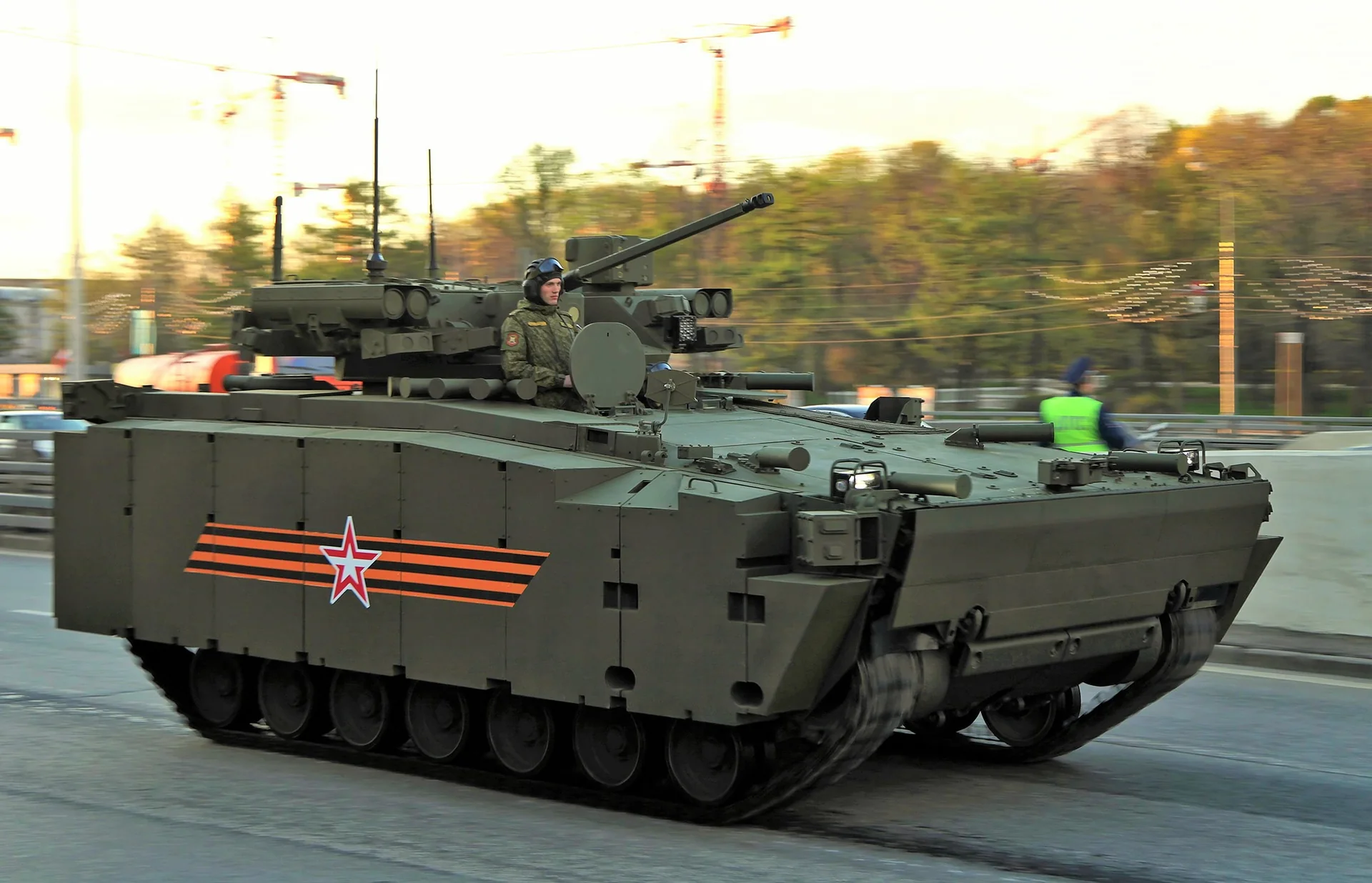
ODIN describes Kurganets-25 as part of a modular medium tracked family rather than a wheeled carrier line. The IFV and APC variants were first shown publicly during rehearsals for the 2015 Moscow Victory Day parade. That appearance is a useful dated development milestone, but it is not evidence that a complete Kurganets fleet entered broad operational service or displaced the older BMP, BMD and MT-LB families on the timetable once proposed. 1
Design, protection, and mobility
Compared with traditional BMPs, Kurganets uses a taller hull and modular protection concept, prioritizing internal space and mine/IED survivability while retaining amphibious capability. 1
Kurganets-25 uses a tracked running gear. ODIN also describes modular armor intended to be adapted to different threats and an amphibious family concept. Those points matter because the previous draft incorrectly treated the vehicle as wheeled and then imported road-mobility tradeoffs that belong to a different class of armored vehicle. The relevant design question is how the tracked hull balances protection, internal volume and amphibious requirements, not how tire and wheel geometry affects a wheeled scout. 1
Protection and internal volume are especially difficult problems in an infantry fighting vehicle because the hull must serve both a vehicle crew and a dismounted fighting element. The troop compartment needs usable space, access routes, ammunition stowage, communications, and enough separation from fuel and mechanical systems to make the vehicle practical in repeated operations. Adding armor improves resistance to fragments and direct fire, but it also increases weight and can reduce mobility, amphibious margin, payload, or growth capacity. As threats change, many IFV modernization programs therefore become exercises in managing accumulated weight and electrical demand as much as in fitting a new gun or sight. 1
Rostec's April 2015 announcement identifies the electronics supplier as well as the vehicle family. It states that both the infantry fighting vehicle and personnel-carrier forms of Kurganets-25 carried integrated communications, navigation and control equipment produced through the Sozvezdie concern. The advertised objective was to connect crews with command posts and other units in a common information system. This was an integration claim made before the parade, not an independently measured account of the system's behavior under combat conditions. 2
Firepower and battlefield role
The family boundary is more secure than a single universal armament description. ODIN's readable asset text describes the APC as lightly armed with a remotely controlled 12.7 mm weapon, while distinguishing an IFV variant within the same Kurganets family. This profile is the IFV entry, so the APC weapon fit is not copied into the IFV facts as though the configurations were interchangeable. A fully sourced IFV combat-module chronology remains an open evidence task. 1
Service, variants, and modernization
The platform has appeared publicly in IFV and APC configurations and has been associated with a range of proposed specialist vehicles. Its development history is therefore as important as its fielding status. 1
ODIN lists ambulance, mortar, antitank, recovery, reconnaissance, command, engineer, air-defense and artillery applications as proposed members of the broader family. Those labels show the intended platform breadth, not proof that every derivative completed development or entered service. The archive therefore records them as proposed family directions unless a separate source establishes a fielded vehicle and its configuration. 1
The manufacturer's 2021 parade account described factory technical specialists supporting experimental and warranty-covered vehicles in a contingent that included Kurganets-25, BMP-2, BMP-3 and airborne vehicles. It reported more than forty Kurganmashzavod-built machines across that mixed contingent. That number cannot be assigned to Kurganets alone. The account is nevertheless useful evidence of the industrial support accompanying public demonstrations, where maintaining a small selected group of vehicles was a different undertaking from sustaining a fielded fleet. 3
How the vehicle fits the formation
The available inspected evidence is strongest on public appearance, platform concept and family boundaries, not on unit-level operational employment. For that reason the article does not infer a mature Kurganets combined-arms doctrine from generic infantry-fighting-vehicle practice. Dated unit issue, exercises, maintenance experience and combat use require separate evidence before they can be presented as established service history. 1
Strengths, limitations, and family boundaries
The archive separates Kurganets IFV and APC configurations by mission even though they share the same chassis family. This profile covers the more heavily armed infantry fighting version. 1
Kurganets should be assessed as a tracked medium platform. Its amphibious requirement, modular protection and larger internal volume distinguish it from older low-profile Soviet designs, while its development history also shows the risk of treating a public prototype family as an established fleet. Claims about road speed, transporter independence or wheeled cross-country tradeoffs have been removed because they were contamination from a generic wheeled-vehicle template. 1
Sources and further reading
- U.S. Army ODIN, Kurganets-25 Russian Amphibious Armored Personnel Carrier asset page (indexed asset-page evidence only)
- Rostec, new parade armor equipped with OPK systems, 27 April 2015 (indexed evidence only)
- Rostec, Kurganmashzavod equipment in the Victory Parade, 8 May 2021 (indexed evidence only)
Visit an Armor Museum
Explore the worldwide museum directory to find armored vehicles, collections, and visitor-planning information.
Browse armor museums