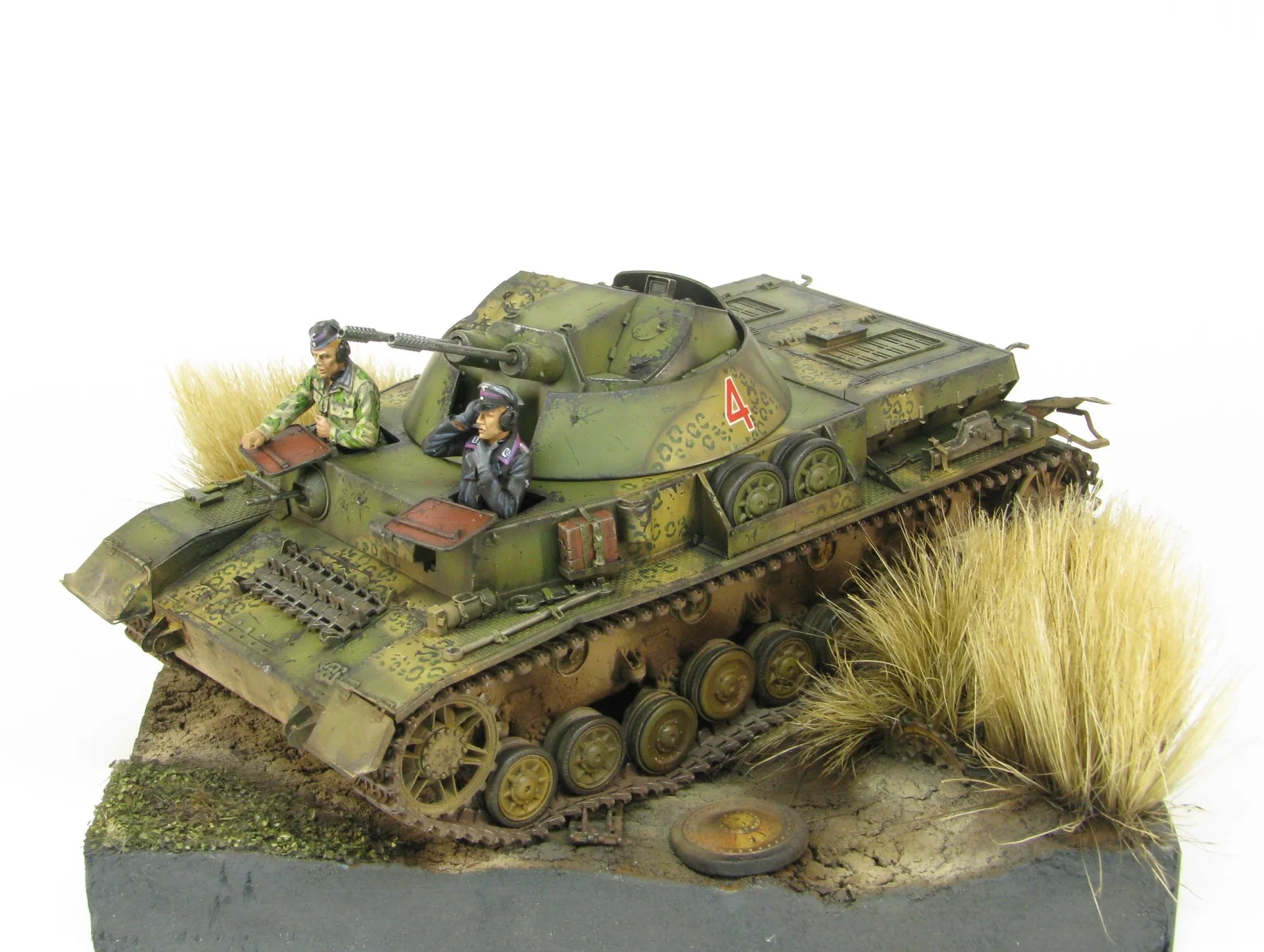
From open Flakpanzers to an enclosed turret
German experience with Möbelwagen, Wirbelwind, and Ostwind showed that a mobile gun could accompany armored formations, but all three exposed their gun crews to some degree. Kugelblitz represented a more ambitious answer: a compact enclosed turret that could remain ready to engage while providing overhead protection. 1, 2
Development began in 1944 as Allied air pressure and the vulnerability of German movement made close air defense increasingly urgent. The program was constrained from the start by shortages, competing chassis requirements, and the fact that a sophisticated new turret had to be integrated into a mature but already heavily tasked Panzer IV production system. 1, 2
Compact turret and Panzer IV integration
The distinctive feature was the closed, ball-like internal gun cradle and external turret arrangement from which the vehicle’s later nickname is derived. Compared with open-topped Flakpanzer turrets, this configuration aimed to protect the gun crew from fragments, small-arms fire, weather, and overhead attack while retaining all-round traverse. 1, 2
Integrating the turret was not simply a matter of replacing the Panzer IV tank turret. The anti-aircraft installation demanded room for two cannon, feeds, sights, crew positions, and rapid movement at high elevation angles, all within the diameter and load limits of an existing hull. Those packaging pressures shaped the compact and unusual turret form. 1, 2
Twin 30 mm cannon
The selected armament used twin 30 mm MK 103-derived weapons rather than the 20 mm Flakvierling or single 37 mm Flak 43 of earlier Panzer IV Flakpanzers. Thirty-millimeter ammunition promised a useful balance between projectile effect, rate of fire, and the physical size of the gun installation. 1, 2
A twin mount also increased the density of fire without returning to four small-caliber barrels. In theory that made Kugelblitz better suited to short engagement opportunities against low-flying aircraft, while retaining enough projectile effect to be dangerous to lightly protected ground targets. In practice, the program never matured far enough for large-scale operational evaluation. 1, 2
Sighting and engagement concept
Kugelblitz remained a visual gun system rather than a radar-directed vehicle. The enclosed turret protected the crew but made direct observation more dependent on periscopes, sights, and carefully arranged viewing positions than on the unrestricted view available from an open Flakpanzer. 1, 2
The enclosed turret required sights and viewing arrangements for the gun crew, but it did not make Kugelblitz a radar-directed system. A proposed installation must also be separated from equipment demonstrated on a surviving or documented prototype. The small number of assemblies and incomplete record do not justify describing the whole vehicle as a fully tested production standard. 1, 2
Protection gains and packaging costs
Full turret enclosure was the design’s most obvious advance. Earlier Flakpanzer crews were vulnerable to strafing, fragments, and artillery airbursts from above even when side armor was present. Kugelblitz attempted to give its crew tank-like enclosure while preserving the rapid traverse and elevation required for air defense. 1, 2
The cost of that protection was complexity and cramped internal volume. Heat, fumes, ammunition handling, access, and crew ergonomics become harder when high-rate automatic cannon are enclosed in a small turret. The design therefore pushed the Panzer IV chassis closer to the practical limits of an improvised anti-aircraft conversion. 1, 2
Automotive base
Kugelblitz retained the Panzer IV family’s engine, running gear, and general mobility. That decision promised a vehicle able to accompany tanks without creating an entirely new training and spare-parts burden for front-line maintenance organizations. 1, 2
By 1945, however, commonality could not remove the underlying shortage of serviceable hulls, fuel, transport, and replacement components. Every Panzer IV chassis allocated to an air-defense experiment was a chassis unavailable for another armored role, and the shrinking German industrial base made specialized production increasingly difficult. 1, 2
Prototype and pre-production status
The project reached prototype or pre-production hardware, but not normal series manufacture. Modern research usually identifies only a handful of complete vehicles or turret assemblies, with exact numbers varying because late-war documentation and postwar claims do not align cleanly. 1, 2
The distinction matters. Kugelblitz is sometimes described as if it were the culmination of a fielded Flakpanzer family, but its true historical status is closer to a near-production concept interrupted by the end of the war. Its technical ideas were real; its operational footprint was negligible. 1, 2
Reported late-war use
Some modern accounts connect surviving Kugelblitz components or prototypes with fighting in Germany during the final months of the war. The evidence is insufficient to support a broad operational narrative comparable to Wirbelwind or Ostwind service. 1, 2
The evidence for local late-war use remains narrower than the evidence for the turret project itself. Surviving components, turret assemblies and complete vehicles are not interchangeable accounting categories. Without secure identification and dated unit documentation, a reported appearance should remain a qualified claim rather than become a continuous operational history. 1, 2
Why the program could not mature
Kugelblitz combined attractive features, an enclosed turret, twin medium-caliber cannon, and a tracked tank chassis, but did so at a moment when Germany was least able to absorb development risk. The system demanded precision manufacture and integration while factories were dispersed, bombed, and short of skilled labor and materials. 1, 2
It also remained an optically aimed gun at a time when aircraft performance made warning and fire-control quality increasingly important. A better-protected gun crew was valuable, but armor alone could not solve detection, identification, lead calculation, or the operational problem of covering large maneuver formations with very few vehicles. 1, 2
Historical place
Kugelblitz brought the question of crew enclosure into the late-war Panzer IV anti-aircraft program. Its enclosed twin-gun installation belongs to the history of attempted wartime designs. Establishing a direct influence on a particular postwar turret would require evidence from that later program, not just a similar preference for enclosing the crew. 1, 2
Kugelblitz documents an attempt to enclose the gun crew while retaining twin automatic cannon and high-angle movement. It reached hardware, but the surviving record does not support describing it as a normally fielded series weapon. Its contribution to the story of the Flakpanzer is therefore a development direction, not a demonstrated wartime performance advantage. 1, 2
Sources and further reading
- Tank Encyclopedia — Flakpanzer IV (3 cm MK 103) Kugelblitz
- Tank Encyclopedia — Panzer IV family
- Wikimedia Commons, Kugelblitz reference category
Visit an Armor Museum
Explore the worldwide museum directory to find armored vehicles, collections, and visitor-planning information.
Browse armor museums