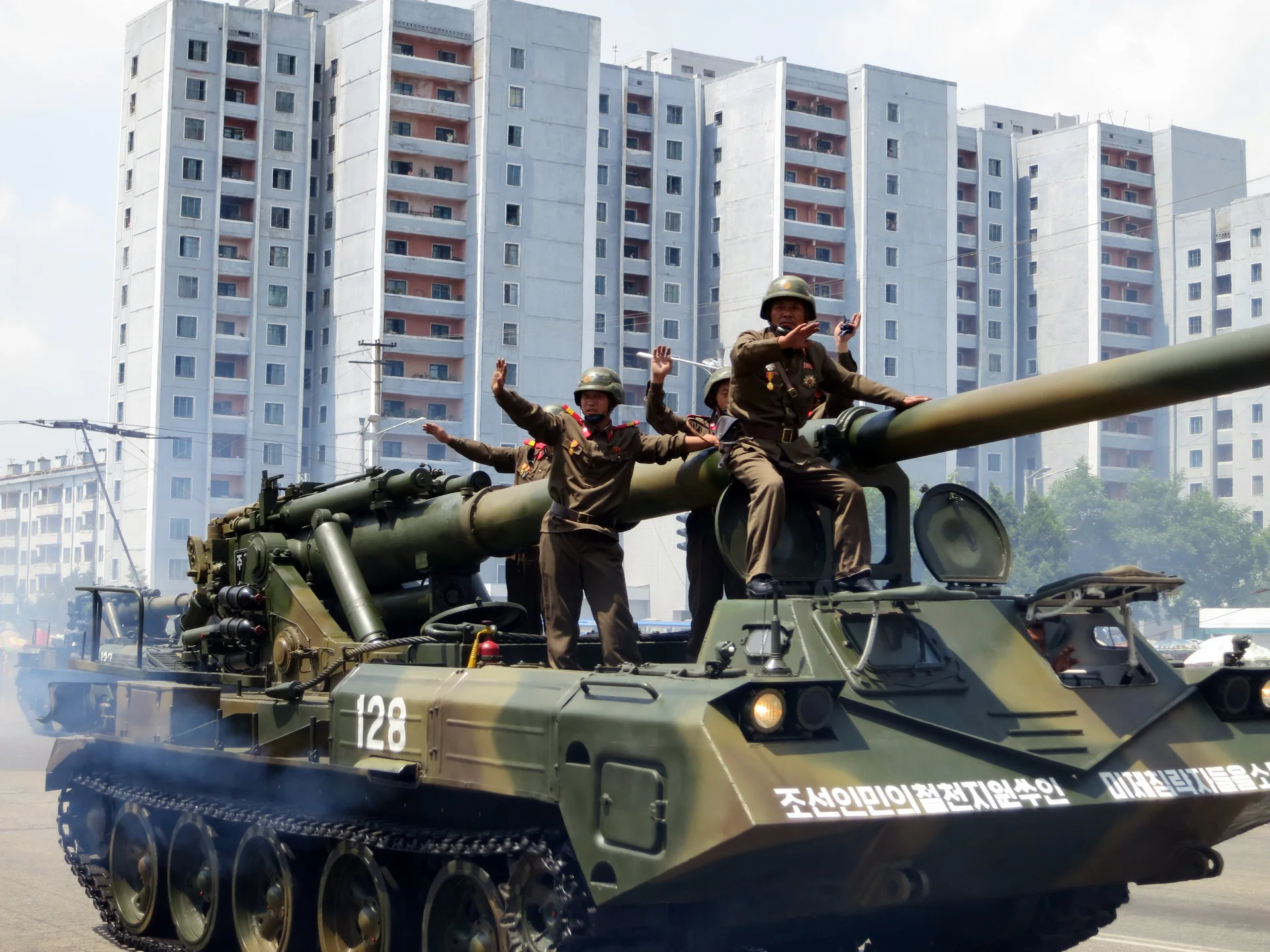
Development and design
U.S. Army reference accounts explain M-1978 as an outside designation applied after the gun was observed near Koksan in North Korea in 1978. M-1989 subsequently identified a later configuration. Neither label supplies a confirmed North Korean adoption date or a complete indigenous development history. The family is consequently known through observed vehicles, exported examples and intelligence-oriented descriptions more than through publicly accessible factory records. 1, 2
An open gun mount on a tracked carrier
The M-1978 is characterized by a large 170 mm gun mounted openly on the rear of a tracked chassis. Secondary references commonly associate the automotive base with North Korean developments related to the Type 59 tank family, though exact component lineage is less certain than the external configuration. Large rear spades stabilize the system for firing, and the crew works around the exposed breech. The arrangement avoids the enormous weight and engineering complexity that a fully enclosed turret for a 170 mm gun would require. 1, 2
A 170 mm gun optimized for reach
The family is conventionally identified as a 170 mm self-propelled gun, an unusually large caliber for a mobile field-artillery system. Public accounts also describe a long-range role, but precise ballistic data remain difficult to establish independently. Projectile type, charge and the distinction between ordinary and assisted ammunition all affect range. The profile therefore does not adopt a single maximum-range figure as a verified specification or use it to claim coverage of a named present-day target. 1, 2
Large ammunition forces an equally large support problem
A 170 mm projectile and its propelling components are physically demanding to transport and handle. The M-1978 is generally described as carrying little or no ready ammunition on the gun vehicle itself, meaning that ammunition trucks and handling crews are integral to the system. This is a major operational constraint: a self-propelled chassis can move the gun, but sustained firing remains tied to a separate logistics echelon. Long-range batteries therefore require protected ammunition routes, concealed storage, and coordination between the firing pieces and support vehicles. 1, 2
The M-1989 improved the carrier more than the concept
ODIN describes M-1989 as a successor to the earlier M-1978. Externally, the later vehicle is usually shown with a revised tracked chassis and additional stowage, including provision for carrying ammunition that the original system lacked. The gun remains an open-mounted 170 mm weapon, so the fundamental design philosophy did not change. North Korea improved the vehicle's independence and usability without turning it into a fully enclosed turreted howitzer. 1, 2
Tracked movement for an otherwise cumbersome weapon
Mounting the 170 mm gun on tracks gives the Koksan a level of tactical mobility that a towed weapon of similar size would struggle to match. The system can move between prepared positions under its own power and does not need a heavy prime mover attached to the gun carriage. That makes dispersal and relocation easier, especially within the road and position networks prepared for North Korean artillery units. It also reduces the time and equipment needed to turn a march column into a firing battery compared with an equivalently large towed gun. 1, 2
Range substituted for armor
The open rear gun mount leaves the working detachment exposed, unlike the enclosed turret of a conventional self-propelled howitzer. A turret large enough to accommodate the gun would have imposed additional weight and engineering demands. That observation explains the layout's consequences, not the undocumented reasoning of individual North Korean designers. Exact armor resistance and crew survival cannot be inferred from parade photographs or from the vehicle's overall size. 1, 2
Service history
One of the strongest pieces of evidence about the M-1978 is that examples left North Korea. Iran acquired Koksan guns during the Iran-Iraq War, providing rare photographic and operational evidence outside the closed North Korean system. At least one example associated with that conflict was later captured by Iraq and eventually examined by the United States. These export and captured examples helped analysts confirm details that would otherwise have remained dependent on distant imagery and parade observation. 1, 2
Why every Koksan specification needs caution
The M-1978 and M-1989 labels come from outside observation rather than a fully published North Korean development record. Photographs and exported examples provide firmer evidence of external arrangement than of internal mechanisms or performance. Even the commonly accepted 170 mm identification is an attributed technical identification, not something a distant image can measure directly. Gun ancestry, exact chassis lineage, production quantities and ammunition performance remain more uncertain than the recognizable open mounting and tracked layout. 1, 2
ODIN also notes that the original system was first shown publicly in the mid-1980s and that at least one example eventually reached U.S. hands. Those facts improve identification confidence, but they do not resolve every published claim about ammunition, range or production. Where those details vary, the profile retains ranges or explicit uncertainty instead of manufacturing a single authoritative specification. 3
Long range did not erase fundamental artillery tradeoffs
The Koksan's limitations follow directly from its design priorities. A very large gun gives heavy projectile effect and long reach, but ammunition is cumbersome, rate of fire is slow, the crew is exposed, and the vehicle needs large support assets. The system cannot provide the flexible high-volume fire of a modern 155 mm battery, and it is poorly suited to close maneuver support. It is instead a specialized heavy gun whose value depends on missions where range and projectile mass justify those disadvantages. 1, 2
Historical place
The names M-1978 and M-1989 are Western observation designations, not North Korean factory model names. U.S. Army ODIN's indexed record explains that M-1978 reflects the year American analysts became aware of the 170 mm system near Koksan, while M-1989 identifies the later successor first observed in that year. That naming history is central to the evidence problem because outside descriptions begin with what foreign observers could see, not with a complete North Korean technical archive. 3
Sources and further reading
References and further reading are listed below. Image identification, credit and reuse terms remain with each photograph.
- U.S. Army ODIN — M-1978 Koksan North Korea 170mm Self-Propelled Gun
- Weaponsystems.net — Koksan
- U.S. Army ODIN, M-1978 / M-1989 Koksan family (indexed asset-page evidence only)
Visit an Armor Museum
Explore the worldwide museum directory to find armored vehicles, collections, and visitor-planning information.
Browse armor museums