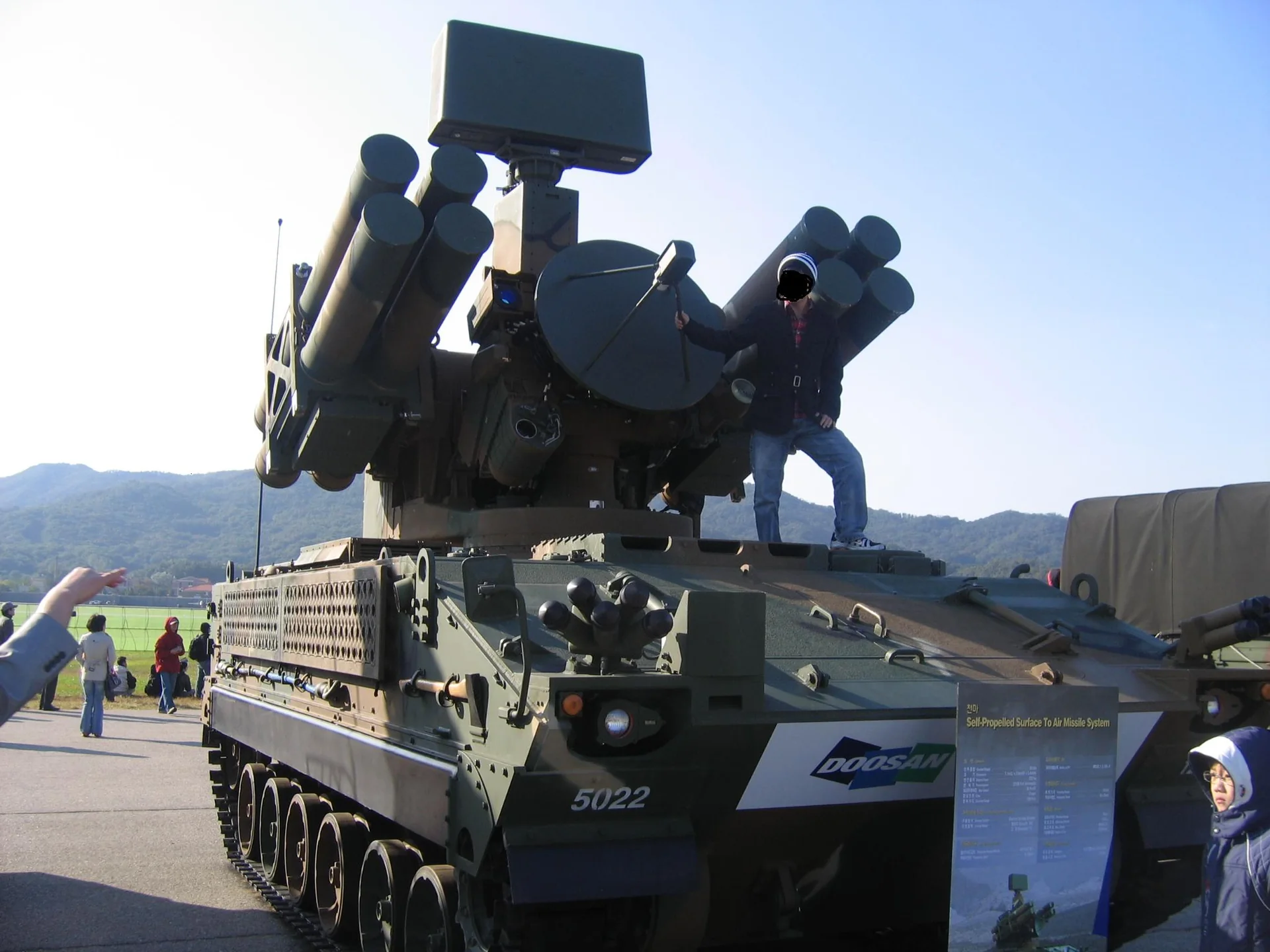
Requirement and development
Chunma emerged from South Korea’s need for a mobile low-altitude missile system that could protect field formations in a country where mountains and dense development complicate radar coverage. Korean Defense Daily records that serious development work began in July 1989, with the Agency for Defense Development directing a program in which Korean organizations would develop the missile, fire-control system, launcher turret, and vehicle while selected radar and tracking technology would be obtained through foreign cooperation. This arrangement reflected the practical state of the national defense industry: Korea sought ownership of system integration while accepting outside help in specialized areas where experience was still limited. 2
Thomson-CSF of France was selected as the important foreign technology partner. Contemporary reporting described the program as a joint effort involving numerous Korean firms, with French participation concentrated in radar, tracking, and missile-related technology. By the middle of the 1990s the system was commonly described as Chonma or Pegasus, with eight missiles on a tracked vehicle and an expected range of roughly 10 km. Production and fielding around 1999 turned the program from an industrial-development project into a regular Army capability and made Chunma one of the most visible products of South Korea’s move toward domestic short-range air defense. 1, 2, 3, 4
Vehicle architecture and crew functions
Chunma carries its launcher and sensor package on a tracked chassis so it can follow mechanized units rather than defend only fixed sites. Eight missile canisters are arranged around the turret structure, with radar and tracking equipment integrated into the same vehicle. This compact architecture reduces the time between target detection and weapon assignment because the crew does not depend on a separate remote launcher for every engagement. It also lets a firing unit displace with the supported formation, an essential characteristic when air-defense coverage must move through valleys, road networks, and temporary assembly areas. 1, 3, 4
The vehicle is not merely a missile rack. Radar, command-guidance equipment, identification and control functions, communications, electrical power, crew stations, and missile stowage all compete for space and weight. The choice of a tracked carrier reflects the same logic found in other maneuver air-defense systems: the launcher must remain close enough to armored forces to cover them without becoming road-bound. The trade-off is maintenance complexity. A missile system with radar and sophisticated electronics demands more specialized support than a basic armored vehicle, making training, diagnostics, spares, and calibration an inseparable part of combat readiness. 1, 2
Missiles and engagement concept
Chunma uses a battery of eight ready short-range missiles intended for low-altitude targets inside the Army’s close defensive zone. Contemporary accounts and later manufacturer material place the practical range at around 10 km, giving the system greater reach than gun-only vehicles such as the original Biho while still leaving longer-range air defense to other echelons. The weapon is best understood as a point and maneuver-defense system: it protects units, routes, and tactical areas from aircraft and helicopters that enter the low-altitude envelope rather than attempting to replace theater-level missile defense. 1, 3, 4
The missile system uses command guidance associated with the line-of-sight tracking process described in Korean program histories. That means the vehicle’s sensors and fire-control system remain central during the engagement; performance cannot be reduced to the missile airframe alone. Radar detection, target tracking, identification, guidance-command generation, and crew decisions form a single sequence. This design was technically demanding for the Korean industry of the late 1980s and early 1990s, which helps explain the deliberate combination of indigenous development and French technology transfer during the program. 2, 3
Radar, tracking, and fire control
The sensor suite was one of the most important parts of Chunma’s development. Korean Defense Daily describes a program decision to use technology transfer for radar and tracking while keeping broader system development under Korean control. This provided a route to a fieldable capability without abandoning the long-term goal of domestic integration. The finished system combines surveillance and tracking functions on the vehicle, allowing a crew to search for low-altitude targets, establish a track, and support missile guidance without waiting for a separate engagement radar to be positioned nearby. 2
Terrain makes that autonomy particularly valuable. Radar cannot see through mountains, and a low-flying aircraft can appear with little warning after using terrain masking. Chunma therefore operates most effectively when its local sensors are combined with external warning from the wider air-defense network. Higher-echelon information can cue the launcher toward a threat sector before the target crosses the local radar horizon, while the vehicle’s own sensors provide the precision needed for engagement. The result is layered sensing rather than a claim of complete independent coverage. 1, 2
Mobility, protection, and sustainment
A tracked launcher makes Chunma a tactical system rather than a semi-fixed missile site. It can accompany maneuver forces across the same general terrain, occupy short-duration firing positions, and relocate as the supported unit changes direction. Mobility also improves survivability because a radar-equipped air-defense vehicle is a high-value target. Repeated displacement and the use of terrain reduce the time available for an opponent to locate and attack a known position, although the need to operate sensors means concealment can never be complete. 1, 2, 3
Protection is necessarily limited by the requirement to carry missiles, radar, and electronics on a mobile chassis. The crew receives armored-vehicle protection from fragments and small-arms hazards, but Chunma is not intended to fight in the direct-fire zone like a tank. Sustainment is more demanding than the outwardly simple eight-canister launcher suggests. Missile condition, radar performance, guidance electronics, vehicle maintenance, power generation, communications, and crew proficiency all determine whether a system that looks ready on paper can actually respond within the short timeline of a low-altitude engagement. 1, 2
Fielding and Army service
Chunma entered production and Army service around 1999, roughly a decade after the development program accelerated. The long gestation reflected both technical ambition and the process of creating an industrial base capable of producing and supporting the system. In Republic of Korea Army organization, Chunma occupies the short-range missile layer alongside gun-based and combined gun-missile systems. It covers maneuver units and tactical sites against low-altitude threats while longer-range systems provide broader regional defense. 1, 2, 4
Chunma’s tracked carrier and missile armament place it in a different part of the close-defense organization from the original gun-only Biho. The two need not duplicate one another: missile reach, gun ammunition, local sensors and support requirements create different constraints. A manufacturer’s portfolio can establish that both systems were offered, but it cannot by itself reconstruct their exact battery distribution or prove the readiness of a contemporary formation. 1, 2
Technology transfer and domestic industry
Chunma is an important case study in technology transfer. The project did not represent either a wholly foreign import or a completely isolated indigenous invention. Instead, Korean agencies and firms divided the system into areas that could be developed domestically and areas where foreign radar and tracking technology would accelerate progress. Korean Defense Daily identifies Thomson-CSF as the selected partner and notes the participation of multiple domestic companies. The arrangement allowed South Korea to field a capable system while accumulating practical experience in integration, production, testing, and support. 2, 4
Hanwha’s 2016 profile lists CHUNMA as a guided surface-to-air missile system and CHUNMU as a multiple rocket launcher. The similar English spellings should not hide the different missions. The same portfolio also lists BIHO and Hybrid BIHO, but that shared industrial presentation does not make Chunma a Biho variant. The catalog establishes those product identities, not a complete technology-transfer history or the specifications of later Korean missile families. 5
The 2016 Hanwha portfolio lists CHUNMA among air-defense products while presenting CHUNMU separately as a multiple-launch rocket system. The similar romanized names should not conceal the different missions and equipment. This is a small but important industrial-history distinction: a corporate list containing both products is not evidence that one was a missile upgrade, export name or chassis variant of the other. The profile documents how the manufacturer organized its portfolio in 2016, not when every individual Chunma entered service. 5
Operational constraints
Chunma’s short-range role imposes clear limits. The system must be positioned close enough to the protected force that it can react before fast targets cross the defended area. Terrain can mask both the launcher’s radar and the target, while electronic warfare may complicate active sensing and command links. Eight ready missiles provide a useful engagement load but not an unlimited one, so reload and resupply become important during sustained operations. These constraints make battery placement, mutual support, and integration with other sensors essential to effective coverage. 1, 2, 3
The changing air threat also alters the economics of short-range defense. Small unmanned aircraft, loitering munitions, stand-off weapons, and massed raids can create more potential targets than a missile launcher was originally designed to service economically. Chunma remains relevant as a mobile guided-weapon layer, but no single system can solve that problem alone. Gun systems, missiles of different ranges, electronic warfare, passive detection, and command networks must share the defensive burden. This is why Chunma’s historical importance should not be confused with a claim of universal contemporary effectiveness. 1, 3
Historical place
Chunma represents one of South Korea’s early successful efforts to field a domestically integrated tracked surface-to-air missile system. Its development linked government research organizations, Korean manufacturers, and a major foreign technology partner in a program that produced both a military capability and industrial experience. Entering service around 1999, it gave the Army a mobile missile layer tailored to local terrain and maneuver requirements while reducing reliance on the direct purchase of complete foreign systems. 1, 2, 4
In the broader history of armored air defense, Chunma fits the late-Cold War and post-Cold War move toward compact vehicles that combine sensors, missiles, communications, and protected mobility. Its significance is not that it introduced an entirely new class of weapon, but that it localized that class within the Korean defense establishment. Alongside Biho, it illustrates how national industry can create overlapping gun and missile layers designed to support a specific army, geography, and sustainment system. 1, 2
Sources and further reading
- Hanwha Aerospace , Hanwha Defense Brochure (CHUNMA)
- Korean Defense Daily , Development history of Chunma (14 March 2022)
- Center for Nonproliferation Studies , Chonma/Pegasus contemporary program note
- SpaceDaily / AFP , France Helps South Korea Build New Missiles (1999)
- Hanwha Profile 2016, Defense Systems portfolio, printed pages 74–75
Visit an Armor Museum
Explore the worldwide museum directory to find armored vehicles, collections, and visitor-planning information.
Browse armor museums