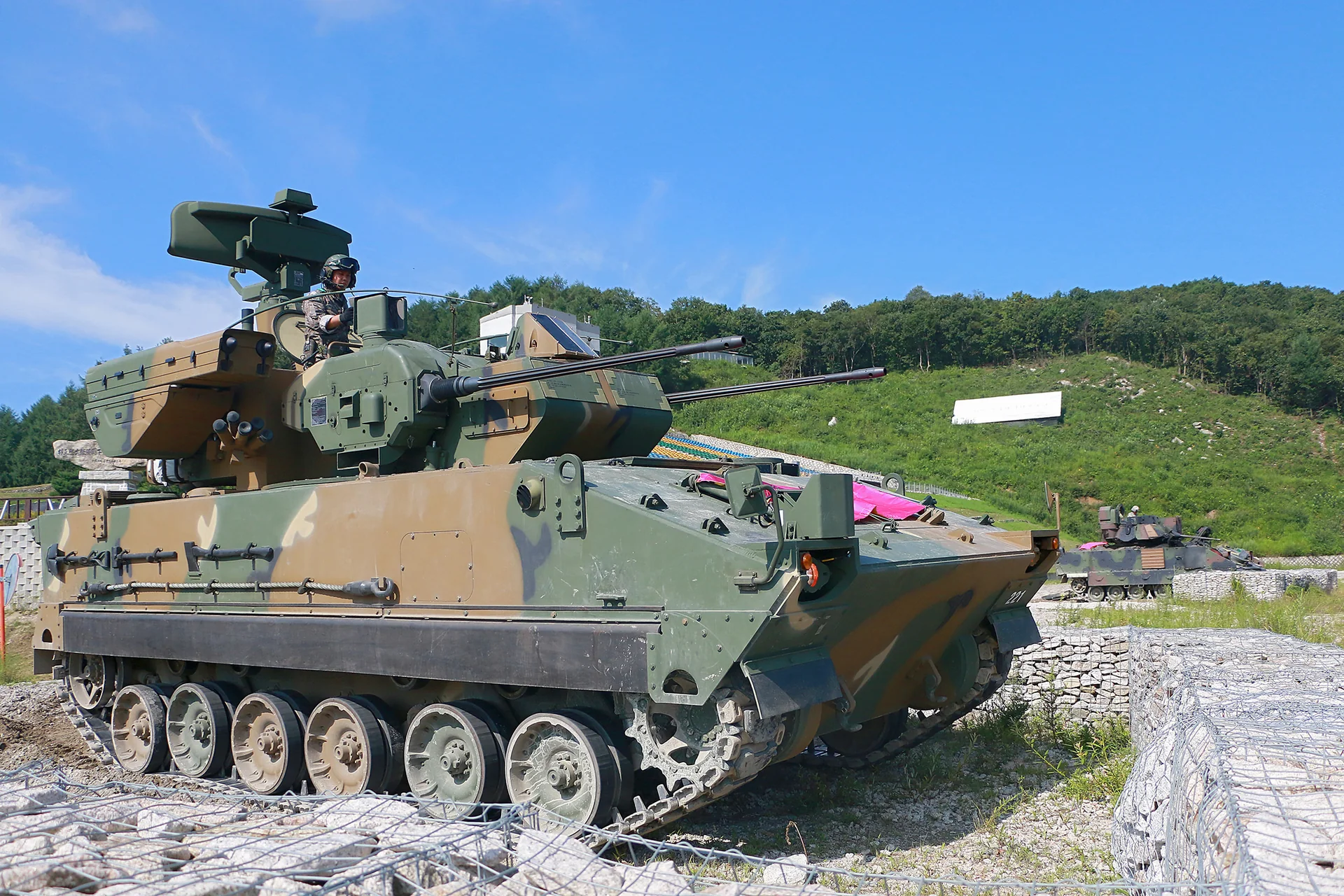
Requirement and development
South Korea began the Biho program during the 1980s as part of a wider effort to reduce dependence on imported air-defense equipment and to create a system suited to the peninsula’s terrain and the Republic of Korea Army’s highly mobile ground forces. The requirement was not simply for an anti-aircraft gun on tracks. It called for a vehicle that could detect, track, and engage low-flying targets while moving with armored and mechanized formations whose routes were constrained by mountains, valleys, towns, and short lines of sight. Development therefore combined a tracked carrier, twin medium-caliber cannon, surveillance radar, electro-optical tracking equipment, and local fire control in one combat vehicle. 1, 2, 3
The program required the integration of radar, gun-control equipment, ammunition handling, electrical generation and a tracked carrier. WeaponSystems places development across the 1980s and early 1990s, followed by low-rate and then broader production. Those dates remain part of the inherited historical account. They should not be presented as verified by a corporate portfolio page, which confirms product identity but does not provide a complete development chronology. Nor does installation of powered gun control alone establish that effective firing on the move was a fielded capability. 1, 2, 3
Hanwha's 2016 corporate profile places Biho and Hybrid Biho separately within its defense-systems portfolio. That contemporary presentation is useful because it does not require the missile-equipped version to be read backward into the original gun vehicle. The page is evidence of the manufacturer's product distinctions and industrial context, not a technical acceptance record for every listed configuration. 3
Vehicle architecture and crew arrangement
Biho uses a tracked chassis with the turret and air-defense mission equipment carried high on the vehicle so radar, optical sensors, and cannon have the necessary arcs of observation and fire. A four-person crew divides driving, command, target-acquisition, and weapon-control tasks. This is important because short-range air defense compresses the decision cycle: a low-flying aircraft or helicopter can appear behind terrain and cross the weapon envelope in seconds. The vehicle’s architecture therefore centers less on troop carrying than on giving the crew an integrated set of sensors and controls while retaining enough protected volume for ammunition, electronics, power systems, and routine sustainment. 1, 2
The tracked carrier reflects the operational need to accompany Korean armored units rather than remain on roads. The cited Hanwha brochure for Hybrid Biho list a combat weight of about 26.5 tonnes, a 520-horsepower engine, and a maximum road speed of roughly 60 km/h. Older references give somewhat different weights and speeds for earlier configurations, illustrating how the vehicle changed during its production and modernization life. The useful point is not a single immutable number but the design balance: enough mobility to keep pace with the supported formation, enough payload for radar and ammunition, and enough stability for controlled bursts from the twin cannon. 1, 2
Cannon armament and engagement concept
The original K30’s defining weapons are two 30 mm cannon mounted in the turret. The cited Hybrid Biho brochure gives a combined cyclic rate of about 1,200 rounds per minute and an effective gun range of roughly 3 km. The cannon are intended for short, radar- or electro-optically controlled engagements against targets that have penetrated into the formation’s close air-defense zone. They also give the crew a weapon that does not depend on missile seeker availability or missile stocks. In doctrinal terms this makes the gun system a last-layer defender against low-altitude aircraft and helicopters rather than a substitute for longer-range surface-to-air missile units. 1, 2
Later Hybrid Biho vehicles add four ready SINGUNG short-range missiles, two on each side of the turret. Hanwha lists an effective missile range of about 6 km, roughly doubling the gun-only engagement reach and giving the crew a second effector with different kinematic and lethality characteristics. The addition changes the tactical flexibility of the vehicle without erasing the original Biho identity: the cannon remain available for very short-range targets and for situations in which a missile engagement is undesirable or impossible. Because the hybrid specification is later than the first production K30, historical accounts should not retroactively describe every Biho as having the missile fit. 1, 3
Sensors and fire control
Biho’s operational value depends as much on detection and tracking as on its cannon. The cited Hanwha brochure describes an X-band pulse-Doppler search radar with a detection range around 21 km and an electro-optical tracking system combining television, thermal imaging, and a laser rangefinder. These sensors give the crew alternatives: radar can provide autonomous search and target cueing, while electro-optical tracking offers a passive means of following a target and can remain useful in an electronic-warfare environment. The system is therefore an integrated air-defense vehicle rather than a visually aimed gun carrier in the tradition of earlier self-propelled anti-aircraft weapons. 1
Korea’s hills and developed terrain can restrict a local radar view, making external warning useful even when a vehicle carries its own search equipment. Biho’s local tracking and gun-control functions are intended to turn a detected target into a firing solution. This is different from proving the ability to engage accurately while the carrier is moving. The retained source set does not justify a universal firing-on-the-move claim, so sensor integration and vehicle movement are described separately. 1, 2
Mobility, protection, and sustainment
Biho’s tracked chassis lets it move on the same kinds of cross-country routes used by the maneuver units it protects. That characteristic is easy to overlook in discussions focused on radar and weapons, but it is central to the system’s military utility. Short-range air-defense vehicles must repeatedly displace to avoid becoming predictable, keep close enough to the supported force to cover it, and remain usable when road networks are congested. The power-to-weight balance shown in manufacturer data is therefore part of an operational design choice rather than a performance statistic in isolation. 1, 2
Protection is oriented toward the hazards faced by a mobile support vehicle, not tank-like resistance. Radar, optical equipment, ammunition handling and tracked running gear add different maintenance tasks, so automotive availability alone does not establish air-defense readiness. Local production can provide an industrial support base, but the present source set does not measure spare-parts sufficiency or component independence. Those are separate questions from whether a vehicle was domestically integrated and marketed. 1, 3
Service history and organization
K30 entered Republic of Korea Army service around the end of the 1990s and became a recognizable part of the country’s layered short-range air-defense structure. Its purpose is to protect maneuver forces and important tactical assets from low-altitude attack, complementing rather than replacing missile systems with greater reach. In service, the vehicle’s mobility allows batteries to redistribute coverage as brigades and divisions move, while radar and electro-optical sensors give local commanders a measure of autonomous target detection even when higher-echelon information is delayed or incomplete. 1, 2, 3
An official U.S. Army DVIDS caption records Republic of Korea Army K-30 Biho live-fire training at Daejeon in March 2026. The caption and date-taken metadata differ by one day, so the month is used here. This is evidence of a documented training appearance, not a fleet census, combat assessment or confirmation of the equipment on every Biho. The video itself was not used to identify a missile configuration. 4
Hybrid Biho and related development
The most important evolution is Hybrid Biho, which combines the existing twin 30 mm cannon with four ready SINGUNG missiles. This upgrade is more than a bolt-on increase in range: it gives one crew two different engagement mechanisms and lets the commander choose an effector according to target range, aspect, and availability. The cited Hanwha brochure describes the hybrid vehicle as a gun-and-missile air-defense system with search radar and electro-optical tracking. Historical profile data should therefore identify the configuration being discussed, because production K30s from the early fielding period and later Hybrid Biho vehicles do not have identical combat systems. 1, 3
Hanwha’s 2016 corporate profile lists BIHO, Hybrid BIHO and CHUNMA as separate products. This supports a distinction between the gun vehicle, its gun-and-missile development and the dedicated missile system. It does not establish that every original K30 was converted to Hybrid Biho, or that Chunma is another Biho turret option. Detailed performance figures must come from the appropriate vehicle documentation rather than the shared corporate portfolio. 3
The manufacturer's business profile describes Hybrid Biho as a combination of anti-aircraft guns and guided missiles. It separately discusses the wheeled 30 mm anti-aircraft gun vehicle supplied to the Republic of Korea armed forces from 2021. These entries establish a distinction between changing the tracked Biho's weapon package and introducing a different wheeled carrier. A general phrase such as the Korean 30 mm air-defense vehicle can conceal that difference. Neither a common caliber nor a shared corporate product page makes the wheeled vehicle a tracked Biho subvariant. 5
Constraints and changing threat environment
Like every close-range gun system, Biho is constrained by the speed at which modern aircraft, stand-off weapons, and unmanned systems can move through or around its engagement zone. Terrain that helps conceal a vehicle can also obstruct its radar horizon, and active radar emission can reveal the system’s presence to an opponent equipped for electronic support. Ammunition capacity and reload time limit how long a single vehicle can sustain repeated engagements. These are not unique flaws; they are inherent trade-offs in a mobile short-range system that must carry its own sensors, weapons, crew, and ammunition. 1, 2
The Hybrid Biho answer to some of those constraints is to expand the engagement envelope with missiles while retaining cannon for the inner zone. Even so, a single vehicle cannot create complete air protection. It works best as one node within a network that supplies early warning, identification, deconfliction, and overlapping coverage. Modern small unmanned aircraft also place new pressure on the economics of air defense because inexpensive targets can consume finite ammunition and missile stocks. Biho’s continued relevance therefore rests on integration and adaptation rather than on any claim that its original 1990s technology provides a self-contained solution to every contemporary air threat. 1, 3
Historical place
Biho is historically significant because it demonstrates South Korea’s transition from a heavy reliance on imported air-defense weapons toward a domestically engineered mobile system built for national requirements. The vehicle combined a locally supported tracked platform, radar, electro-optics, and automatic cannon at a time when South Korea’s defense industry was broadening from licensed production into more complex indigenous systems. Its value as an archive subject lies in that industrial story as much as in the gun specifications: the system represents a national effort to control integration, production, and long-term support for a critical battlefield function. 1, 2, 3
The later hybrid configuration also captures a wider trend in ground-based air defense. Gun systems that once stood alone increasingly gained missile partners, improved electro-optics, digital fire control, and network connections as threats became faster, smaller, and more varied. Biho thus forms a bridge between the classic radar-directed self-propelled anti-aircraft gun and the modern combined-effector short-range air-defense vehicle. It remains best understood not as a universal solution, but as one layer in a deliberately overlapping defense designed to move with the forces it protects. 1, 3
Sources and further reading
- Hanwha Aerospace , Hanwha Defense Brochure (BIHO / CHUNMA)
- WeaponSystems.net , K30 Biho
- Hanwha Profile 2016, Defense Systems portfolio, printed pages 74–75
- U.S. Army DVIDS, ROK Army soldiers fire K-30 Biho, March 2026 video caption (caption and metadata only)
- Hanwha, aerospace and defense business profile
Visit an Armor Museum
Explore the worldwide museum directory to find armored vehicles, collections, and visitor-planning information.
Browse armor museums