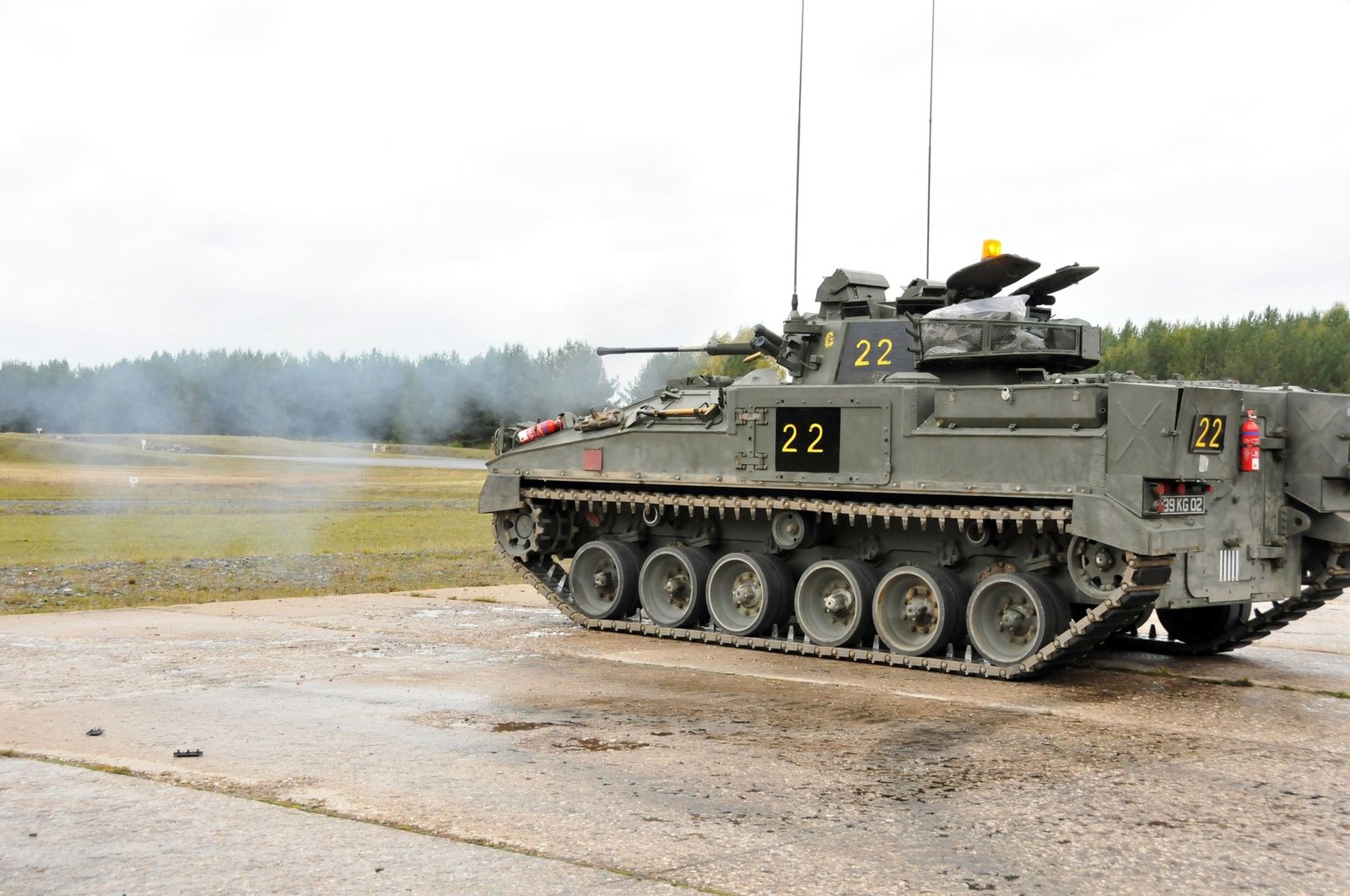

Development and requirement
The Warrior grew from Britain’s MCV-80 program and entered service in 1988 as the armored infantry counterpart to the Army’s main battle tanks. The design emphasized cross-country mobility, protection, and enough firepower to defeat light armored vehicles while carrying a complete infantry section close to the objective. 1, 2
Design and fighting role
The FV510 uses a conventional tracked layout with a driver forward, two-man turret, and rear troop compartment. Its 30 mm RARDEN cannon and coaxial machine gun supported infantry after dismount. The British Army describes the family as capable of keeping pace with Challenger tanks over difficult terrain, while later appliqué armor and thermal-imaging improvements adapted the vehicle to changing threats. 1, 2
Service and evolution
Warrior served in the Gulf War, the Balkans, Iraq, Afghanistan, and other deployments. Combat experience led to added armor and survivability measures, including bar armor in Iraq. The family also supported command, artillery observation, and repair functions, demonstrating the value of a common armored chassis within brigade formations. 1, 2
Archive boundaries
The archive keeps the infantry-carrying FV510 at the center of the family while linking specialist Warrior variants through lineage. Boxer, which is replacing Warrior in British heavy mechanized formations, is treated as a separate wheeled APC family rather than as a Warrior successor variant. 1
Sources and further reading
Representative source set used for this profile. Primary image source and reuse terms are listed with the image.