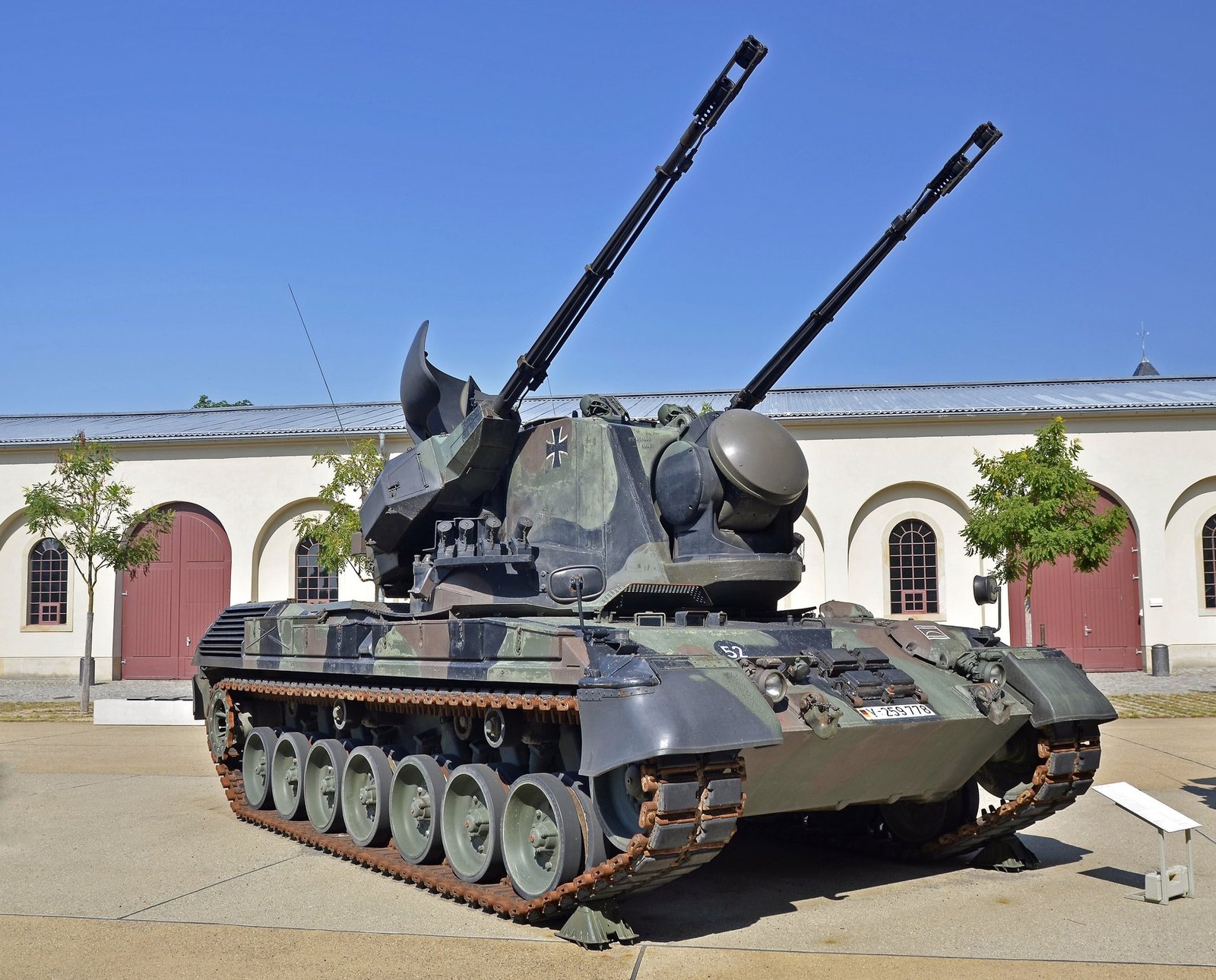
_in_Dresden.JPG)
Air defense that could keep up with armor
Cold War mechanized formations needed air defense able to move at the pace of tanks and infantry fighting vehicles while reacting quickly to low-level aircraft and helicopters. West Germany developed the Gepard around Leopard 1 automotive components, giving the air-defense vehicle the mobility to accompany the maneuver force. 1, 2
The system combined twin 35 mm cannon with onboard search and tracking radar, allowing a single vehicle to detect, track, and engage targets without relying on a separate fire-control vehicle for every engagement. 1
Radar, guns, and an armored chassis
Bundeswehr descriptions emphasize the Gepard’s rotating search radar, tracking radar, and all-weather engagement capability. The crew could also engage ground targets optically, although the vehicle’s purpose remained short-range air defense. 1
This combination is why the Gepard belongs squarely in the Armor Archive. It is not merely a truck carrying an antiaircraft gun: the vehicle integrates armored mobility, sensors, fire control, and weapons into a dedicated combat system designed to live with armored units. 1
Bundeswehr service and retirement
The Bundeswehr used the Gepard from 1976 until 2010, with the 1A2 among its final German configurations. The vehicle served alongside missile systems in the Army air-defense force before Germany retired the type as that organizational structure was dissolved. 1, 2
Later operators and renewed battlefield demand have extended the historical relevance of the design beyond its German retirement. Those operator-specific chapters will be treated separately from the basic German development and service story so transfer, modernization, and combat-use dates do not blur together. 1
Why air-defense armor belongs here
Gepard demonstrates the logic of the Version 2 expansion: a purpose-built armored combat vehicle should not be excluded simply because its main target is in the air. Its armor, tracked mobility, integrated weapons, and tactical relationship to maneuver formations make it part of armored warfare history. 1
Sources and further reading
Representative source set used for this profile. Primary image source and reuse terms are listed with the image.