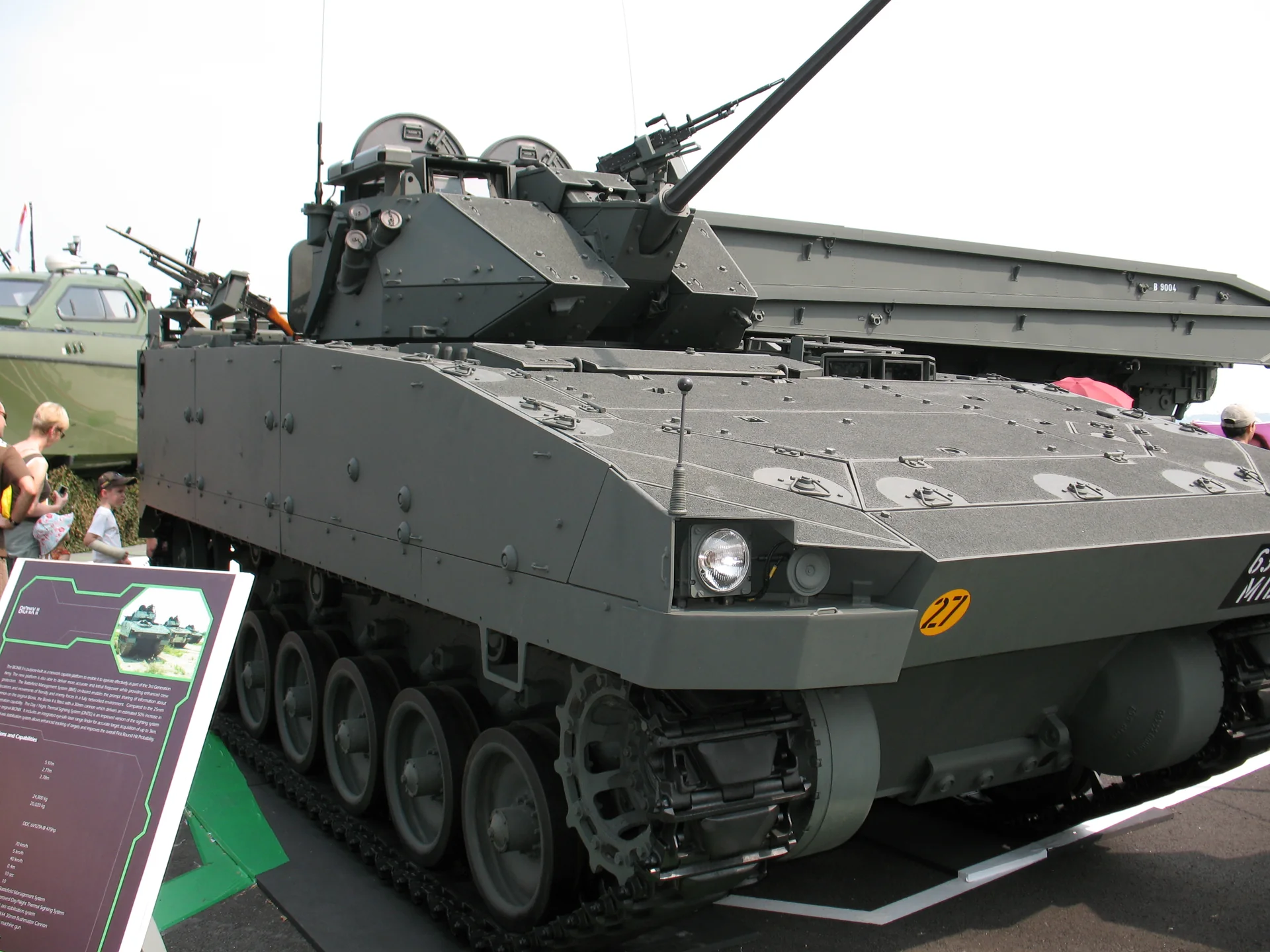
Development and requirement
Singapore developed Bionix as part of a long-term effort to modernize its armored force beyond upgraded M113 carriers. The program established a domestic design and production base for tracked combat vehicles. 1
The Bionix family spans several weapon arrangements. The Singapore Army distinguishes the Bionix 40/50 from the 25 mm two-man-turret vehicle it labels Bionix 2MT. The later Bionix II carries a 30 mm cannon. “2MT” on that formation page is therefore not another name for Bionix II. 2, 3
Design, protection, and mobility
Bionix combines a compact tracked troop-carrying hull with different weapon installations. It should not be described as universally cannon-armed: the 40/50 configuration and the cannon versions use different arrangements. The Singapore Army lists eleven occupants for the 40/50 as a commander, driver and nine troops. Its 2MT entry instead identifies a commander, driver, gunner and eight troops. Those figures belong to the page’s named configurations, not to every later Bionix generation. 2
The tracked layout of the Bionix Infantry Fighting Vehicle Family emphasizes cross-country mobility and the ability to remain with armored formations away from improved roads. Tracks spread vehicle weight over a larger contact area and help negotiate soft ground, broken surfaces, and obstacles, but they bring higher maintenance demand and more mechanical wear than an equivalent wheeled carrier. For crews and infantry, this means mobility is inseparable from sustainment: track condition, suspension components, fuel, recovery support, and route selection all affect whether the vehicle can deliver its combat function when required. The design is therefore a compromise between tactical mobility and the logistical cost of preserving that mobility over time. 1
Protection and internal volume are especially difficult problems in an infantry fighting vehicle because the hull must serve both a vehicle crew and a dismounted fighting element. The troop compartment needs usable space, access routes, ammunition stowage, communications, and enough separation from fuel and mechanical systems to make the vehicle practical in repeated operations. Adding armor improves resistance to fragments and direct fire, but it also increases weight and can reduce mobility, amphibious margin, payload, or growth capacity. As threats change, many IFV modernization programs therefore become exercises in managing accumulated weight and electrical demand as much as in fitting a new gun or sight. 1
Firepower and battlefield role
Firepower on the Bionix Infantry Fighting Vehicle Family has to be read through its mission rather than by caliber alone. Armored carriers and fighting vehicles use their weapons to protect movement, suppress opposition, cover dismounts, and create enough local advantage for the formation to continue its task. The usefulness of that weapon depends on sights, stabilization where fitted, ammunition, crew training, and the ability to detect a target before the vehicle is itself exposed. The vehicle's combat value therefore comes from the integration of mobility, protection, observation, communications, and weapon effect rather than from a single specification in isolation. 1
Service, variants, and modernization
Bionix became a mainstay of Singapore Army Armour and remains in service alongside the newer Hunter. The two vehicles show an evolutionary transition rather than an immediate one-for-one replacement. 1
The 23 October 2006 MINDEF factsheet presents Bionix II as more than an armament change. It describes a battlefield-management system linking the vehicle with headquarters and other assets, a Mk44 30 mm cannon, and an improved day/night sight with a laser rangefinder. The release’s percentage improvements are government estimates, not independent tests reproduced here. 3
The 2006 factsheet distinguishes a 20,020-kilogram empty weight from a 24,800-kilogram combat weight and gives a total capacity of ten. Those figures should not be combined with the formation page’s eleven-person 40/50 or 2MT arrangements. Each describes a named configuration, not a universal Bionix family specification. 3
How the vehicle fits the formation
In combined-arms employment, the Bionix Infantry Fighting Vehicle Family is not an independent substitute for tanks, infantry, artillery, engineers, or air defense. Its purpose is to connect protected mobility with the infantry's ability to seize and hold ground. The mounted crew can observe and engage while the dismounted element deals with terrain and threats that cannot be solved from inside the hull. Effective use therefore depends on coordination: tanks provide heavier direct fire and protection, artillery and mortars suppress or isolate, engineers open routes, and the infantry fighting vehicle moves soldiers while contributing its own sensors and weapons. The platform is most effective when those capabilities overlap rather than when it is sent forward alone. 1
Strengths, limitations, and family boundaries
The archive treats the principal cannon-armed troop carriers as IFVs. Other Bionix chassis roles remain linked through lineage while preserving their own battlefield classifications. 1
Bionix remained an active Singapore Army platform into the late 2010s: MINDEF documented safety modifications installed from November 2018, including additional emergency-horn controls in the rear troop compartment and a rear-view camera system. That evidence is useful because it shows continued fleet-level modification after Bionix II entered service, without implying a wholly new vehicle generation. 4
The family boundary is therefore best handled by named configuration. Bionix 40/50, the 25 mm two-man-turret vehicle, Bionix II, and later support derivatives share lineage, but Singaporean records assign different armament, crew arrangements, and improvement packages to them. The archive keeps those distinctions visible rather than treating every Bionix as one fixed specification. 1 3 4
Sources and further reading
References and further reading are listed below. Image identification, credit and reuse terms remain with each photograph.
- Singapore Ministry of Defence, Armour Formation equipment and history
- Singapore Army: Armour formation equipment descriptions
- MINDEF: Bionix II capabilities and technical specifications, 23 October 2006 (NAS archival PDF) (original dated factsheet, not a technical manual)
- Singapore MINDEF, Enhancements to Bionix Infantry Fighting Vehicle, 11 February 2019
Visit an Armor Museum
Explore the worldwide museum directory to find armored vehicles, collections, and visitor-planning information.
Browse armor museums