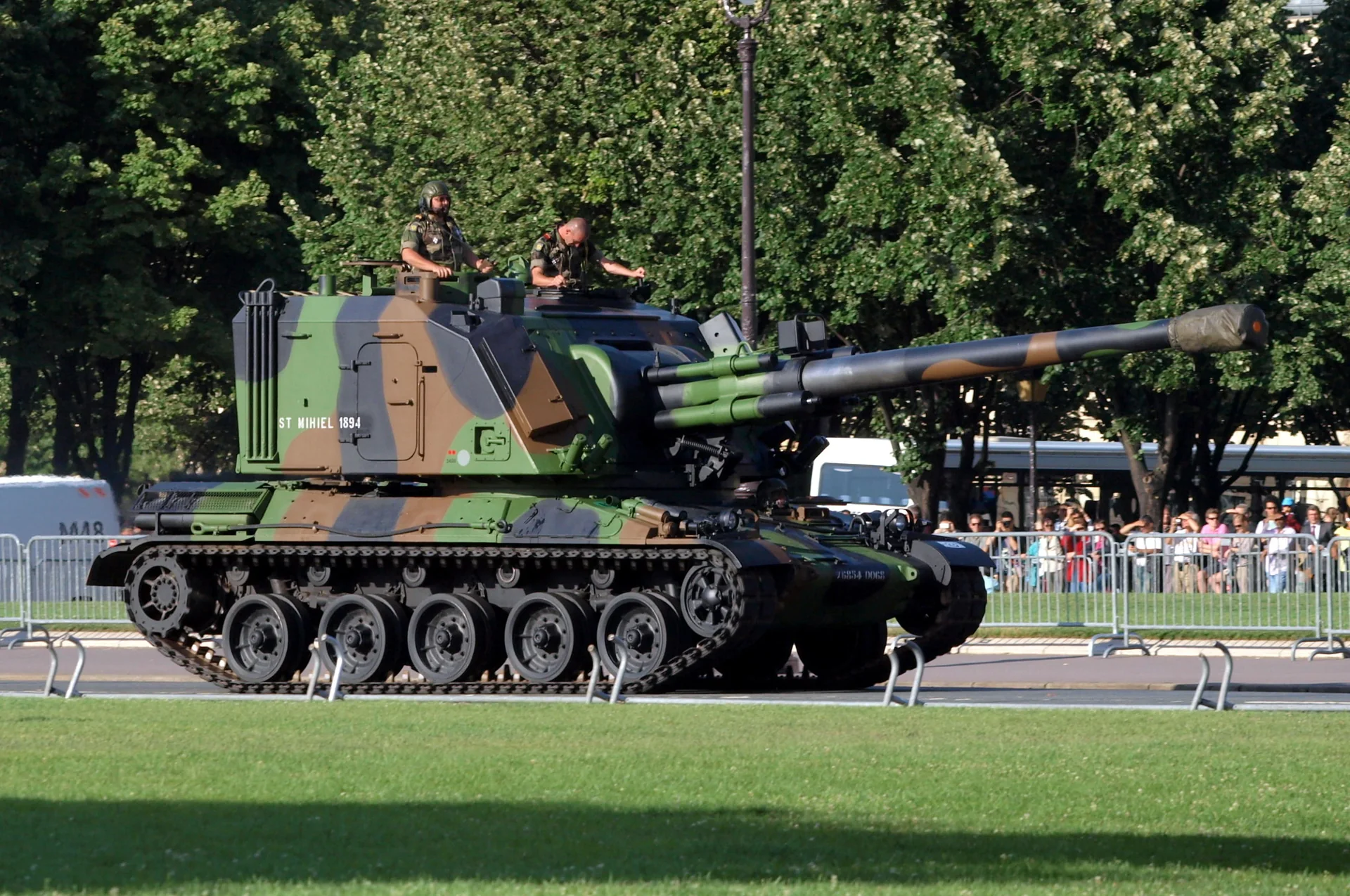
Development and design
Development of the system that became the AuF1 began around the turn of the 1970s. Weaponsystems.net places development from 1969 into the mid-1970s and describes the GCT/AuF1 as a French effort to field a modern 155 mm self-propelled howitzer with a fully enclosed turret. The choice reflected the same pressures affecting other NATO armies: artillery needed enough mobility to keep pace with armored formations, enough protection to operate on a dangerous battlefield, and enough automation to deliver substantial fire without an oversized crew. 1
The same secondary history traces development from 1969 through the mid-1970s, with prototypes appearing in 1972. Those dates are best read as separate development milestones, not as evidence that all vehicles or export customers received the same configuration at once. Production, national acceptance and later upgrades followed their own timelines. 1
AMX-30 mobility beneath a dedicated artillery turret
The AuF1’s tracked chassis gave it the cross-country mobility expected of an armored formation’s organic artillery. Weaponsystems.net describes a front-driving position, tank-derived running gear, and a large rear turret. The vehicle’s proportions differed sharply from the low AMX-30 battle tank because the artillery turret needed room for the gun breech, crew stations, ammunition, and loading machinery. That high, boxlike superstructure became the vehicle’s most recognizable feature. 1
A 155 mm weapon built for mechanized artillery
Weaponsystems.net identifies the main armament as a 155 mm 40-caliber howitzer with a 360-degree traverse. Published figures for maximum range depend on ammunition; a French Ministry of the Armed Forces regimental page lists the AuF1 among the 40e Régiment d’Artillerie’s equipment and cites a range of up to 24 kilometers in its service description. That figure is useful as a French-service reference point, but the vehicle’s historical role cannot be reduced to maximum range alone. 1, 2
Service history
The AuF1 entered French service during the late Cold War and became one of the country’s principal self-propelled artillery systems. Its tracked mobility fit an army still structured around armored and mechanized formations expected to fight in Europe. The vehicle also represented national industrial independence: France fielded a domestically designed chassis lineage, gun system, and supporting artillery equipment rather than relying wholly on an imported self-propelled howitzer. 1, 2
ATLAS and the digitalization of French artillery
French descriptions connect AuF1 modernization with CALP-equipped guns and the ATLAS artillery command-and-control system. This was a development in how information reached and was processed by the gun, not a replacement for the vehicle's turret or chassis. Older and upgraded installations should remain distinguishable. Digital mission handling could extend the usefulness of the existing weapon while leaving much of its original automotive and ammunition-handling architecture in place. 3
A turret concept with life beyond the French chassis
The GCT/AuF1 turret was offered beyond the standard French AMX-30 installation. Export and demonstration configurations show why gun-and-turret ancestry must be distinguished from the chassis beneath it. A proposal or displayed alternative is not automatically evidence of serial production for a customer. This profile centers on the AMX-30 AuF1 and treats other installations as related developments rather than giving all of them one set of automotive specifications. 1
Tracks, armored formations, and changing operational priorities
The tracked chassis gave the AuF1 strong cross-country mobility and allowed it to accompany mechanized forces over terrain that could challenge heavy wheeled vehicles. During the Cold War, this was a logical choice for artillery expected to support armored operations in Europe. Track systems imposed higher maintenance and transport burdens on long road moves, but those costs were accepted in return for tactical mobility and commonality with a force built around tracked combat vehicles. 1
The value of an enclosed artillery vehicle
The AuF1 gave its crew armored protection while moving and during much of the firing cycle. The armor was not intended to withstand the same threats as a main battle tank, but it offered meaningful protection against fragments, small-arms fire, and battlefield contamination compared with exposed towed artillery. Weaponsystems.net also describes NBC protection, a feature consistent with the Cold War expectation that artillery might have to continue operating in contaminated environments. 1
A product of France’s independent defense-industrial strategy
The AuF1 belongs to a period when France maintained a particularly broad domestic defense-industrial base. The country produced its own tanks, aircraft, missiles, artillery, and command systems while remaining part of the Western strategic environment. Developing a national self-propelled howitzer fitted this pattern. The use of an AMX-30-derived chassis and French artillery technology reduced dependence on foreign suppliers and helped sustain domestic engineering expertise across multiple categories of land systems. 1, 3
Historical place
AuF1, often described through the GCT program name, put a 155 mm automatic-loading turret on the AMX-30 automotive base. Weaponsystems.net places prototype work in the early 1970s and service introduction in 1977. That chronology makes the system an early example of the fully enclosed, turreted 155 mm self-propelled howitzer pattern that became common in the following decades. 1
Sources and further reading
References and further reading are listed below. Image identification, credit and reuse terms remain with each photograph.
- Weaponsystems.net, GCT / AMX-30 AuF1 (secondary source; not primary certification)
- French Ministry of the Armed Forces — 40e Régiment d’Artillerie
- French Ministry of the Armed Forces — ATLAS
- French Army — 1er Régiment d’Artillerie
Visit an Armor Museum
Explore the worldwide museum directory to find armored vehicles, collections, and visitor-planning information.
Browse armor museums