Requirement and development
French studies in the 1950s and early 1960s sought an autonomous mobile 30 mm system that could protect fast armored formations at low altitude. SAMM developed the S-401A turret with twin HS 831 guns. The decision to add radar and a fire-control computer came after the gun mounting was already advanced, delaying completion of the fully integrated system. 1, 2, 3
The artillery history describes a staged introduction rather than one clean service-entry date. Initial type-A vehicles arrived in July 1963 without the completed radar installation. It places the first Œil Noir radar in August 1964, trials of the complete prototype in 1966, and the first acceptance of that standard toward the end of the same year. Retrofit work continued into March 1969. These milestones explain why an early chassis-delivery date and a later radar-equipped service date can both appear in accounts of the DCA without referring to the same event. 2
Vehicle architecture and crew arrangement
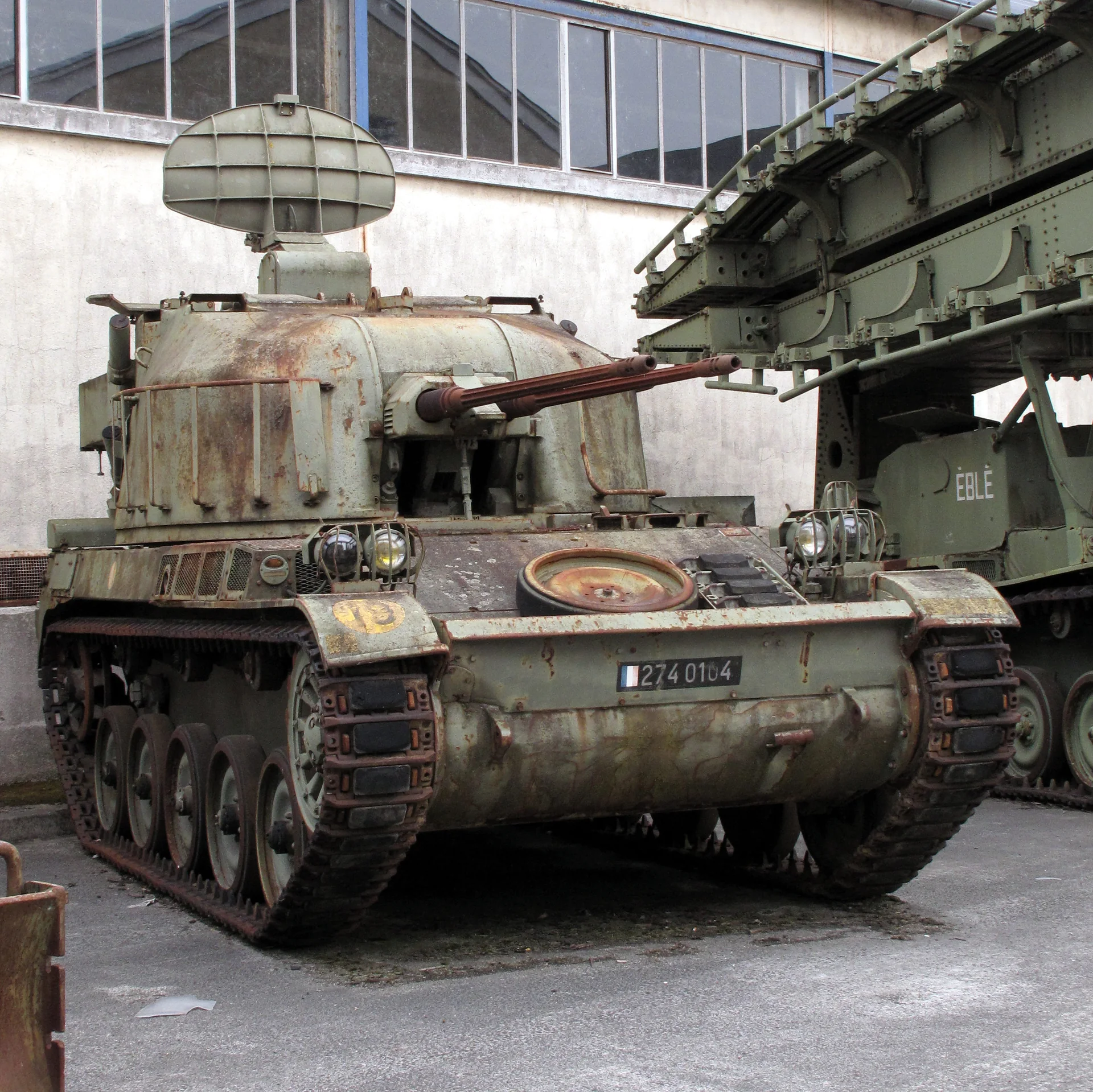
The DCA used a reinforced AMX-13-family chassis carrying the large two-gun turret. Three crew operated the vehicle, with the radar mounted at the turret rear where it could be retracted or folded for movement. The compact light-tank chassis kept the system mobile but left little unused volume once ammunition, radar, fire-control electronics, and crew stations were fitted. 1, 2, 3
Weapons and engagement concept
The retained French descriptions identify twin 30 mm HS 831A cannon and an ammunition load of roughly six hundred rounds for the AMX-13 installation. They also describe different firing modes and a secondary ground-target sight. These details belong to the light-chassis configuration; published technical figures should be treated as source-specific where they differ. Caliber alone does not establish a comparative rate of fire, target effect or traverse performance against other systems. 1, 2, 3
Sensors, fire control, and target information
The key modernization was the Œil Noir pulse-Doppler radar and associated calculation equipment. Early hulls were delivered before the radar program had fully matured, and French sources describe radar installation and retrofit continuing through the later 1960s. The completed system could search and direct the guns without relying entirely on an external director, although optical sights remained available. 1, 2, 3
The museum-associated description gives the radar and optical equipment distinct roles. Œil Noir provided search information in azimuth, while optical acquisition supplied the vertical element of the target solution. Folding the radar into its rear protective position also changed the vehicle's visible outline. The completed DCA should not consequently be described as if every stage of acquisition were an independent radar function. Its mixture of radar, optical observation and calculation reflects the particular installation developed for this vehicle. 4
Mobility, protection, and sustainment
The AMX-13 base gave the DCA good road speed and a small footprint relative to later radar SPAAGs. It also imposed limits on payload, electrical power, and ammunition. French sources note the electrical demand of radar watch and the use of an auxiliary generating arrangement, a reminder that sensor power consumption was a major design issue for early self-contained anti-aircraft vehicles. 1, 2, 3
Place in the air-defense system
AMX-13 DCA batteries were intended to provide low-altitude protection to forward French formations. Historical French artillery material describes distribution by divisional anti-aircraft regiments rather than employment as isolated vehicles. Radar autonomy reduced dependence on a centralized gun director, but battery coordination and broader air-warning information remained necessary to make the most of the short engagement window. 1, 2, 3
The same account describes a twelve-vehicle battery and discusses additional personnel carried in support trucks rather than inside the three-man fighting vehicles. Its reference to an auxiliary generator concerns radar watch. These details put the compact turret into a larger working unit: relief personnel and supporting electrical equipment did not disappear simply because the guns and radar were mounted together. They should not be added to the DCA's onboard crew figure, or mistaken for proof that the vehicle could perform every function with its main engine stopped. 4
Variants and modernization
The 30 mm DCA concept followed earlier AMX-13 anti-aircraft experiments and in turn influenced a heavier AMX-30 installation. The principal service distinction within the AMX-13 fleet was between early vehicles delivered before the complete radar package and vehicles brought to the radar-equipped standard. French sources also mention other experimental anti-aircraft armaments on the AMX-13 chassis, but they did not define the main service vehicle. 1, 2, 3
Service history and operators
The French Army fielded AMX-13 DCA as a specialized Cold War air-defense asset. Retained French accounts disagree over whether 60 or 70 vehicles should be counted. The discrepancy remains unresolved: it is not evidence, by itself, that one figure counts production and the other acceptance or prototypes. The fleet was small compared with the wider AMX-13 family, and early delivery must be distinguished from the later radar-equipped standard. A dependable final chronology will require production, radar-retrofit and unit-acceptance records rather than a combined total assembled from inconsistent summaries. 1, 2, 3
Constraints and changing threat environment
The light chassis had to carry the gun mounting, ammunition, radar equipment and electrical supply together. Their integration is a different question from the performance of the gun in isolation. The retained references do not establish a single target-specific engagement envelope or show that all deliveries had the same sensor fit. Nor does the appearance of later missile systems, by itself, establish why this particular vehicle was retained, modified or withdrawn. 1, 2, 3
Historical place
AMX-13 DCA is historically significant as an early French effort to combine radar, computation, twin automatic cannon, and tracked mobility in one forward-area vehicle. It belongs to the same broad technological generation as Shilka while following a distinctly French industrial path. Its S-401 turret concept later moved to the AMX-30 chassis for export, showing how a mission system could outgrow the light chassis on which it first matured. 1, 2, 3
Sources and further reading
- Chars-Français , 1969 AMX-13 DCA
- Base Artillerie, transition from FTA to ASA, 1960–1970 (indexed evidence only)
- Encyclopédie des Armes , AMX-13 DCA
- Base Artillerie and Musée de l’Artillerie, 30 mm self-propelled twin mounting (indexed evidence only)
Visit an Armor Museum
Explore the worldwide museum directory to find armored vehicles, collections, and visitor-planning information.
Browse armor museums