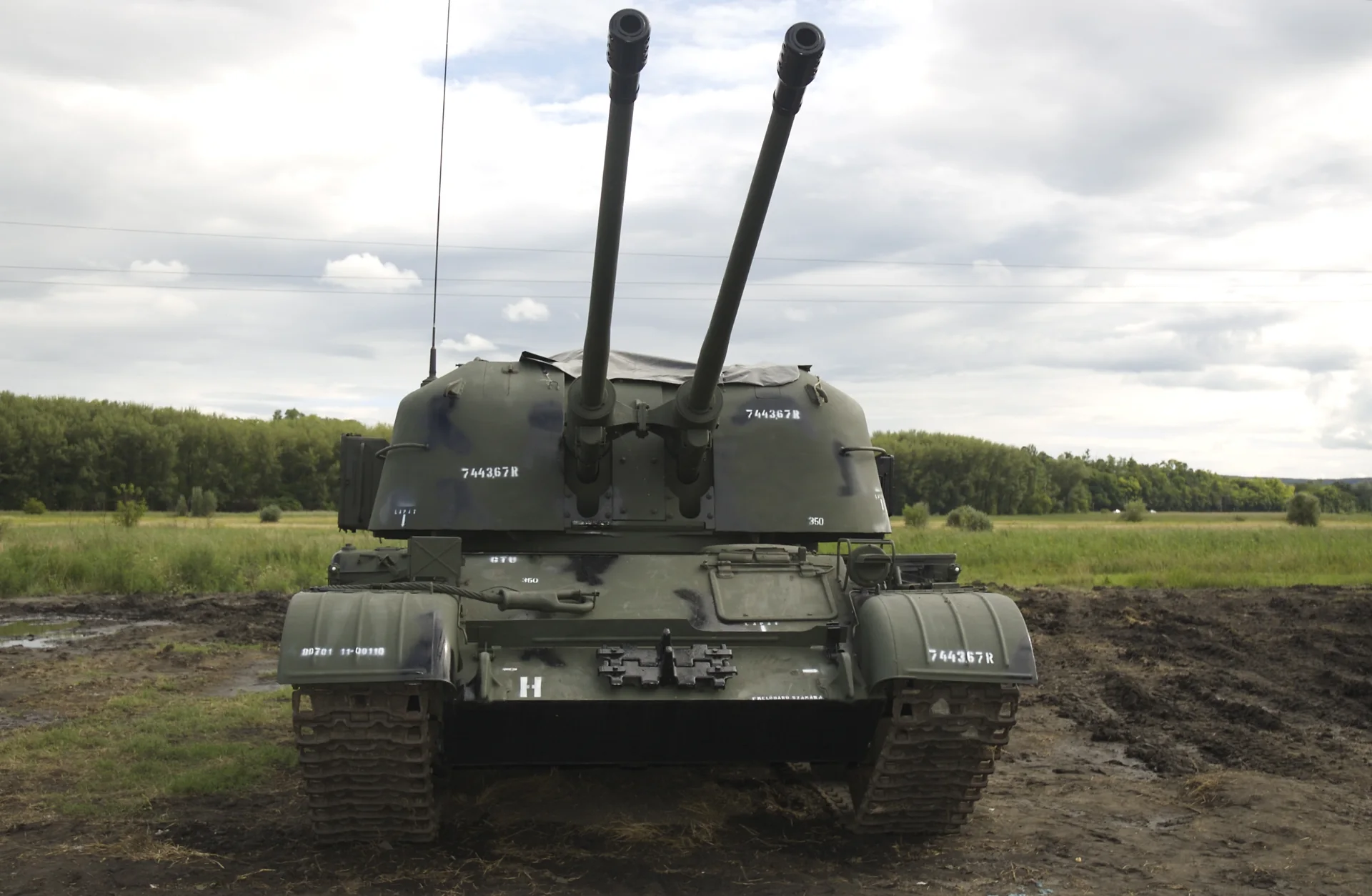
Postwar requirement for heavier mobile air defense
The ZSU-57-2 was a postwar twin-57 mm tracked anti-aircraft design. Its development should not be explained solely as a reaction to the wartime ZSU-37 unless a requirements record establishes that connection. The two vehicles belong to different chassis and weapon configurations, despite their common self-propelled anti-aircraft designation. 1, 2, 3, 4
The postwar design paired the 57 mm gun family with a modified T-54-derived chassis and became known as Ob'yekt 500 or ZSU-57-2. It followed the smaller wartime ZSU-37 rather than establishing the first Soviet tracked anti-aircraft vehicle of any kind. Claims about a first series or mass-produced vehicle depend on what production category the source is using. 1, 2, 3, 4
Modified T-54-derived chassis
The ZSU-57-2 used a shortened and lightened chassis related to the T-54, with four road-wheel stations per side rather than the tank’s five. Thin armor and a large turret reduced weight while preserving enough mobility to accompany tank formations. 1, 2, 3, 4
The turret was open at the top and housed most of the crew around the twin cannon and ammunition handling positions. This gave loaders and sight setters working room and unrestricted elevation but sacrificed overhead protection against fragments, small arms, and air attack. 1, 2, 3, 4
Twin 57 mm S-68 cannon
Two 57 mm S-68 automatic cannon gave the vehicle unusually heavy antiaircraft fire. The weapon family was related to the towed S-60, and ODIN notes that the self-propelled system retained the same broad ballistic characteristics while carrying the guns in a twin mount. 1, 2, 3, 4
The large projectile offered reach and destructive effect against aircraft and made the ZSU-57-2 formidable against lightly armored or exposed ground targets. The price was bulky ammunition, a lower practical volume of fire than smaller-caliber multi-barrel weapons, and a demanding loading task for the turret crew. 1, 2, 3, 4
Optical sights without integral radar
The standard ZSU-57-2 did not carry radar. Its crew used optical sights and manual target data, unlike towed S-60 batteries that could be supported by separate radar and fire-control equipment. 1, 2, 3, 4
This was the system’s central weakness. The guns could reach high and far enough to threaten many aircraft, but acquiring and tracking a fast low-level target visually was difficult. The vehicle could be ready to fire immediately yet still fail to obtain a useful firing solution before the target passed. 1, 2, 3, 4
Light armor and open turret
Protection was deliberately light compared with the T-54 tank because the air-defense vehicle needed mobility and a large rotating gun platform more than heavy tank armor. The hull protected against fragments and small-arms fire from some aspects, while the turret remained open above. 1, 2, 3, 4
The open turret improved visibility and ventilation but exposed five of the six crewmen. This vulnerability became especially relevant when operators used the ZSU-57-2 for direct ground fire, a role in which its powerful cannon were attractive but enemy small arms, artillery, and antitank weapons were much closer. 1, 2, 3, 4
Mobility with tank regiments
A diesel engine and tank-derived running gear gave the ZSU-57-2 much better compatibility with armored formations than the gasoline-powered ZSU-37. It could move cross-country with medium tanks and did not require a towing vehicle or lengthy emplacement process. 1, 2, 3, 4
Mobility was one of the design’s genuine strengths. Even after the air-defense fire-control system became obsolete, the chassis remained useful enough that exported vehicles could continue operating for decades in countries where maintenance and ammunition support were available. 1, 2, 3, 4
Soviet service and organization
The ZSU-57-2 entered Soviet service in the mid-1950s and equipped air-defense elements of tank and motor-rifle formations. Small batteries gave regimental commanders an organic mobile gun capability rather than relying entirely on towed weapons. 1, 2, 3, 4
Its service life in first-line Soviet units was comparatively short because radar-guided systems became available. Beginning in the 1960s, the ZSU-23-4 Shilka offered an integral radar and much higher rate of fire, addressing the target-acquisition problem that the twin 57 mm guns could not solve. 1, 2, 3, 4
Export service and long secondary career
ZSU-57-2s were exported and continued in several foreign services after Soviet units adopted newer systems. The cited Yugoslav account describes one national service history, not a complete worldwide inventory. Its dates and holdings should not be used as a proxy for every operator or for the number remaining operational today. 1, 2, 3, 4
Export longevity reflected the vehicle’s mechanical utility and the power of its cannon, not continuing parity with modern air-defense systems. Operators often found the weapon valuable as direct-fire support even when it was increasingly unsuitable against fast, low-flying aircraft. 1, 2, 3, 4
Combat use beyond the original air-defense role
ZSU-57-2s appeared in multiple regional conflicts and were frequently used against ground targets. The high velocity and large explosive projectile could damage light vehicles, buildings, field positions, and infantry, giving commanders a form of rapid direct fire unavailable from many ordinary armored vehicles. 1, 2, 3, 4
That employment could be tactically effective but highlighted the gap between weapon power and air-defense effectiveness. A vehicle may be formidable as a gun platform while still being obsolete against aircraft if it lacks modern detection, tracking, identification, and engagement controls. 1, 2, 3, 4
Historical place
The ZSU-57-2 represents the high point of the manually aimed heavy-gun Soviet SPAAG. It solved mobility and firepower problems with a tank-derived chassis and twin 57 mm cannon, yet its lack of integral radar left the crew dependent on visual engagement at the dawn of the jet age. 1, 2, 3, 4
Its successor, the ZSU-23-4, chose smaller cannon but added radar and a much higher rate of fire. That contrast captures a larger technological shift: by the 1960s, mobile air defense increasingly depended on sensors and fire-control integration as much as on caliber and ballistic performance. 1, 2, 3, 4
Sources and further reading
- U.S. Army ODIN — ZSU-57-2 (Ob’yekt 500) Russian 57 mm SPAAG
- U.S. Army ODIN — S-60 / ZSU-57-2 57 mm gun context
- Tank Encyclopedia — ZSU-57-2 in Yugoslav service
- GlobalSecurity — ZSU-57-2 Anti-Aircraft Artillery
See Armor in Person
This vehicle family is connected to 1 verified museum through 1 documented display record.