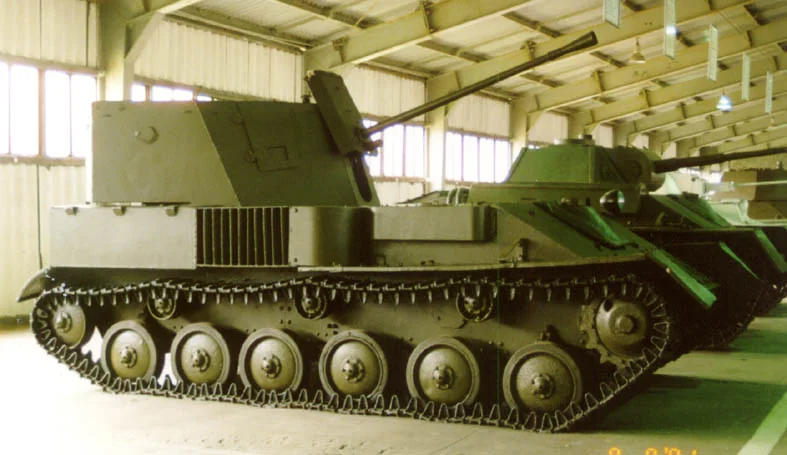
A wartime need for tracked air defense
The Red Army used large numbers of towed 37 mm antiaircraft guns during the war, but armored and mechanized forces still lacked a satisfactory fully tracked vehicle carrying the same class of weapon. Earlier experiments on light tank chassis were too cramped or lightly armed to solve the problem. 1, 2, 3, 4
Design attention therefore moved to the larger SU-76 family. By removing the self-propelled gun’s artillery installation and creating an open rotating antiaircraft turret, Soviet engineers could combine an existing tracked chassis with a proven automatic cannon rather than developing both elements from scratch. 1, 2, 3, 4
SU-76-derived chassis and turret
The ZSU-37 used running gear and automotive concepts derived from the SU-76M, placing the antiaircraft fighting compartment toward the rear. The open turret gave the crew room to observe the sky, handle clips, and elevate the weapon through the steep angles required for aerial targets. 1, 2, 3, 4
As with many wartime SPAAGs, the open top was a deliberate compromise rather than an oversight. It reduced weight and prevented the turret roof from obstructing the weapon, but it exposed the crew to fragments, weather, and air attack at precisely the moment the vehicle was intended to contest enemy aircraft. 1, 2, 3, 4
The 37 mm 61-K family weapon
The ZSU-37’s gun was derived from the Soviet 37 mm M1939 (61-K), a widely used automatic antiaircraft weapon. U.S. Army ODIN describes the 61-K as a five-round-clip-fed gun used extensively on the Eastern Front against low- and medium-altitude targets. 1, 2, 3, 4
Putting this proven caliber on tracks preserved ammunition commonality and gave mechanized units a weapon with more reach and projectile effect than heavy machine guns. The single-barrel arrangement, however, limited the density of fire compared with later twin- and quadruple-gun self-propelled systems. 1, 2, 3, 4
Manual optical engagement
The vehicle lacked radar and relied on optical sights, crew observation, and manual target tracking. That was normal for many wartime systems but placed a heavy burden on the crew when aircraft crossed the engagement zone quickly. 1, 2, 3, 4
A tracked chassis reduced the time needed to move and prepare the gun, yet it did not improve warning or lead calculation by itself. This distinction became increasingly important after the war, when aircraft speed rose faster than manual fire-control techniques could comfortably accommodate. 1, 2, 3, 4
Light armor and exposed crew
The SU-76-derived hull offered protection against small-arms fire and fragments around the driver and lower fighting compartment. The gun crew, however, worked in a lightly protected open turret and could not expect to survive direct engagement with tanks or concentrated infantry weapons. 1, 2, 3, 4
The design was therefore best suited to accompanying columns and armored units while staying out of the foremost ground fight. In practice, self-propelled antiaircraft guns were always tempted into direct-fire roles because their automatic cannon were useful against light ground targets, but doing so increased the risk sharply. 1, 2, 3, 4
Mobility and automotive compromises
Using the SU-76M family gave the ZSU-37 a production base and tracked mobility without creating a new chassis. It could follow Soviet mechanized formations across terrain more effectively than a towed 37 mm gun and did not require a separate prime mover. 1, 2, 3, 4
The SU-76-related gasoline automotive installation belonged to a light wartime vehicle family. It was not the same chassis as the later T-54-derived ZSU-57-2. That difference affected internal arrangement, weight and support requirements, but the available references do not justify attributing the ZSU-37's replacement to fuel type alone. 1, 2, 3, 4
Production too late for the war
Development progressed slowly enough that production only began in 1945. Tank Encyclopedia’s reconstruction identifies about 75 completed vehicles, with most production occurring too late for them to influence the war against Germany. 1, 2, 3, 4
Production beginning in 1945 and later deliveries are separate from documented combat use. The small completed series establishes a manufactured vehicle, but does not by itself demonstrate that operational batteries fought before the war ended. Orders, factory completion, army acceptance and unit deployment need to be distinguished before assigning a wartime service record. 1, 2, 3, 4
Postwar use
After the war, the ZSU-37 provided the Soviet Army with limited experience operating a tracked automatic antiaircraft gun as part of armored forces. It demonstrated the practical advantages of keeping the weapon mobile and ready without unhitching a towed carriage. 1, 2, 3, 4
At the same time, postwar evaluation exposed the inadequacy of a single manually aimed 37 mm gun against increasingly fast aircraft. The vehicle’s short service life reflected a rapidly changing technical environment rather than failure of the basic idea of self-propelled air defense. 1, 2, 3, 4
Toward heavier postwar SPAAGs
Soviet designers explored greater firepower and eventually moved toward the twin-57 mm ZSU-57-2 on a modified T-54 chassis. That successor offered more powerful guns, better mobility with medium tanks, and a larger turret, although it still lacked integral radar. 1, 2, 3, 4
The transition shows a clear design progression: wartime light chassis with one 37 mm gun, then a medium-tank-derived carrier with two 57 mm guns, followed finally by radar-directed systems such as the ZSU-23-4 that integrated sensors directly with high-rate automatic weapons. 1, 2, 3, 4
An early Soviet tracked anti-aircraft vehicle
ZSU-37 belongs to the earliest Soviet series-built tracked anti-aircraft vehicles. Its SU-76-derived carrier and single 37 mm gun separate it from both earlier experimental light-tank mounts and the later ZSU-37-2 Yenisei project. The shared caliber and similar designation do not make those two ZSU-37 names one continuous production model. 1, 2, 3, 4
The wartime vehicle should also be separated from the postwar Soviet gun-and-radar systems that followed it. A shared ZSU designation is not a statement that the carrier, aiming equipment and weapons remained unchanged. The early ZSU-37 can be placed in that chronology without claiming that its shortcomings dictated the design of every later system. 1, 2, 3, 4
Sources and further reading
- Tank Encyclopedia — T-60-3 and Soviet ZSU development
- U.S. Army ODIN — M-1939 (61-K) Russian 37 mm Towed Anti-Aircraft Gun
- Tank Encyclopedia — Soviet WWII vehicle overview
- ZSU-37 overview
Visit an Armor Museum
Explore the worldwide museum directory to find armored vehicles, collections, and visitor-planning information.
Browse armor museums