Requirement and development
Soviet designers developed Shilka to replace earlier self-propelled anti-aircraft guns whose optical fire control and slower-firing weapons were increasingly inadequate against fast, low-flying aircraft. The key conceptual change was to combine the guns, target-tracking radar, fire-control computation, and tracked carrier in one vehicle so a battery could react without waiting for a separate director. 1, 2, 3
The Padikovo museum dates the start of development to 1957, the first prototype to 1960 and state trials to the following year. It gives 5 September 1962 as the acceptance date. These separate milestones show the interval between producing a working vehicle and authorizing equipment for the army. They also place the project within the late-1950s effort to combine automatic gun laying, radar and a tracked carrier, rather than treating radar as a later accessory attached to an otherwise finished antiaircraft gun. 4
The museum's separate acceptance history connects the vehicle to the Mytishchi design team led by N. A. Astrov, whose earlier work included light tanks and postwar airborne self-propelled vehicles. It also identifies the competing ZSU-37-2 Yenisei. Shilka's selection was therefore part of a contest between different mobile gun systems, not simply a decision to put four existing weapons on any available hull. The museum favors Shilka in its comparison, but does not provide a trial record from which to reconstruct every evaluated condition or performance result. 5
Vehicle architecture and crew arrangement
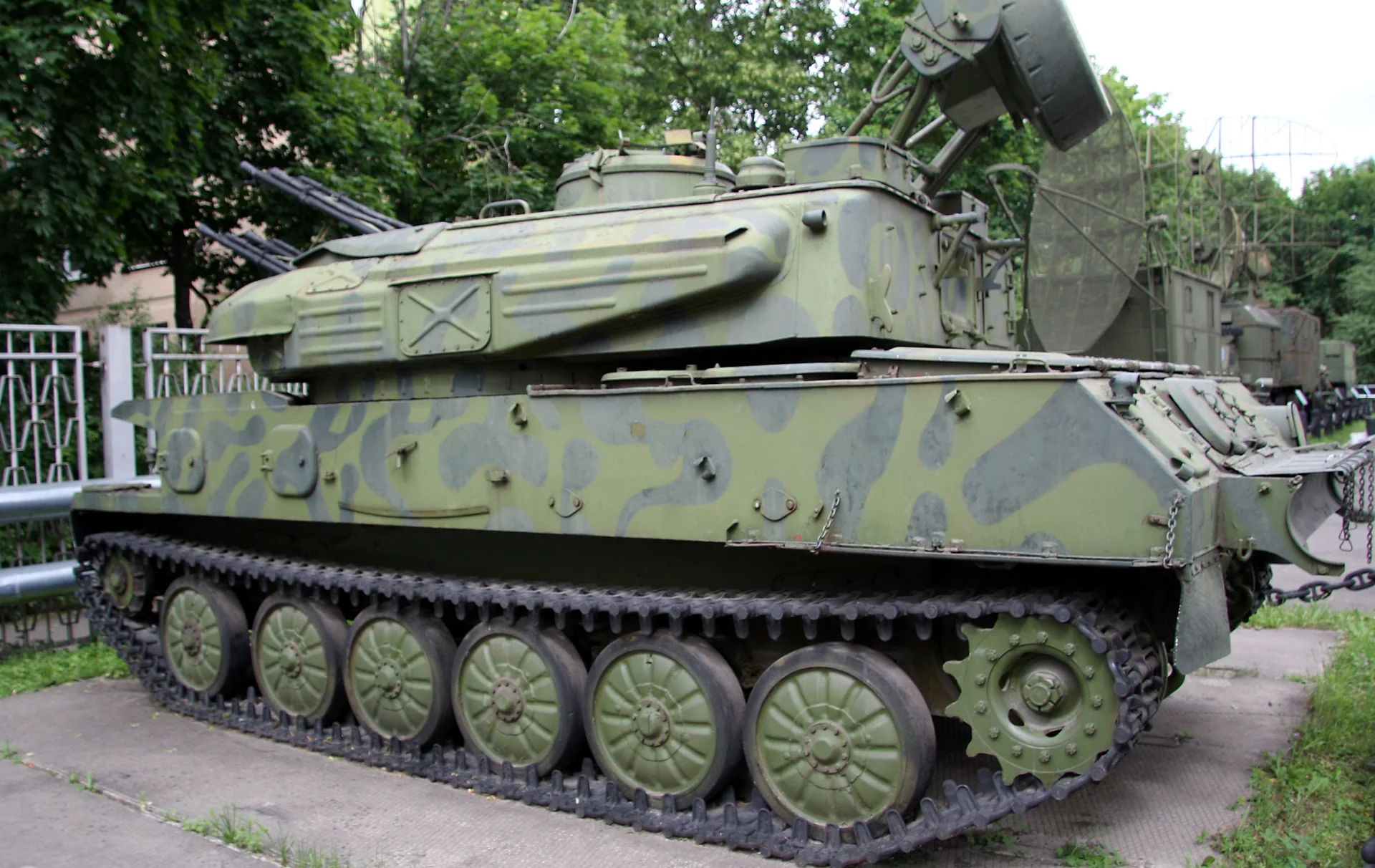
The driver sat forward in the hull while the commander, gunner, and radar operator worked in the broad turret. Four water-cooled 23 mm cannon projected from the turret front and the circular radar antenna folded at the rear for travel. The low chassis borrowed automotive ideas from existing Soviet light tracked vehicles, reducing the need for an entirely new mobility system. 1, 2, 3
Weapons and engagement concept
Shilka's gun installation combines four water-cooled 23 mm automatic cannon, rather than a single rotating four-barrel weapon. Standard reference descriptions give a large onboard ammunition supply, but capacity and fittings need to remain tied to configuration. The smaller ammunition differs markedly from the twin 57 mm installation of the preceding ZSU-57-2, while radar and fire control are equally important parts of the comparison. 1, 2, 3
Sensors, fire control, and target information
The defining equipment was the Gun Dish/RPK radar and its associated analog fire-control computer, backed by optical sights. The system could search and track locally and generate firing solutions without a separate gun-laying radar. Later Shilka models introduced improved radar and electronics, while some modernization packages added electro-optical sensors and short-range missiles. 1, 2, 3
The museum identifies RPK-2 as the integrated radar-and-instrument complex and describes an analog computing installation in the earlier vehicle. Its account contrasts that equipment with digital processing in the later Shilka-M4. Thus a preserved early Shilka represents not only an older gun mounting but also an earlier generation of computing and electronics. Four cannon barrels are an immediately recognizable feature; the less visible changes behind them can be equally important to identifying the vehicle's modernization standard. 4
Mobility, protection, and sustainment
Shilka used a lightly armored tracked chassis designed to keep pace with mechanized units rather than survive direct tank combat. Its road mobility and cross-country performance allowed anti-aircraft sections to move with Soviet tank and motor-rifle formations. Thin armor, exposed gun assemblies, and a prominent radar remained deliberate compromises made to keep weight within the limits of the specialized chassis. 1, 2, 3
Place in the air-defense system
Soviet doctrine placed Shilka inside a layered divisional and regimental air-defense network alongside surface-to-air missiles and acquisition radars. The vehicle covered the close and low-altitude zone where larger missile systems had limitations, while external warning could cue crews before their own radar acquired a target. This complementary role explains why Shilka was normally evaluated as part of a battery and not as a stand-alone air-defense solution. 1, 2, 3
Variants and modernization
Early and later Shilka versions differ in radar, internal equipment and maintenance arrangements. Subsequent national modernization packages can add digital processing, electro-optical devices or missile launchers, but those features do not describe every Soviet M-series vehicle. An upgraded exhibit or export vehicle therefore needs a specific model identification before its electronics are assigned to the whole family. 1, 2, 3
Service history and operators
Shilka was exported across the Warsaw Pact and to many Soviet partners and became especially prominent in Middle Eastern conflicts, where its radar-directed guns complicated low-level attack profiles. Soviet and later Russian forces also used the vehicle in Afghanistan and post-Soviet conflicts, including for direct-fire support against ground positions when the high-elevation, rapid-firing cannon offered useful characteristics outside the original anti-aircraft mission. 1, 2, 3
Constraints and changing threat environment
The same design that made Shilka revolutionary imposed clear limits as aircraft weapons gained range and speed. The 23 mm guns had a relatively short effective anti-aircraft reach, the radar was limited by the compact installation and period electronics, and the ammunition supply could be consumed quickly. Modernization could improve detection and tracking, but it could not fully overcome the engagement-envelope problem that drove development of missile-armed successors. 1, 2, 3
Historical place
Shilka combined guns, radar and fire-control equipment on a tracked carrier. That configuration is distinct from the manually aimed twin-57 mm ZSU-57-2 and from the later gun-and-missile Tunguska. The comparison identifies different arrangements; it does not, by itself, establish that every later designer copied Shilka or that one system’s service experience caused a particular successor requirement. 1, 2, 3
Sources and further reading
- U.S. Army ODIN: ZSU-23-4 Shilka, indexed identity only (indexed asset-page evidence only)
- GlobalSecurity — ZSU-23-4 Shilka overview
- GlobalSecurity — ZSU-23-4 specifications
- Museum of National Military History, ZSU-23-4 exhibit
- Museum of National Military History, Shilka acceptance anniversary
See Armor in Person
This vehicle family is connected to 1 verified museum through 1 documented display record.