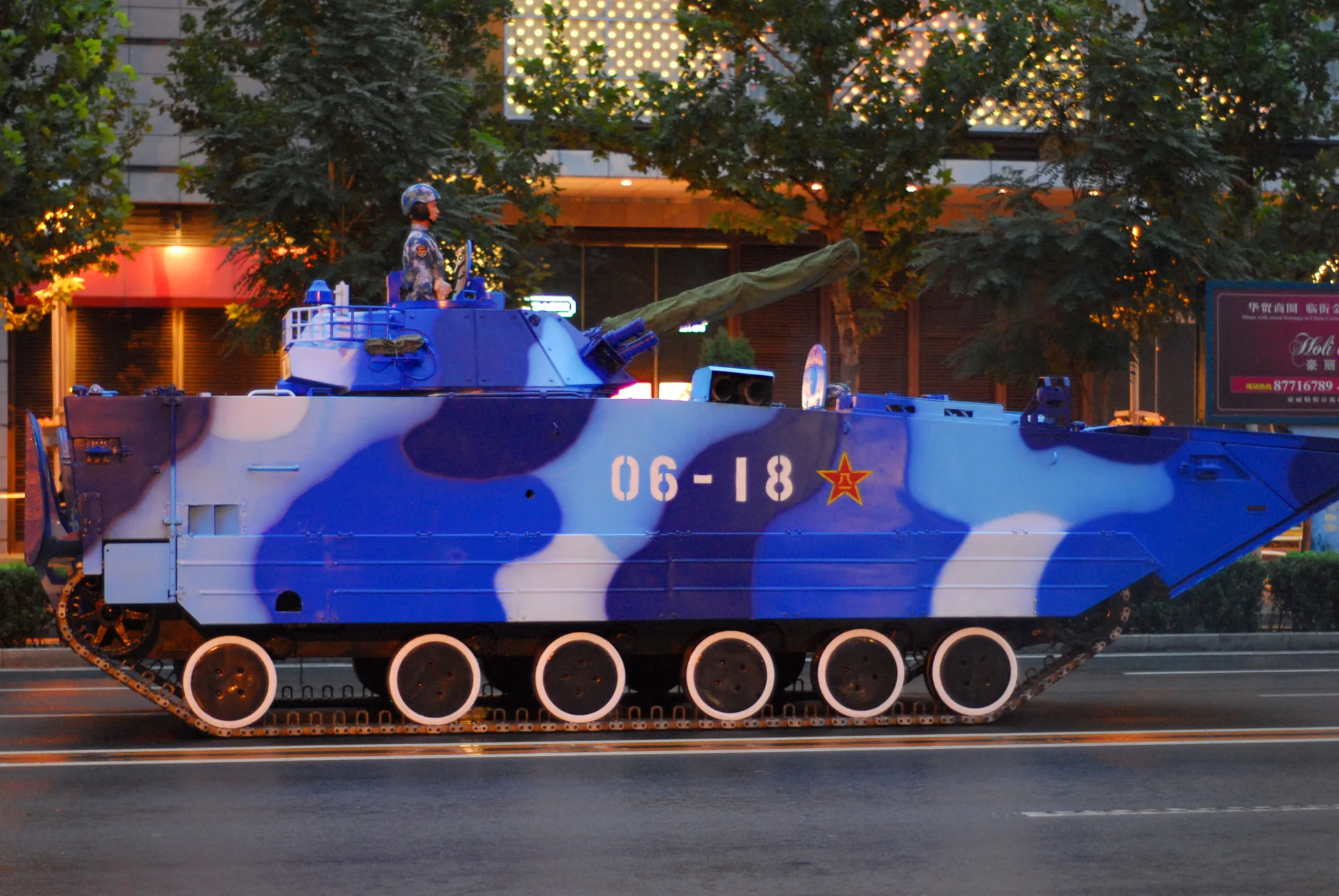
Development and requirement
China developed the Type 05 family to support amphibious operations where armored vehicles must travel meaningful distances through open water before fighting ashore. Unlike ordinary amphibious IFVs that swim mainly to cross rivers, the ZBD-05 was optimized for higher water speed and ship-to-shore movement, making its design priorities unusually maritime for a tracked infantry vehicle. 1, 2
The Type 05 family was developed around the movement between water and land, not merely the ability to cross a river obstacle. That amphibious assault requirement shapes the hull and propulsion as well as the vehicle’s work after reaching shore. The infantry version must carry soldiers during the water movement and continue to support them on land. Its turret weapon is therefore only one part of a larger design problem. Treating it as an ordinary tracked IFV with incidental flotation would miss the reason the family differs from other Chinese infantry carriers. 1, 2
Design, protection, and mobility
The hull and suspension are shaped around the transition between land and water operations, with waterjet propulsion and hydrodynamic features that support much higher swimming speed than conventional tracked carriers. Once ashore, the ZBD-05 functions as an IFV with turreted cannon armament and an infantry compartment. This produces a different protection and volume tradeoff from heavier land-focused IFVs. 1, 2
Amphibious capability strongly influenced the proportions and weight discipline of the ZBD-05 Amphibious Infantry Fighting Vehicle. A vehicle that must swim cannot simply add armor without consequence: buoyancy, freeboard, water propulsion, sealing, trim, and the location of heavy components all constrain later growth. That capability can be operationally important where rivers, canals, coastal approaches, or destroyed bridges would otherwise halt a mechanized force, but it also forces a different protection balance than a vehicle designed only for land combat. The most meaningful comparison is therefore with other amphibious fighting vehicles serving the same mission rather than with much heavier non-amphibious designs. 1, 2
Protection and internal volume are especially difficult problems in an infantry fighting vehicle because the hull must serve both a vehicle crew and a dismounted fighting element. The troop compartment needs usable space, access routes, ammunition stowage, communications, and enough separation from fuel and mechanical systems to make the vehicle practical in repeated operations. Adding armor improves resistance to fragments and direct fire, but it also increases weight and can reduce mobility, amphibious margin, payload, or growth capacity. As threats change, many IFV modernization programs therefore become exercises in managing accumulated weight and electrical demand as much as in fitting a new gun or sight. 1, 2
Firepower and battlefield role
Firepower on the ZBD-05 Amphibious Infantry Fighting Vehicle has to be read through its mission rather than by caliber alone. Armored carriers and fighting vehicles use their weapons to protect movement, suppress opposition, cover dismounts, and create enough local advantage for the formation to continue its task. The usefulness of that weapon depends on sights, stabilization where fitted, ammunition, crew training, and the ability to detect a target before the vehicle is itself exposed. The vehicle's combat value therefore comes from the integration of mobility, protection, observation, communications, and weapon effect rather than from a single specification in isolation. 1, 2
Service, variants, and modernization
The ZBD-05 equips PLA amphibious forces and sits within a broader family that includes direct-fire and command variants. Its importance lies less in any single weapon than in the attempt to give landing forces armored speed during the vulnerable movement from ships to beaches and then retain useful combat power inland. 1, 2
Within the Type 05 family, the infantry-carrying ZBD-05 and the gun-armed ZTD-05 perform different tasks. They may share broad amphibious design features, but the presence of a much larger gun changes internal space, ammunition and crew work. A photograph of one cannot establish the troop capacity or armament of the other. Export designations and advertised configurations add further distinctions. They need their own records before they can be used as specifications for domestic vehicles, particularly where equipment, protection or the exact amphibious arrangement may differ. 1, 2
How the vehicle fits the formation
In combined-arms employment, the ZBD-05 Amphibious Infantry Fighting Vehicle is not an independent substitute for tanks, infantry, artillery, engineers, or air defense. Its purpose is to connect protected mobility with the infantry's ability to seize and hold ground. The mounted crew can observe and engage while the dismounted element deals with terrain and threats that cannot be solved from inside the hull. Effective use therefore depends on coordination: tanks provide heavier direct fire and protection, artillery and mortars suppress or isolate, engineers open routes, and the infantry fighting vehicle moves soldiers while contributing its own sensors and weapons. The platform is most effective when those capabilities overlap rather than when it is sent forward alone. 1, 2
Strengths, limitations, and family boundaries
The archive separates ZBD-05 from ZBD-04 despite both being Chinese tracked amphibious IFVs. ZBD-05 is optimized for high-speed amphibious assault, while ZBD-04 is primarily a land IFV with amphibious capability. The gun-armed ZTD-05 belongs in direct fire. 1
The ZBD-05 has to work in two very different environments. A hull shaped and equipped for rapid movement through water must also support tracked movement, soldiers and a turret after landfall. That combination makes the transition itself part of the vehicle’s function rather than an incidental capability. It also means that a single land-speed or gun-caliber figure says little about the complete design. Claims about water speed, sea conditions and loading should be tied to a documented configuration and test setting, not drawn from an undated family label. 1, 2
ZBD-05 is not an upgrade suffix for ZBD-04. The two names refer to distinct design lines with different amphibious emphases. The ZTD-05 direct-fire vehicle belongs to the same wider Type 05 family as the infantry carrier but is not itself an infantry fighting vehicle. Keeping those boundaries clear is necessary when interpreting images of amphibious exercises, where several related vehicles may appear together. A formation’s mixed equipment should not be turned into one composite vehicle carrying the troops, guns and performance of every type shown. 1, 2
Sources and further reading
References and further reading are listed below. Image identification, credit and reuse terms remain with each photograph.
- U.S. Army TRADOC ODIN Worldwide Equipment Guide — ZBD-05 search
- U.S. Army TRADOC ODIN Worldwide Equipment Guide — ZBD-04
Visit an Armor Museum
Explore the worldwide museum directory to find armored vehicles, collections, and visitor-planning information.
Browse armor museums