Requirement and development
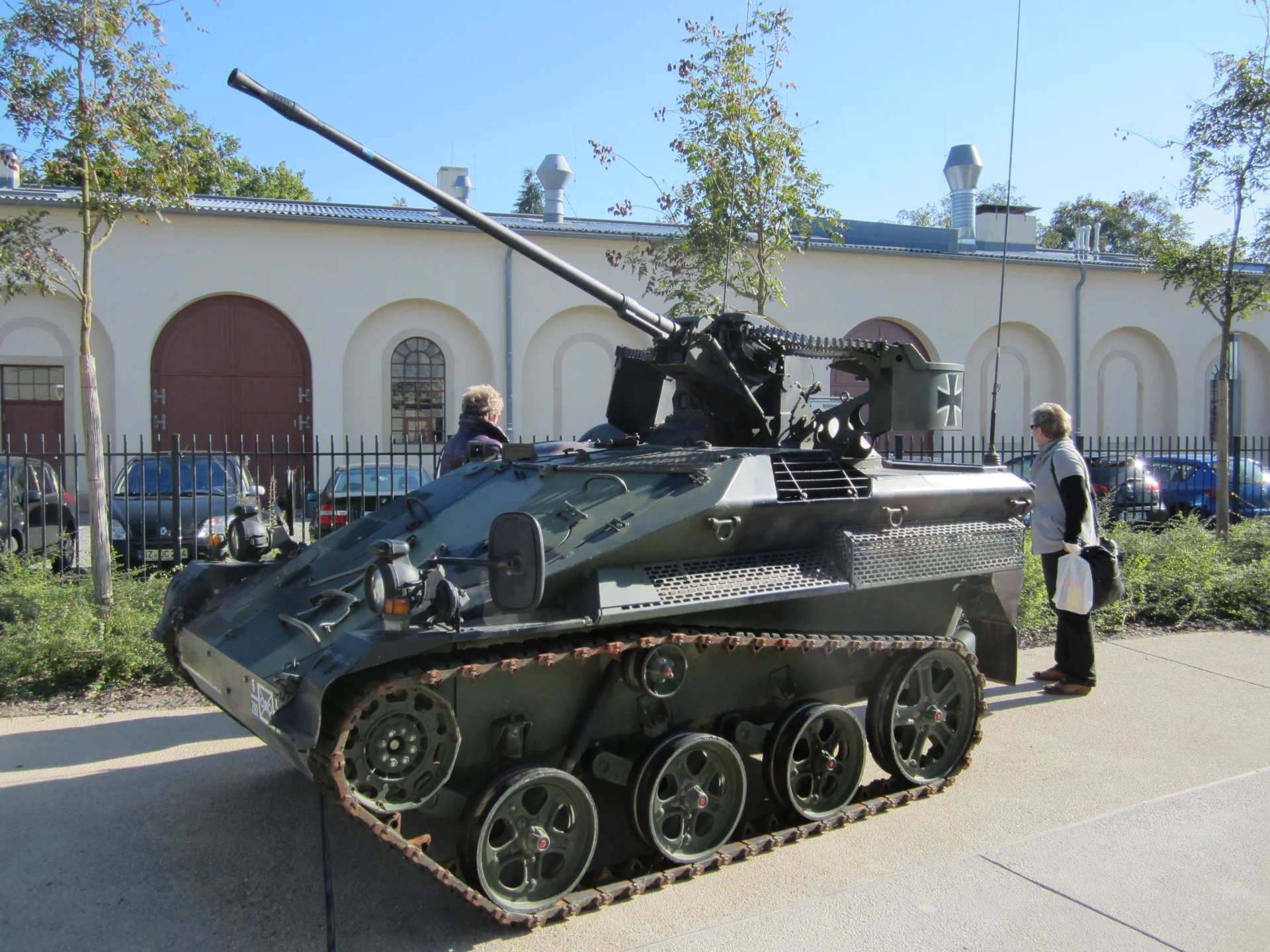
Wiesel was developed to give German airborne forces protected mobility and weapons that could be moved by air without the mass of a conventional infantry fighting vehicle. The Wiesel 1 became a tiny tracked carrier for systems such as the 20 mm cannon and antitank missile, while the later Wiesel 2 enlarged the basic concept to provide more internal space and payload. Bundeswehr material describes the family as air-transportable and suitable for difficult terrain. Its relationship to reconnaissance is therefore functional rather than universal: some variants observe, command, or support forward forces, but the Wiesel concept as a whole is a light weapons-and-specialist carrier for units where deployability is paramount. 1, 2, 3
Layout, crew, and architecture
Wiesel 1 is exceptionally compact, with Bundeswehr data listing roughly 3.3 tons for armed configurations, width around 1.8 meters, and very low overall dimensions. That size helps air transport and concealment but leaves little room for crew, ammunition, and electronics. Wiesel 2 stretches and enlarges the architecture to increase payload and protected volume, supporting medical, command, and air-defense roles. Both use tracks to provide cross-country mobility at low mass. The family demonstrates an alternative to the wheeled scout-car tradition: instead of maximizing road range, it gives light and airborne troops a small tracked platform that can carry specialist systems where larger armor cannot easily deploy. 1, 2, 3
Mobility and operational reach
Low weight improves strategic and helicopter transportability and reduces ground pressure, while tracks support movement off road. Wiesel 2 trades some of the first model’s extreme compactness for payload and internal volume; Bundeswehr medical-variant data lists a lower maximum speed of 50 km/h. These differences show why family-wide performance figures are misleading. Operationally, the vehicles prioritize deployability and access over the long road range of wheeled reconnaissance cars such as Fennek or Rooikat. 1, 2, 3
Protection and survivability
The Wiesel family is lightly armored because weight is tightly constrained by the airborne mission. Protection is intended to give crews and mission equipment some shielding from battlefield threats while keeping the vehicle small enough for rapid transport. The low silhouette also supports concealment, and tracked mobility helps the vehicle use covered off-road approaches. It should not be compared with an IFV on passive armor alone; the Wiesel’s design assumes that airborne and light forces cannot bring a full-weight armored fleet. Later Wiesel 2 applications gain space and payload but remain within the same light-protection philosophy. 1, 2, 3
Weapons, sensors, and reconnaissance task
The Wiesel 1 weapons carrier and the enlarged Wiesel 2 perform different tasks. Wiesel 1 configurations include a 20 mm cannon vehicle and an antitank-missile carrier. The Bundeswehr's current equipment description records the replacement of TOW by MELLS on the latter, so TOW should be described as an earlier installation rather than a universal present-day fit. Wiesel 2 applications include the medical vehicle and the separate Ozelot launcher and AFF reconnaissance/fire-control components of the light air-defense system. 1, 2, 3
Variants and configuration changes
The Wiesel name covers two related but distinct vehicle sizes and several mission fits. Bundeswehr material states that Wiesel 1 entered service in 1990 in 20 mm cannon and TOW antitank versions; a reconnaissance configuration followed in 2005. Current German material also notes replacement of TOW by MELLS on upgraded antitank vehicles. Wiesel 2 is a larger derivative used for missions such as the armored medical team and the Ozelot light air-defense system, so Wiesel 2 dimensions and payloads should not be projected backward onto Wiesel 1. 1, 2, 3
Bundeswehr data makes the family boundary concrete. Wiesel 1 is a very small tracked weapons carrier, while Wiesel 2 provides a larger platform for specialized systems such as the protected medical team vehicle and the Ozelot air-defense carrier. The shared name reflects lineage and air-mobile intent, not identical hull dimensions. Any facts panel or narrative that mixes the two has to identify which chassis the figure belongs to. 1, 2, 3
Operational service and employment
Wiesel has served primarily with German airborne and specialist formations that value strategic deployability and the ability to move weapons under light armor. The family’s persistence reflects a niche that heavier vehicles cannot fill efficiently: accompanying troops that may deploy by aircraft or helicopter while still carrying cannon, missiles, command equipment, medical capability, or air-defense sensors. Bundeswehr material continues to present Wiesel 1 and Wiesel 2 systems in active equipment contexts. That longevity does not make the vehicles general-purpose armor; rather, it shows the value of a specialized platform when the force structure consistently preserves the mission for which it was designed. 1, 2, 3
Limitations and tradeoffs
Extreme lightness imposes obvious constraints. Wiesel offers less protection, interior volume, ammunition capacity, and crew endurance than larger armored vehicles. Its short track base and compact hull also limit ride quality and growth margin. The advantage is that forces can transport and conceal it in ways that would be impossible for a 20- or 30-ton vehicle. Reconnaissance and security tasks must therefore account for the platform’s vulnerability and avoid confusing mobility with invulnerability. Wiesel is most effective when it enables light troops to bring a specific capability forward, not when it is expected to stand in for conventional mechanized armor. 1, 2, 3
Assessment and related development
Wiesel is a family of air-transportable weapons and specialist carriers rather than a single reconnaissance model. The small Wiesel 1 and larger Wiesel 2 share the light tracked approach but differ in room, payload and equipment. A missile carrier, ambulance and air-defense vehicle require separate descriptions even when their family resemblance is obvious. 1, 2, 3
Sources and further reading
References and further reading are listed below. Image identification, credit and reuse terms remain with each photograph.
- Bundeswehr — Waffenträger Wiesel 1
- Bundeswehr — Wiesel 2 Sanitätstrupp
- Bundeswehr — Leichtes Flugabwehrsystem Ozelot and AFF
See Armor in Person
This vehicle family is connected to 1 verified museum through 1 documented display record.