Requirement and development
The VBL answered a French requirement for a small protected scout and liaison vehicle alongside heavier cavalry vehicles. Its compact 4×4 arrangement prioritized limited dimensions, observation and communications rather than a large cannon turret. The inherited chronology gives 1990 for French service entry, whereas OCCAR’s later program overview gives 1991. The exact milestone behind that difference remains unresolved; early-1990s service is used here without silently choosing one date. 2, 3, 4
Layout, crew, and automotive architecture
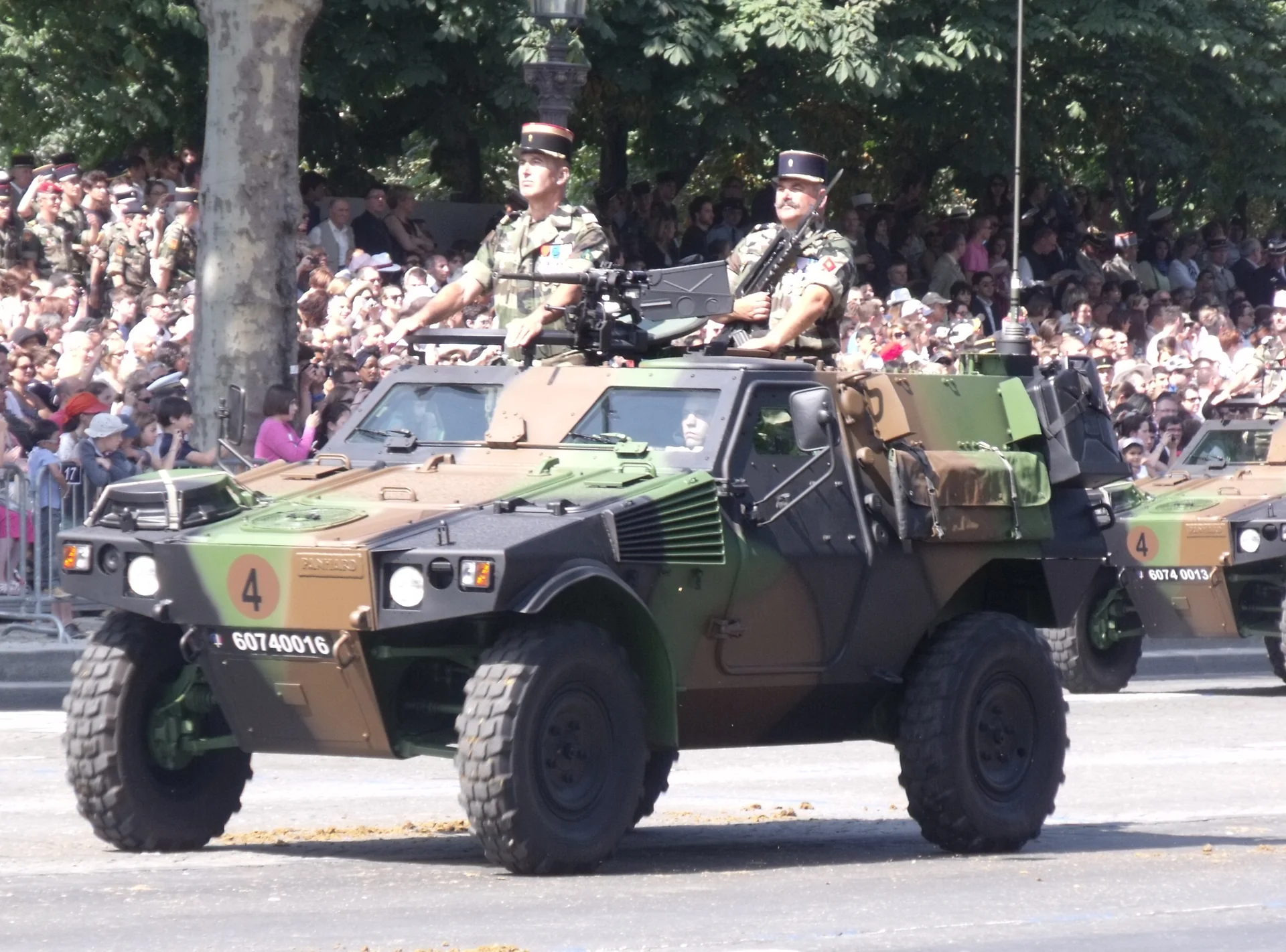
The VBL uses a compact monocoque armored hull with the engine forward, a small crew compartment, and a rear mission/storage area. Most configurations carry a driver and two other crew members, though mission equipment changes the exact internal arrangement. The original vehicle was amphibious and optimized for low silhouette and narrow width rather than for heavy armor or a large turret. Variants can carry machine guns, anti-tank equipment, command radios, or reconnaissance sensors, but the platform's defining characteristic is the small protected volume. Ultima regeneration changes important automotive and electrical systems while retaining the recognizable hull, showing how much of the VBL's value lies in its dimensions and basic layout rather than in a particular weapon. 1, 2, 3
Mobility and terrain behavior
Small size and 4×4 mobility make the VBL particularly well suited to reconnaissance on road networks, tracks, and restricted urban or rural routes. The original amphibious capability broadened route choice, while low weight supported strategic transport. DGA's Ultima description shows how mobility requirements evolved: regenerated vehicles received a substantially more powerful engine, power steering, ABS, strengthened suspension, and greater payload capacity. Those changes were intended to handle added electronics and protection while preserving the agile character of the platform. The modernization is a useful reminder that mobility is not just top speed; electrical load, payload, braking, steering effort, and suspension margin all determine whether an older scout can carry modern equipment safely. 1
Protection and survivability
The VBL was never intended to offer the protection of an infantry fighting vehicle. Its armored hull provides a measure of defense against small arms and fragments, while the low silhouette and compact dimensions support concealment and route selection. Operational experience with mines and improvised explosive devices exposed the limits of very light vehicles, contributing to modernization. DGA states that Ultima is prepared to accept an additional protection kit and includes chassis changes that support the increased load. Even so, the VBL's survivability concept remains based on scouting behavior, dispersion, and mobility. Adding too much armor would undermine the very size and mobility that make the platform useful in reconnaissance. 1
Armament, observation, and communications
VBL armament depends on mission rather than defining the chassis. French vehicles have appeared with light or heavy machine guns, anti-tank systems, command and reconnaissance equipment, and other specialized installations. That flexibility allows a small vehicle to support cavalry scouts, anti-armor teams, liaison elements, and intelligence tasks without pretending that every VBL is identically equipped. DGA's 2024 description emphasizes reconnaissance and intelligence roles more than weapons, which is doctrinally significant. The VBL's central contribution is the ability to place a protected observation and communications team forward with a small logistical footprint; weapons provide self-defense or specialist capability around that core function. 1, 2, 3
Variants and production evolution
French and export VBLs exist in numerous mission fits, while the most important contemporary distinction is between legacy vehicles and regenerated VBL-R/Ultima examples. Ultima adds a stronger engine, ABS, power steering, reinforced suspension, air conditioning, renewed electrical generation, and increased payload, according to the DGA. These changes support modern radios, sensors, and optional protection without replacing the hull. Export customers have adopted different weapons and equipment, so a photograph of a foreign VBL should not automatically be used to define French service configuration. The family therefore resembles a light mission platform more than a single fixed reconnaissance-car model. 1, 2, 3
Operational service
The DGA’s 29 March 2024 indexed notice reports delivery of the first four regenerated VBLs for that year. It documents a specific modernization event, not the condition or quantity of the entire fleet in September 2026. The notice is used here as dated evidence that regeneration was proceeding. The vehicles’ reconnaissance and liaison history, and the detailed equipment of Ultima, still require the fuller retained references rather than extrapolation from a delivery headline. 1
Historical place
OCCAR records a VBAE Stage 1 predesign contract dated 6 December 2023 and describes VBAE as a potential replacement for the French VBL. Predesign covers requirements and architecture before later development, qualification, production and delivery. The contract is not evidence that replacement vehicles had been delivered or that VBL had been withdrawn. The separately retained March 2024 DGA notice concerns VBL regeneration, a different program and milestone. 1, 4
The VBL and heavier gun-armed cavalry vehicles occupied different positions within reconnaissance units. A small team carrier could provide observation, liaison and communications without carrying a large turret, while another vehicle supplied heavier direct fire and protection. Regeneration preserves that distinction rather than proving that every old vehicle should be retained. The dated modernization and successor planning must be read separately from the later decisions and deliveries that would complete a transition. 1, 2, 3
Sources and further reading
References and further reading are listed below. Image identification, credit and reuse terms remain with each photograph.
- French DGA, first four regenerated VBL deliveries of 2024,29 March 2024, indexed excerpt (indexed excerpt)
- Arquus Heritage , Panhard vehicle collection and VBL lineage
- VBL overview
- OCCAR, VBAE general information and predesign contract
Visit an Armor Museum
Explore the worldwide museum directory to find armored vehicles, collections, and visitor-planning information.
Browse armor museums