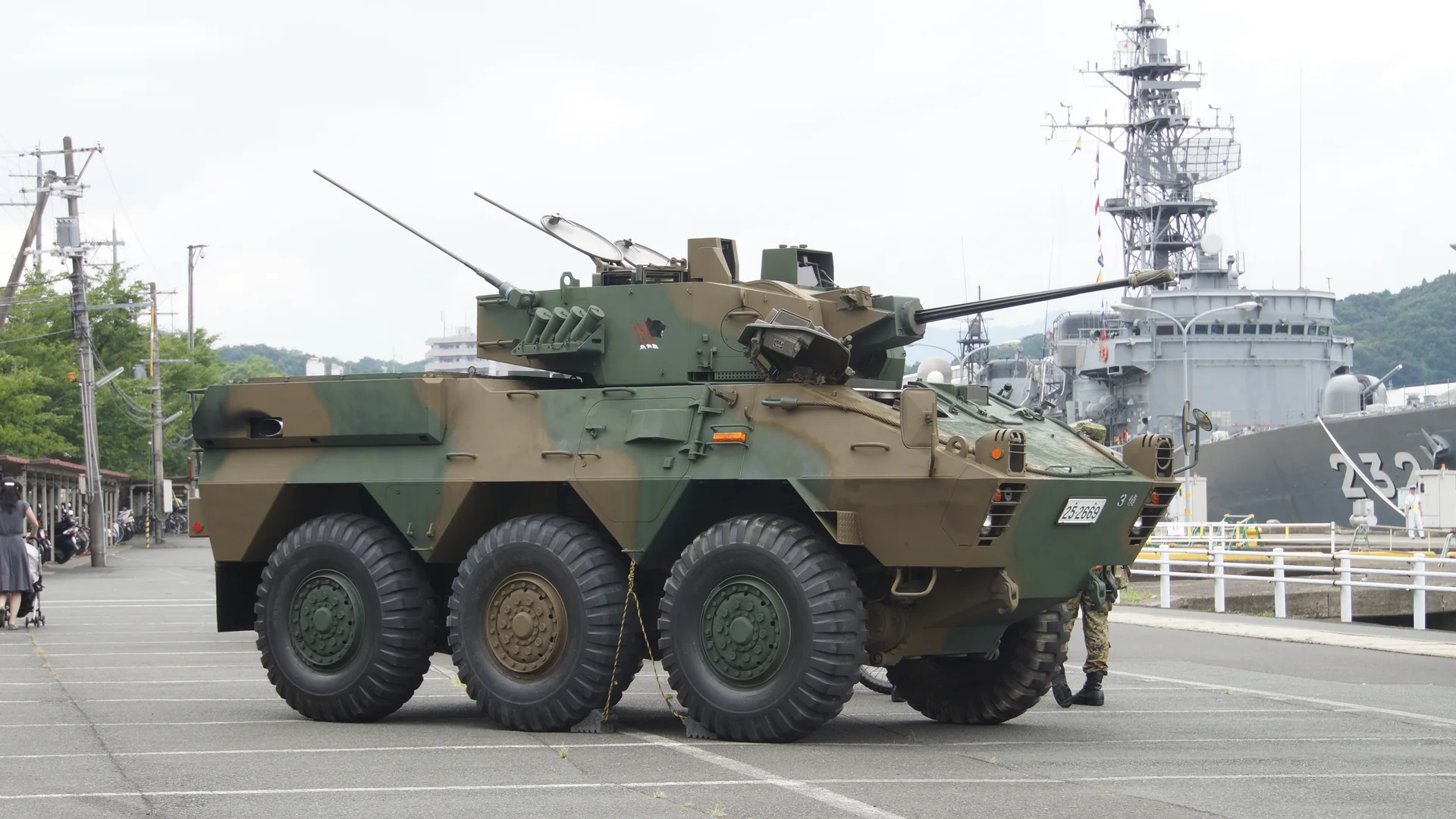
Requirement and development
The Type 87 RCV was standardized in 1987 to give Japanese reconnaissance units a domestically produced wheeled armored vehicle suited to road movement, observation, and security tasks. JGSDF unit material describes it as a reconnaissance and warning vehicle used primarily through road mobility and for flank-security action under threat. That wording captures the design logic: Japan’s dense road network and defensive organization rewarded speed and rapid movement between observation sectors. The vehicle also needed enough weaponry and night capability to remain useful when scouts encountered light opposition, without becoming so heavy that it lost the mobility advantages expected of a reconnaissance car. 1, 2, 3
Layout, crew, and architecture
The Type 87 uses a 6×6 armored hull with a five-person crew and a turret mounting a 25 mm cannon. The vehicle is larger than the tiny scout cars of earlier decades but remains compact relative to an infantry fighting vehicle. Crew size gives commanders more manpower for observation, radios, and security than a three-person sensor vehicle provides. Driver and gunner night-vision equipment described by the JGSDF reflects the expectation that reconnaissance must continue in reduced visibility rather than being limited to daylight patrols. 1, 2, 3
JGSDF pages give a five-person crew and identify a 25 mm cannon as the vehicle’s principal weapon. They also describe low-light night-viewing equipment for the driver and gunner. Those details point to a reconnaissance vehicle expected to continue moving and observing after dark while retaining enough armament for security and light combat. They do not make the Type 87 equivalent to the tracked Type 87 self-propelled antiaircraft gun, which is a separate vehicle sharing only the year designation. 1, 2, 3
Mobility and operational reach
JGSDF unit pages describe the Type 87 as a six-wheeled reconnaissance and security vehicle whose road speed is about 100 km/h. They emphasize quiet, high-speed, long-distance movement and use in reconnaissance, warning, and flank-security tasks. Those statements support a road-mobile scouting role; they do not by themselves prove lower maintenance burden or superior cross-country performance compared with a tracked vehicle. The operational claim should therefore stay tied to the movement and security tasks the JGSDF actually describes. 1, 2, 3
Protection and survivability
The Type 87 is an armored reconnaissance vehicle, not a tank, and its survivability concept follows that distinction. Its armored hull protects the crew from battlefield threats associated with scouting, while mobility and early detection are expected to prevent prolonged exposure to heavier weapons. Official JGSDF descriptions emphasize operating under air and ground fire threats but do not present the vehicle as heavily protected. The 6×6 chassis, turret, and five-person crew already consume substantial weight and volume, leaving the same balance faced by other reconnaissance cars: enough armor to make forward observation survivable without undermining the speed and range that let the vehicle perform the mission. 1, 2, 3
Weapons, sensors, and reconnaissance task
The 25 mm cannon gives the Type 87 the ability to engage light armored vehicles and other limited threats while conducting reconnaissance and security. Official unit pages also identify night-observation equipment for driver and gunner, which is important because information collection cannot stop when visibility worsens. The vehicle’s primary product remains reconnaissance reporting rather than firepower. Its armament allows the crew to protect itself, influence light opposition, and support flank-security actions, but heavier combat remains a task for tanks and other fighting vehicles. This balance closely resembles the logic behind other gun-armed scouts such as Fox, Luchs, and Scimitar. 1, 2, 3
Variants and configuration changes
The Type 87 RCV should be distinguished carefully from Japan’s Type 87 self-propelled antiaircraft gun, which shares the year-based designation but is an entirely different tracked system. Within the reconnaissance vehicle fleet, changes over service life have involved equipment maintenance and incremental updates rather than a widely publicized family of radically different variants. That makes configuration control important in a different way: photographs or specifications labeled only “Type 87” can easily be confused with the SPAAG. 1, 2, 3
Operational service and employment
The 3rd Reconnaissance Combat Battalion's equipment description identifies the Type 87 as a six-wheeled vehicle standardized in 1987, armed with a 25 mm cannon and a Type 74 vehicle machine gun. It emphasizes road-mobile reconnaissance and security. The battalion itself was established in March 2023 from the former 3rd Tank Battalion and 3rd Reconnaissance Unit. Its equipment page places the Type 87 alongside the Type 16 maneuver combat vehicle, showing two distinct vehicle roles within the reorganized formation. 3
Limitations and tradeoffs
The Type 87’s 25 mm cannon and five-person crew give it more combat capability than a small sensor scout, but they also produce a larger silhouette and heavier vehicle. Six-wheel road mobility is excellent for the mission described by the JGSDF but cannot match tracked systems in every soft-ground or obstacle condition. The crew can fight light threats, yet protection remains below the level needed for sustained direct combat with tanks or modern IFVs. As sensors and digital communications become more demanding, an older hull also faces pressure for electrical power, protected volume, and integration space. These are common challenges for long-lived reconnaissance vehicles. 1, 2, 3
Assessment and related development
The Type 87 RCV is a six-wheeled reconnaissance vehicle, not the tracked antiaircraft system with the same year-based designation. Official unit descriptions emphasize road reconnaissance and security supported by a 25 mm cannon. Its appearance beside the Type 16 in a reorganized reconnaissance combat battalion does not mean that the two vehicles have identical jobs. 1, 2, 3
Sources and further reading
References and further reading are listed below. Image identification, credit and reuse terms remain with each photograph.
- JGSDF 6th Reconnaissance Unit — equipment list
- JGSDF 2nd Reconnaissance Unit — main equipment
- JGSDF 3rd Reconnaissance Combat Battalion — equipment
Visit an Armor Museum
Explore the worldwide museum directory to find armored vehicles, collections, and visitor-planning information.
Browse armor museums