Development
The Ministry of Defense’s fiscal year 2016 budget overview connected mobile combat vehicle procurement with improved mobility for rapidly deployable formations. It included an acquisition provision for thirty-six vehicles. This is useful evidence of the program’s institutional purpose and funding stage, but it should not be transformed into a delivery date for every vehicle or a complete account of all later production. 3
The Ministry of Defense's equipment guide separates the industrial responsibilities behind the Type 16: Mitsubishi Heavy Industries is listed for the vehicle and Japan Steel Works for the main gun. The entry also associates the equipment with fiscal 2016. That division of responsibility is more informative than treating the complete vehicle as a product of one factory. Chassis, weapon and their integration belonged to the same program but represented distinct manufacturing contributions. 5
Layout and crew
The Type 16 combines an eight-wheeled hull with a turret-mounted gun and a dedicated vehicle crew. Its layout is organized around direct fire rather than the carriage of an infantry section. Gun installation, observation equipment and ammunition occupy space that a troop carrier would use differently. That specialization gives the vehicle a separate role within a mixed force, even when other vehicles share the advantages of road movement. 1
Armament
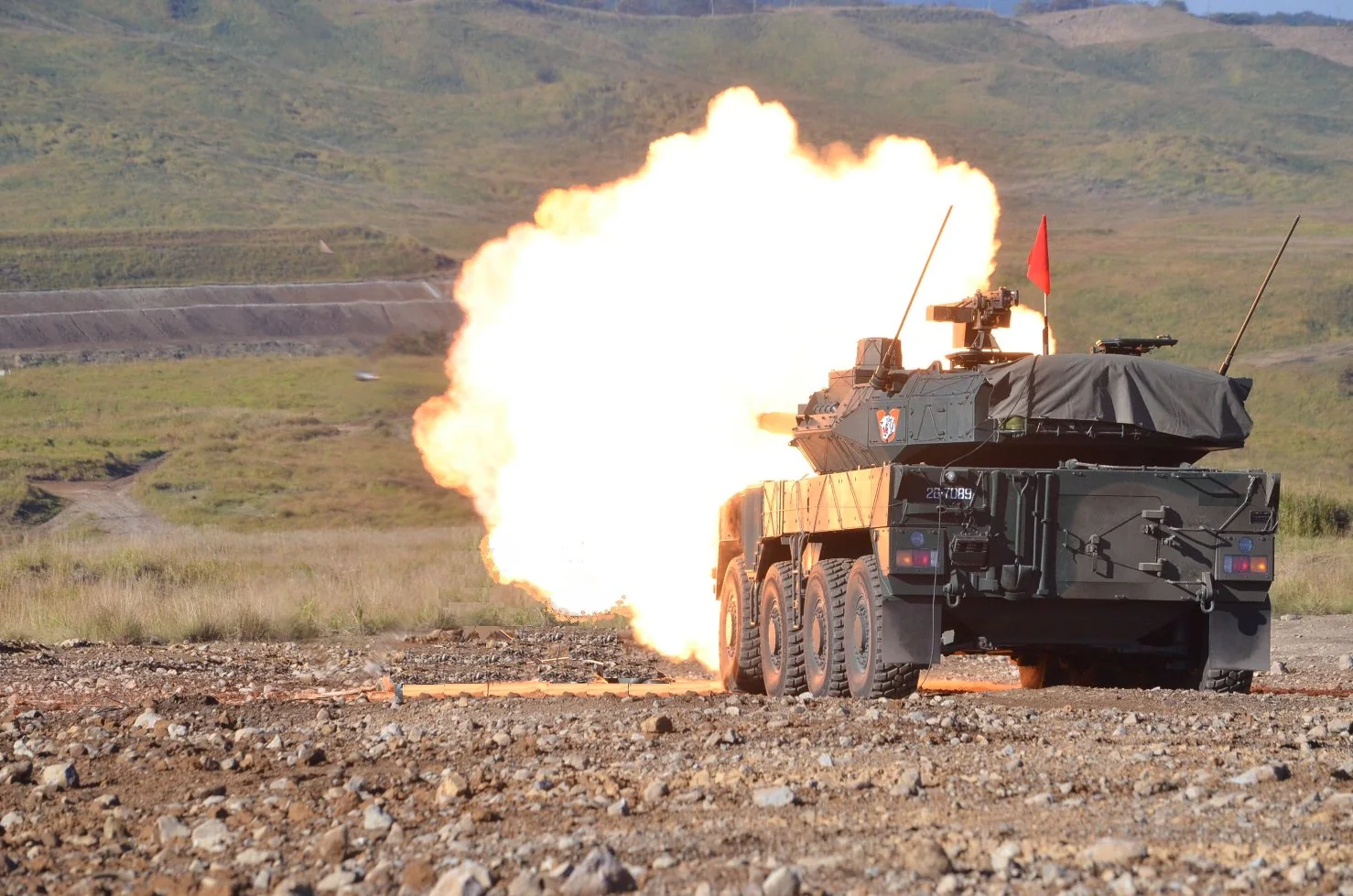
The 105 mm gun makes the Type 16 a dedicated direct-fire vehicle rather than an infantry carrier with a small defensive weapon. The JGSDF identifies armored targets among its intended uses. That role does not establish equality with a particular tank in every circumstance. Caliber alone cannot settle comparisons involving sights, ammunition, protection, crew arrangements, or the different missions assigned to the vehicles. 1, 2
The guide emphasizes that the main armament can use the same ammunition as the Type 74 tank. This connects the new wheeled vehicle to an existing ammunition lineage rather than presenting its 105 mm weapon as an entirely isolated system. It does not make the complete Type 74 and Type 16 gun installations identical: mounts, fire-control equipment and the vehicles carrying them remain separate subjects. The statement concerns ammunition compatibility, not a claim that all mechanical parts interchange. 5
Crew protection
A vehicle optimized around a transportable, wheeled configuration must balance protection against the other demands placed on its weight and volume. The public equipment description does not provide enough information to establish a comprehensive protection standard against particular weapons. It is therefore more accurate to distinguish the Type 16’s role from that of a main battle tank than to assign an unsupported armor-equivalence figure. 1
Mobility and support
Japan’s Ministry of Defense emphasizes the Type 16’s wheeled road mobility and rapid redeployment by road, ferry and C-2 transport as part of a reinforcement concept for the country’s southwestern region. That official framing explains why strategic and operational movement were central to the design. It does not mean that every route, ship or aircraft load can be assumed feasible without the corresponding transport limits and preparation. 4
Versions and conversions
Type 16 identifies the gun vehicle, not every Japanese wheeled armored design. Changes in production equipment and fittings do not automatically establish a wholly new vehicle type. Similarly, another carrier with eight wheels is not necessarily a Type 16 derivative. The principal distinctions are the official vehicle identity, the turret and weapon installation, and the role for which its internal space is arranged. 1, 2
Service history
The combination of an official equipment listing and the historical acquisition record establishes the Type 16 as an adopted service vehicle rather than a display-only concept. The budget’s emphasis on rapidly deployable formations is particularly important for understanding its place in the force. The thirty-six-vehicle FY2016 provision describes one budget milestone; it is not presented as the number in service in September 2026. 1, 3
Official JGSDF equipment material identifies a four-person crew, a 105 mm rifled gun and a maximum road speed of about 100 km/h for the Type 16. Those figures describe the Japanese service vehicle rather than a generic eight-wheel gun platform. Keeping them tied to the named configuration prevents comparison tables from borrowing dimensions or crew arrangements from superficially similar foreign vehicles. 4
The Type 16 appeared alongside Type 87 reconnaissance vehicles and Type 10, Type 74 and Type 90 tanks in the live-firing portion of the Fuji exercise on 23 May 2020. The Ministry's account describes an educational event observed by approximately a thousand students from military schools and the Eastern Army Combined Brigade. The later phase presented a joint island-defense scenario. This was a documented training appearance, not a combat action or proof that the wheeled vehicle had displaced the tanks beside it. 6
Operating constraints
Road mobility, transportability, direct fire, and protection cannot all be maximized without tradeoffs. A movement advantage along suitable routes does not guarantee equivalent performance on every surface, while a tank-caliber gun does not automatically confer a tank’s survivability. Those are general design considerations, not findings of a comparative trial. The available official descriptions establish the intended balance more firmly than they establish exact limits in every operational environment. 1, 2
Design legacy
The Type 16 illustrates the value of reading procurement purpose alongside hardware specifications. Its significance is not simply that Japan placed a gun on an eight-wheeled chassis, but that the vehicle joined direct-fire capability to a stated requirement for rapid movement and transport. Seen that way, it represents a specialized contribution to a mixed force, rather than an attempt to make every armored role interchangeable. 2, 3
Sources and further reading
- Japan Ground Self-Defense Force: Vehicle equipment, Type 16 Maneuver Combat Vehicle entry
- JGSDF Western Army: Equipment introduction, Type 16 entry
- Japan Ministry of Defense: Defense Programs and Budget of Japan, Overview of FY2016 Budget, printed page 8
- Japan Ministry of Defense — Type 16 Maneuver Combat Vehicle
- Japan Ministry of Defense, equipment guide, printed page 05
- Japan Ministry of Defense, Fuji Firepower Exercise 2020
See Armor in Person
This vehicle family is connected to 1 verified museum through 1 documented display record.